
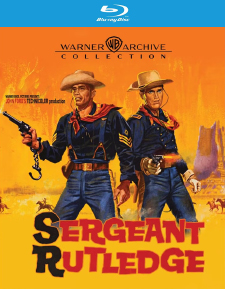
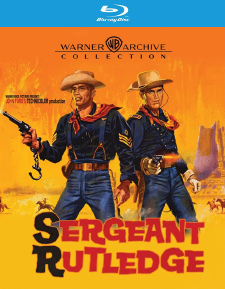
Sergeant Rutledge (Blu-ray Review)
Director
John FordRelease Date(s)
1960 (August 18, 2026)Studio(s)
John Ford Productions/Warner Bros. Pictures (Warner Archive Collection)- Film/Program Grade: B+
- Video Grade: A
- Audio Grade: A
- Extras Grade: B

Review
John Ford’s Sergeant Rutledge (1960) is an ambitious failure, with good and bad components. Partly it’s a then-politically progressive tribute to the former black slaves who became “Buffalo Soldiers” in the U.S. Cavalry, who maintained their dignity despite racial prejudice. However, these admirable aims are almost ruinously undermined by an unfocused, poorly structured screenplay, which stubbornly keeps moving away from its own themes, and by Ford himself allowing (if not encouraging) a number of ludicrously indulgent performances.
Nevertheless, Sergeant Rutledge’s nearly insufferable stretches are almost offset by its many fine qualities; throughout are little and big moments superbly done.
In 1881, former slave Sgt. Braxton Rutledge (Woody Strode) of the 9th U.S. Cavalry is on trial for the rape and murder of a young (and white) woman and her Cavalry Major father in their quarters at Fort Linton in Arizona Territory. Rutledge is defended by Lt. Tom Cantrell (Jeffrey Hunter). As witnesses are questioned, the events leading to the trial are told via flashbacks.
The movie’s strange structure has testimony primarily focused on events after the murders; perfunctory flashbacks to the discovery of the bodies, for instance, aren’t shown until about the halfway point. Instead, the movie audience first hears testimony from Mary Beecher (Constance Towers), who had arrived by night train to meet her father at a remote station. All alone, she discovers the stationmaster dead, an Apache Indian’s arrow in his chest. Rutledge appears out of nowhere, saving her life from two attacking Indians, part of a group of Mescaleros that have broken out of the reservation earlier that day. After the attack, Mary realizes Rutledge is bleeding, not from an Indian knife wound but rather from a gunshot.
Testimony from Mrs. Cordelia Fosgate (Billie Burke), the elderly wife of the presiding judge, Lt. Col. Fosgate (Willis Bouchey), is damning: she claims to have seen Rutledge tumble out of the victims’ quarters after hearing two gunshots. Meanwhile (in other testimony), after Cantrell takes Rutledge prisoner at the station, they and other black soldiers have little choice but to go after the escaped Mescaleros.
Overwhelming the film’s good qualities are its poorly-conceived trial scenes, which contribute almost nothing. There, characters discuss action already seen or later seen in the flashbacks, and there’s an unwelcome comic tone—hardly appropriate given the gravity of the charges—within the courtroom. Many find fault with Ford’s The Searchers only in the comical brawl between Jeffrey Hunter’s Martin Pawley and goofy Charlie McCorry (Ken Curtis), rivals for Laurie Jorgensen’s (Vera Miles) affections, she practically orgasmic watching them duke it out. But that fight occupies only a few minutes of The Searchers’ running time and arguably is dramatically justified. The courtroom shenanigans in Sergeant Rutledge is half the movie.
Dominating the courtroom scenes are Billie Burke, Willis Bouchey, and Carleton Young (as prosecuting attorney Capt. Shattuck), all of whom inflict considerable damage. Had Burke’s Cordelia been racist, perhaps with Hunter’s lawyer revealing her prejudices toward Rutledge through cross-examination, the stunt casting might have worked. But here Burke simply plays a—in this case, insufferable—variation of her longtime screwball comedy persona as a scatterbrained wife, the type of character she played throughout the 1930s through early-’50s. Willis Bouchey and Carleton Young were favorites of John Ford, longtime members of his stock company of actors; both were usually fine in small roles, or part of a large ensemble cast, such as Ford’s The Last Hurrah, in which both appear. In this case, however, their characters are much more prominent, and Ford allows them to ham it up. Also part of the tribunal is Walter Reed, a much better actor who has almost no lines, and so mostly just sits there, trying not to look appalled at Bouchey’s and Young’s overacting.
Woody Strode, fourth billed and buried in the credits, despite playing the central, title character, was not a particularly great actor, either (though he’s very good, briefly, while giving testimony), but the former football star was an immense screen presence. Though he never quite became a big movie star, he was unforgettable as a gladiator in Spartacus that same year, and also memorable in such films as The Last Voyage, Ford’s The Man Who Shot Liberty Valance, Tarzan’s Three Challenges, The Professionals and many others. He made an amusing cameo at the beginning of Once Upon a Time in the West, which marked the start of a European career, Strode again visually striking even in those generally cheap and unambitious pictures.
After Ford became disillusioned with John Wayne, mainly for Wayne avoiding military service during World War II, Army Air Corps veteran Woody Strode in some respects took Wayne’s place, with Strode utterly devoted to Ford, even caring for him during Ford’s final illness, and with Ford rewarding Strode with occasionally prominent movie roles. (Wayne and Strode did not get along during the making of The Man Who Shot Liberty Valance.)
As Sgt. Rutledge, Strode is a magnificent physical presence, but the character is written as achingly noble. His refusal to defend himself or even to declare his innocence is maddening at times. The idea, apparently, is that he’d rather hang than do anything to diminish the reputation of blacks serving in the Cavalry; better to be thought of as a one-off aberration, but this is taken to ludicrous extremes.
The picture comes to vivid life here and there. Mary’s arrival at the lonely station in the middle of the night, only to find the stationmaster dead, Rutledge appearing out of nowhere, and they trying to stay alive as the Apache stalk them is beautifully done and singularly tense. It’s on the level of the Scar’s raid on the Edwards homestead in The Searchers, DP Bert Glennon’s cinematography quite similar in terms of lighting and color to Winton C. Hoch’s work in the earlier film.
Likewise, the location footage around Monument Valley is very well done, the locations and situations—such as the Cavalry and Indians facing off on opposite banks of a river—recall The Searchers, but this time, intriguingly, with Hunter’s officer leading Buffalo Soldiers. Yet, impressive though these scenes are, the movie audience can’t help but wonder the purpose of all this footage, other than redundantly demonstrate Rutledge’s bravery and devotion to the Cavalry, his adopted home.
The last 15 minutes or so go back to the courtroom for another long stretch of tiresome and often poorly-acted speeches, including a particularly embarrassing one by Carleton Young. When it’s all over, Rutledge all but cameos while Ford shifts the focus to the romance between Jeffrey Hunter and Constance Towers.
Warner Archive’s Blu-ray of Sergeant Rutledge is a thing of beauty. After the VistaVision clarity of The Searchers, it looked disappointing on DVD, but the Blu-ray is notable for its sharpness and excellent color. At times it approaches Warner’s Blu-ray of The Searchers and, given the visual similarities, makes this release all the more impressive. The Region-Free disc includes DTS-HD Master Audio (2.0 mono) in English only, with optional English subtitles.
Extras consist of an audio interview of film historian/author Donald Bogle by TCM’s Ben Mankiewicz. It plays over a kind of rolling still gallery, though the images are partly obscured by strange framing. Also included are two cartoons, Hopalong Casualty (a Road Runner-Coyote short), and West of the Pecos (Speedy Gonzalez). A trailer, trying to make the film steamier that it is, rounds out the supplements.
Sergeant Rutledge is a fascinating failure. Scott Eyman’s biography of Ford notes the director was atypically deferential to screenwriters, resulting in a real mess of good and bad scenes. Still, it’s half of a great movie. If only...
- Stuart Galbraith IV