
Falling Down (4K UHD Review)
Director
Joel SchumacherRelease Date(s)
1993 (July 21, 2026)Studio(s)
Le Studio Canal+/Regency Enterprises/Alcor Films/Warner Bros. Pictures (Arrow Video)- Film/Program Grade: A-
- Video Grade: A+
- Audio Grade: A+
- Extras Grade: B

Review
The early 1990s were a hotbed of social and societal unrest in Los Angeles, spurred by the police brutality brought upon Rodney King, the subsequent acquittal of the officers involved, and the week-long riots that occurred in the streets in the aftermath. This combined with record-breaking heat waves and citizens becoming disillusioned by the empty promises of their employers and their government made it a significantly tumultuous time. During this era, actor and screenwriter Ebbe Roe Smith put together a script about an individual who had essentially snapped due to the world around him and his eventual response to it. At first it didn’t attract many producing entities, but it did wind up in the hands of director Joel Schumacher, who wanted to make something more challenging. It also caught the eye of Michael Douglas, who had been starring in a string of major Hollywood hits. The result, Falling Down, opened more doors for Schumacher, but the film itself became steeped in contention and mixed critical reaction; touching a nerve and developing a following for highlighting a complex character that could very well step right out of our society.
Bill Foster (Douglas), sometimes identified as “D-Fens” from the characters on his license plate, steps out of his car on a hot day with no air conditioning during a traffic jam, telling a man who’s complaining about his departure that he’s going “home.” Unfortunately, going “home” isn’t that simple. He’s recently lost his job as a military contractor and his ex-wife Beth (Barbara Hershey) has a restraining order against him, which forces him away from her and his daughter. As he walks his way across Los Angeles to Venice, intent on seeing his daughter on her birthday, he grows increasingly frustrated and aggressive toward everyone he meets, escalating to the point that the police become involved. On his last day of active duty, Sergeant Prendergast (Robert Duvall) and his partner Detective Flores (Rachel Ticotin) realize what they’re dealing with and must reach Venice before Foster does. Also in the cast are Tuesday Weld, Frederic Forrest, Lois Smith, Michael Paul Chan, Raymond J. Barry, D.W. Moffett, Dedee Pfeiffer, and Vondie Curtis-Hall.
Falling Down is not an easy film for some to grasp, which is why it wasn’t as well received as it should have been when it was released in 1993. Foster’s relatability is also due to Michael Douglas’ performance, which gives him a slight comedic edge that makes Foster charming in certain moments. But because “D-Fens” is such a complex character, audiences and critics have a difficult time reconciling with the fact that they’re going down a dark path with someone who becomes more and more unhinged. Many of his actions, including leaving his car in traffic, insisting that a fast food restaurant serve him breakfast even though it’s technically lunch time, or demanding lower prices at a convenience store, are at least commonly identifiable. In his own mind, he’s standing up for himself as an American, but in doing these things it makes him more of a miscreant, both lawfully and morally. He’s not a protagonist at all, but a victim of a world that has no place for him to exist in. He never got the kind of help he needed, and he believes that he’s doing the right thing, which is his ultimate and tragic downfall (hence the title).
Occasionally, Falling Down spells out its thematics a little too broadly, with D-Fens even saying out loud “I’m the bad guy? How did that happen?” Moments like these make you realize that this was intended to be a commercial property, which in a lot of ways makes it that much more interesting. To think that a film like this got made in the studio system is kind of remarkable. However, for a story that sets up such a complicated character, with clear allusions to David Sumner in Straw Dogs and Travis Bickle in Taxi Driver, the lack of subtly can sometimes be a little overbearing. Foster is also contrasted against Prendergast, who’s looking at a future wherein he’s no longer needed, but facing it more with an open mind.
The other unfortunate aspect of Falling Down (like Flatliners, The Lost Boys, and 8mm, among others), is that Joel Schumacher’s career was been overshadowed by his involvement with the Batman film series, particularly Batman & Robin. He became a punching bag for many years after, despite continuing to make movies. His versatility as a filmmaker is often forgotten, seemingly able to slip in and out of different genres without much notice, which isn’t always easy for directors. Falling Down is proof that he could and did try his hand at different things and actually succeeded. It’s also one of his best works, and it’s time that he got his due.
Cinematographer Andrzej Bartkowiak shot Falling Down on 35mm film (Eastman EXR 500T 5296) using Panavision Panaflex Platinum cameras with Panavision Primo and E-Series lenses. The results were finished photochemically and framed theatrically at the aspect ratio of 2.39:1. Arrow Video debuts the film on Ultra HD from a 4K 16-Bit scan by Warner Bros. Motion Picture Imagining and 4K restoration by Duplitech from the original camera negative, which has been graded by High Dynamic Range in HDR10 and Dolby Vision, supervised by Andrzej Bartkowiak, and encoded by Leroy Moore of The Engine House Media Services to a triple-layered BD-100 disc. It’s a terrific upgrade that gets the film looking closer to what was intended. Gone is the sickly yellow haze of the Blu-ray presentation, and though the hot and the haze of the summer Los Angeles sun still remains, saturation is much more natural with organic reds, greens, blues, and purples. The HDR grades soak up the detail in the image, running at a fairly consistent 80 to 100Mbps, with a strong encode and well-resolved grain. Blacks are deep with good contrast and flesh tones are more consistent, and nothing ever appears overcooked. The image is immaculate and stable throughout, giving the film a much more crisp and film-like appearance. It’s a knockout.
Audio is included in English 2.0 LPCM and 4.0 DTS-HD Master Audio, both restored by Þorsteinn Gíslason, with optional subtitles in English SDH. The film was released in Dolby Stereo, with a 4 channel option in some theaters. Previous releases of the film on DVD and Blu-ray had decent soundtracks, but these restored audio choices surpass them all with much more aggressive low end, as well as more dynamic surround activity. Dialogue is obviously the driving force, but James Newton Howard’s score, as well environmental ambience and the music selection, not to mention occasional gunfire and explosions, are all much richer. Both tracks are stellar.
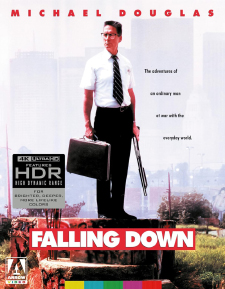
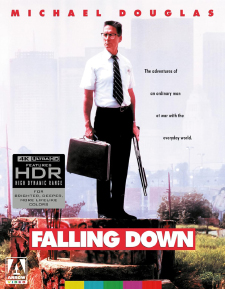
Arrow Video’s 4K Ultra HD release of Falling Down sits in a black Amaray case with a double-sided insert, featuring the original theatrical poster artwork on the front (as well as the slipcover), and a still from the film on the reverse. Also included is a 24-page insert booklet containing cast and crew information, the essays “I’m the Bag Guy?”: Nostalgia, America, and the Military Imagination in Falling Down by Alexandra Heller-Nicholas and White Collar: The Look of D-Fens by Simon Ward, presentation information, production credits, and special thanks. The following extras are included on the disc:
- Cast & Crew Commentary
- Man on the Edge: Screenwriter Ebbe Roe Smith Unravels Falling Down (HD – 18:43)
- At War with the World: Composer James Newton Howard on Falling Down (HD – 9:04)
- Going Home: Falling Down’s Los Angeles, Then and Now (HD – 12:49)
- Deconstructing D-Fens: A Conversation with Michael Douglas (SD – 10:12)
- Theatrical Trailers:
- Trailer 1 (HD – 2:32)
- Trailer 2 (HD – 2:34)
- Image Gallery (HD – 162 in all)
The commentary was recorded in 2009 and features director Joel Schumacher, editor Paul Hirsch, screenwriter Ebbe Roe Smith, journalist Shawn Hubler, and actors Michael Douglas, Michael Paul Chan, Vondie Curtis-Hall, and Frederic Forrest. It’s cut together from various interviews, some conducted at the time, and others during the making of the film. It unfortunately reverts to the film’s audio a little too often for my taste, but when it’s fully engaged, it’s very much like listening to a documentary. Each contributor is also introduced, giving their honest opinions about the experiences of making the film, but more importantly, the aftermath of its release.
In Man on the Edge, screenwriter Ebbe Roe Smith discusses his inspiration for the central character and the story, changes from his original screenplay, himself portraying a minor character in the film, the strength of the cast, whether or not D-Fens should be considered a vigilante (he shouldn’t), and the longevity of the film. In At War with the World, composer James Newton Howard talks about previously working with Joel Schumacher, being hired at the last minute for Falling Down, the aggressiveness of the score and how free he felt creating it, making demos and working with directors, his regret for not working with Schumacher again, the strife in Los Angeles at that time, and the lasting quality of the film.
In Going Home, producer Gillian Wallace Horvat takes us on a journey through the sites of Los Angeles as seen in the film and compares them to how they appear today. Deconstructing D-Fens contains a 2009 interview with Michael Douglas who talks about becoming involved with the project and how interesting he found it, various aspects of his character, why studios didn’t want to make the film, the importance of seeing the local culture in Los Angeles, the darkness of his character, the Rodney King riots and their effect on him personally, and the magic of film today. Last are two trailers and an Image Gallery containing 162 stills of production photos, publicity shots, and posters.
Falling Down is a film that ages well because things in society haven’t changed all that much. That’s a sad fact, and newer generations that can step out of their comfort zone do realize that he’s also a sympathetic character, even if that makes them uncomfortable. Nevertheless, Arrow Video’s 4K release is a stunner and definitely a major upgrade in both video and sound. Highly recommended.
- Tim Salmons
(You can follow Tim on social media at these links: Twitter, Facebook, BlueSky, and Letterboxd. And be sure to subscribe to his YouTube channel here.)