
Clash of the Titans (4K UHD Review)
Director
Desmond DavisRelease Date(s)
1981 (November 17, 2026)Studio(s)
Metro-Goldwyn-Mayer/Charles H. Schneer Productions/United Artists (Arrow Video)- Film/Program Grade: B+
- Video Grade: B+
- Audio Grade: A-
- Extras Grade: A-


Review
Ray Harryhausen was certainly no stranger to Greek mythology since he had worked on what many consider to be one of his greatest efforts, Jason and the Argonauts, released in 1963. He continued to perfect his craft in what was initially marketed as Dynamation, later to be called SuperDynamation, and finally Dynarama, building bigger and better stop-motion monsters for eager young kids and film fans to enjoy. Post-Star Wars, the Hollywood landscape changed quickly, and stop-motion animation was seen more as old hat than charming or impressive, at least to certain factions of critics and audiences. Nevertheless, it continues to be used to this day, especially by studios like Laika; but before Ray Harryhausen hung up his hat for good, he, his long-time producing partner Charles H. Schneer, and writer Beverley Cross would revisit the world of Greek gods, Earthly heroes, and oversized creatures in 1981’s Clash of the Titans.
Perseus (Harry Hamlin) lives peacefully on the island of Seriphos, having been marooned there with his mother Danaë after she became impregnated by the god Zeus (Laurence Olivier), with her father, King Acrisius of Argos, casting her and her newborn into the sea. In retribution, Zeus orders Poseidon (Jack Gwillim) to unleash the last known titan, the Kraken, to destroy Argos. The goddess Thetis (Maggie Smith), who seeks revenge against Zeus for transforming her son Calibos (Neil McCarthy) into a hideous monster, sends Perseus against his will to Joppa, where he befriends the poet Ammon (Burgess Meredith). Perseus soon discovers that Princess Andromeda (Judi Bowker) seeks a suitor, but only if he answers an impossible riddle laid upon her by her once beloved Calibos, whom her spirit visits against her will while she sleeps. Perseus defeats Calibos and answers the riddle correctly, subsequently falling in love with Andromeda. However, when Queen Cassiopeia (Siân Phillips) compares Andromeda’s beauty to that of Thetis, she angrily appears and demands that Andromeda be sacrificed to the Kraken in thirty days, forcing Perseus and a group of the king’s men to search for a way to defeat it. The rest of the cast includes Ursula Andress, Claire Bloom, Pat Roach, Susan Fleetwood, Tim Pigott-Smith, Flora Robson, Anna Manahan, Freda Jackson, Vida Taylor, and Donald Houston.
Clash of the Titans has always been a complicated entry in Ray Harryhausen’s oeuvre because it’s perceived to be one of his lesser efforts, if not the least of his efforts, especially since it was the last film he participated in before permanently retiring from the film industry. Had it been made under the direction of someone more experienced with the process of stop-motion animation and the fantasy genre, things might have fared a bit better. Matters weren’t helped that the production house in London where Harryhausen normally shot his background plates, Rank Studios, had shuttered the doors on that department, forcing him to use lesser facilities. He was also not quite as hands on as he had been in the past and required a few assistants to help him get the work done. All of this in comparison to pictures like The 7th Voyage of Sinbad and Jason and the Argonauts left many Ray Harryhausen devotees feeling disappointed in the summer of 1981.
For me personally, I’ve always been extremely fond of Clash of the Titans since it was on constant rotation on TV when I was young, being my first Ray Harryhausen experience. Later I was able to experience it on home video in its full form, and to my surprise, I realized that it’s a much more adult film than Ray Harryhausen normally would have participated in. Part of this can be chalked up to the time frame it was made in, where violence and nudity were becoming more fashionable, but funnily enough, there are only three instances of female nudity, and none of it is used in a sexual manner. Danaë is shown breastfeeding her baby at the beginning of the film, Princess Andromeda stands up from bath to be quickly robed (it should be noted that it’s a body double and not the lovely Judi Bowker), and the sight of the unclothed upper torso of Medusa’s body, though she’s seen only in very low light making it difficult to discern the full details of her body anyway. There are also decapitations, instances of blood, and generally dark tones involved. I remember being frightened by the film as a youngster, which made it that much better, especially by the scene featuring Medusa which is by far the most successful scene in the film.
Not all who participated in Clash of the Titans were fond of the material. Laurence Olivier for instance, who was very ill at the time, apparently told Harry Hamlin that he was only doing it for the money. Hamlin was also something of a troublemaker on the set as he wanted to integrate his ideas for the film into various scenes, often butting heads with director Desmond Davis, and even going so far as to not leave his trailer until his demands were met. This included the scene in which he actually decapitates Medusa, which was later changed to him throwing his shield “like a Frisbee” to do it in lieu of swinging his sword, which he refused to do. He also insisted that the cinematographer use what was left on one of the film magazines to capture the moment of Perseus exiting Medusa’s lair and holding up her severed head while the director was off the set, attempting to re-create the visage of Benvenuto Cellini’s Perseus with the Head of Medusa sculpture. Whether any of this is true or not, it’s all in the final film.
Thankfully the star power of Clash of the Titans, another first for one of Ray Harryhausen’s projects, gives it a more prominent status. The equally beautiful Harry Hamlin and Judi Bowker are very good in the film together, as is the rest of the cast, even if the script feels like a Greek mythology hodgepodge, which it sort of is. Ray Harryhausen’s creations, including the winged Pegasus, the diabolical Calibos, the squawking over-sized Vulture, the two-headed Dioskilos, the deadly Gorgon Medusa, the giant Scorpions, the infamous Kraken, and the lovable-but-unfairly-maligned-by-many-a-filmgoer mechanical owl Bubo, are some of his most memorable. The European locations, the swords-and-sandals styled action and adventure, and Laurence Rosenthal’s wonderful romantic score help to create one of the most influential Greek mythology tales ever told. Just as a side note, Harry Hamlin would reprise the role Perseus in the video game God of War II as a foe to Kratos, which was an endearing aspect of that game to discover.
Cinematographer Ted Moore shot Clash of the Titans on 35mm film (Eastman 100T 5247) using Arriflex 35BL and Mitchell NC cameras (the latter used by Ray Harryhausen for visual effects) with spherical lenses. Everything was finished photochemically and framed at the aspect ratio of 1.85:1. Arrow Video debuts the film on Ultra HD with a new 4K restoration from the original camera negative (with obvious uses of interpositive elements). The results have been graded for High Dynamic Range in HDR10 and Dolby Vision, and authored by Leroy Moore of The Engine House Media Services to a triple-layered BD-100 disc.
Clash of the Titans has always been a rough-looking film, and no amount of remastering can ever improve it fully without remaking it completely, which would be utterly pointless. Arrow’s restoration is about as good as the film is ever going to look, given the vast amount of optical work and heavy grain that it still carries. When the presentation is strictly using OCN, which is not always for very long lengths of time, it resolves well. However, opticals, including mattes and fades between scenes, are in poor shape. Even the OCN features frequent scratches and speckling, with lines sometimes running right down the center of the frame. To even get the film looking this good must have been a Herculean effort (Sir not appearing in this film). With all of those caveats out of the way, the film still looks remarkable with much improved saturation, excellent compression, and bitrates sitting in the 80 to 100Mbps range most of the time. A few attempts are made not to rely on optical transitions by favoring digital ones instead, but they’re very few and very noticeable next to the rest of the material. The HDR irons out flesh tones and the color palette, giving reds, blues, greens, and purples more life without oversaturating anything. Contrast is also improved with deeper shadows and more solid blacks. The image is stable throughout, making for a presentation that betters its predecessors, especially in regards to color and sharpness, but with the obvious built-in deficiencies. However, if you’re familiar with the film in any capacity, you should have an idea of what you’ll be getting here.
Audio is included in the original English 2.0 LPCM with a new Dolby Atmos option, as well as optional subtitles in English SDH. While the original stereo track is certainly no slouch, the new Atmos track is a marked improvement, mostly in the depth that it provides, with much more powerful low end. The Kraken emerging is now a window-rattling event, while Laurence Rosenthal’s score is offered plenty of room to breathe in the surrounds. Height is also added to moments such as Pegasus flying overhead. The majority of the dialogue is anchored to the front, but wind and other ambient moments have definitely been given more attention. It’s a terrific track and, for me personally, will be my go-to track to watch the film with from here on in.
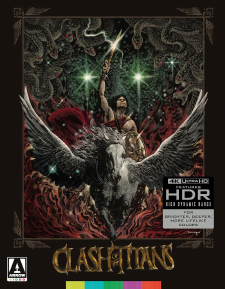
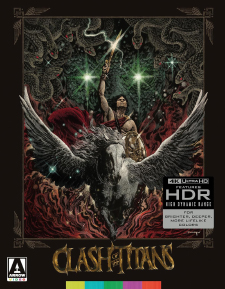
Arrow Video’s 2-Disc 4K Ultra HD release of Clash of the Titans sits in a black Amaray case alongside a 1080p Blu-ray of extras, as well as a double-sided poster featuring beautiful new artwork by Richey Beckett on one side and the main theatrical one sheet by Greg and Tim Hildebrandt on the other, which is also replicated on the double-sided insert. Unfortunately, the classic Daniel Goozee artwork for the theatrical teaser poster that was included on the cover of Alan Dean Foster’s movie novelization, as well as the initial DVD release, is relegated to the second page of a 60-page booklet that’s included with this set. It also contains cast and crew information, the essays The Stars Will Never Fade: Celebrity and Clash of the Titans by Alexandra Heller-Nicolas, Show the Work: Special Effects in Clash of the Titans by Martyn Pedler, A Kraken Soundtrack: Scoring Titans by Charlie Brigden, Acting Choices: The Humanity in Harryhausen’s Monsters by David Moses, The Many Faces of Medusa in Visual Culture by Icy Sedgwick, costume sketches, the original pressbook, presentation information, production credits, and special thanks. Everything is packed into a side-loading slipcase with a slipcover, both featuring the same new artwork by Richey Beckett. The following extras are included on each disc:
DISC ONE: UHD (FILM)
- Ray Harryhausen at the BFI
- Ray Harryhausen & Charles Schneer at the BFI
DISC TWO: BD (EXTRAS)
- Courage & Imagination: Ray Harryhausen’s Mythic Adventure (HD – 108:07)
- Vintage Extras:
- A Conversation with Ray Harryhausen (SD – 12:14)
- Myths and Monsters:
- Calibos (SD – 1:20)
- Pegasus (SD – 1:22)
- Bubo (SD – :48)
- The Scorpions (SD – :41)
- Medusa (SD – 1:53)
- The Kraken (SD – 1:29)
- Dioskilos (SD – 1:07)
- Teaser Trailer (HD – 1:50)
- Theatrical Trailer (Upscaled SD – 1:49)
- Image Galleries:
- Costume Designs (HD – 20 in all)
- Behind the Scenes (HD – 3 in all)
- Pressbook (HD – 8 in all)
- Posters (HD – 13 in all)
- Colour Stills (HD – 133 in all)
- Black & White Stills (HD – 70 in all)
The two interviews included on the UHD act as audio commentary tracks. The first features Ray Harryhausen at a BFI screening of the recently-completed Clash of the Titans in 1981, while the other features Ray Harryhausen and producer Charles H. Schneer at the BFI in 1970. (The former ends at 83:03 and the other ends at 93:07, reverting to the film’s audio when they end.) In each case, the interviewers ask the two men questions while also taking questions from the audiences. On the first track, some of the models are presented on stage, and it’s a pity can’t see them, while on the second the two men are there to preview clips from their films and talk about their work. Both recordings are absolutely invaluable and most assuredly worth your time.
Courage & Imagination is a new feature-length documentary by David Cairns and Fiona Watson that celebrates the life and work of Ray Harryhausen, while also detailing the making of Clash of the Titans, and connecting with filmmakers Joe Dante, John Landis, Randall William Cook, daughter Vanessa Harryhausen, and collections manager for the Ray and Diana Harryhausen Foundation Connor Heaney, who all discuss their love and appreciation of Harryhausen’s work.
A Conversation with Ray Harryhausen is an archival interview with the maestro about his earliest interests in fantasy and wanting to bring it to life, developing the story for Clash of the Titans, working with movie stars for the first time, shooting on location in Europe, the importance of the musical score, and his appreciation in the knowing that he influenced so many people. Myths and Monsters (previously Map of Myths and Monsters) features Harryhausen discussing many of the creatures from the film, including Calibos, Pegasus, Bubo, the Scorpions, Medusa, the Kraken and Dioskilos (a pity that they overlooked the Vulture). Last are the teaser and theatrical trailers, as well as a series of Image Galleries containing a total of 247 images of costume designs, behind-the-scenes stills, pressbook pages, lobby cards, posters, and a combination of promotional and production stills in color and black-and-white.
Clash of the Titans remains an all-time classic film for those of us who appreciate it and look past its flaws, celebrating it for its charm and how dazzling it can be if you’re in the right frame of mind. Arrow Video’s 4K debut of the film will likely leave many unsatisfied, but taking into account that this is how the film is supposed to inherently look, many will discover how much clearer and more vibrant it is. And with a fantastic Dolby Atmos audio upgrade and some fine extras in tow, it’s a highly recommended release.
- Tim Salmons
(You can follow Tim on social media at these links: Twitter, Facebook, BlueSky, and Letterboxd. And be sure to subscribe to his YouTube channel here.)