
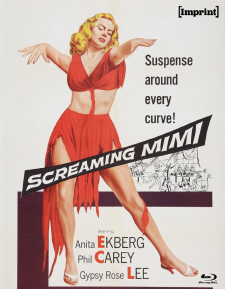
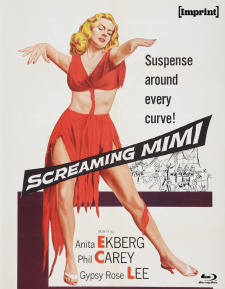
Screaming Mimi (Blu-ray Review)
Director
Gerd OswaldRelease Date(s)
1958 (September 9, 2026)Studio(s)
Sage Productions/Columbia Pictures (Imprint Films/Via Vision Entertainment)- Film/Program Grade: C+
- Video Grade: A-
- Audio Grade: A-
- Extras Grade: D

Review
[Editor’s Note: This is a Region-Free Australian Blu-ray import.]
Intriguingly screwy, Screaming Mimi (1958) is a late film noir entry from Columbia, a B-level feature from short-lived Sage Productions, co-partnered by Bob Fellows, who earlier in the decade produced a number of films in collaboration with John Wayne, including the wildly popular The High and the Mighty (1954). Soon after, however, Fellows was on the downslide. Screaming Mimi is cheap and tawdry.
After a refreshing swim in the ocean, Virginia Wilson (Anita Ekberg) is taking an outside beach shower when an escaped lunatic from a nearby psychiatric hospital attacks her with a knife. Hearing the commotion, her stepbrother, sculptor Charlie (Romney Brent), shoots the man dead with his rifle. Traumatized, Virginia herself is ironically institutionalized at the same mental hospital.
There, psychiatrist Dr. Greenwood (Harry Townes) becomes so obsessively in love with Virginia that he convinces her to disappear together and assume new identities, she as exotic dancer “Yolanda Lange” and he as her manager, “Bill Green,” she eventually becoming a sensation at the El Madhouse nightclub owned by former burlesque dancer Gypsy Mapes (Gypsy Rose Lee).
Looking for a story, reporter Bill Sweeney (Philip Carey) attempts to interview the emotionally fragile Yolanda, but Bill stands in his way. After Virginia is attacked in the streets late one night, Bill, himself falling for Yolanda, finds a connection between her assault and a serial killer whose previous victim (an uncredited Jeanne Cooper, seen only in newspaper photos) like Yolanda possessed a “Screaming Mimi,” a sculpture of Virginia at the moment of her first attack, one of three made by Charlie.
It’s difficult to tell how much of Screaming Mimi’s kinkiness was deliberate or accidental. Clearly, Anita Ekberg wasn’t cast for her acting ability, which is just about nonexistent. Twenty-six at the time, she was already starting to pack on the pounds, but was still undeniably voluptuous. The camera emphasizes her considerable bosom, and during her nightclub dancing there are numerous crotch shots—to put it politely—that likely escaped Production Code scrutiny only because Screaming Mimi was such a minor, cheap picture its censors may have slept through it. Likewise, there’s a bit more blood than usual for a late-’50s Hollywood film, and something like stripteases with both Ekberg and Gypsy Rose Lee (who performs “Put the Blame on Mame,” from Gilda) in a tame if suggestive manner. At the nightclub, the men drool over the women, and one fleeting shot shows what’s clearly a lesbian couple seated at one table.
But the script by Robert Blees from Frederic Brown’s 1949 novel, is hopelessly confused, made worse by Ekberg’s catatonic performance. Blees’s only notable credit was Douglas Sirk’s Magnificent Obsession, but that was a remake. His other credits are minor, some with notably terrible dialogue: Cattle Queen of Montana, The Black Scorpion, High School Confidential!, and From the Earth to the Moon. Ekberg’s character is vaguely (and selectively) amnesiac, Ekberg expressing this was a blank look on her face, like a deer caught in the headlights. Partly because of her acting inability, the confusing plot never really becomes clear, even at the end.
Co-producer Fellows became friendly with pulp writer Mickey Spillane during the making of Ring of Fear (which starred the author), and following Screaming Mimi Fellows ended his career with two Spillane adaptations: The Girl Hunters (1963; starring Spillane as Mike Hammer) and The Delta Factor (1970), based on a Spillane novel. Screaming Mimi itself resembles one of his potboilers; it’s not unlike an episode of the late-’50s Mike Hammer TV series that starred Darren McGavin.
Gerd Oswald is probably best remembered today for a batch of stylish episodes he directed for the TV series The Outer Limits, though cinematographers like Conrad Hall probably had greater impact on those programs than Oswald’s direction; his other work is often visually unremarkable. In any case, Oswald likely didn’t have the time to inject much in the way of style to Screaming Mimi, which was likely shot in 15 days or less. And it looks it. Even the musical score is lifted from other Columbia titles, mostly On the Waterfront.
Other than Ekberg, the cast fares reasonably well, including male leads Towne and Carey. Gypsy Rose Lee made relatively few films, but she’s the best thing about the picture as the worldly nightclub owner. Jazz vibraphonist Red Norvo and his Trio (actually a quartet) provide welcome musical relief. Familiar faces like Vaughn Taylor, Betsy Jones-Moreland, Alan Gifford, and Thomas Browne Henry turn up in uncredited bits.
Australia’s Imprint label has released Screaming Mimi as a no-frills, Region-Free Blu-ray. The 1080p 1.85:1 widescreen presentation of this black-and-white production is excellent, better than the usual Columbia second feature, with a bit less graininess (common to a lot of late-’50s Columbia B-pictures), a sharper image, and good blacks and contrast. The LPCM 2.0 mono is also good, supported by optional English subtitles.
The lone extra feature is a trailer, and it’s not in the best shape.
A real curio to be sure, though Screaming Mimi’s kinkiness is relatively minor, and the film ultimately unsatisfactory, though still worth a look for noir fans.
- Stuart Galbraith IV