
28 Days Later (Steelbook) (4K UHD Review)
- Review Date: Nov 11, 2026
- Format: 4K Ultra HD
-


Director
Danny BoyleRelease Date(s)
2002 (September 1, 2026)Studio(s)
DNA Films/Film Council/Fox Searchlight Pictures/20th Century Fox (Sony Pictures Home Entertainment)- Film/Program Grade: A-
- Video Grade: C
- Audio Grade: A
- Extras Grade: B


Review
Though inspired by 17th and 18th century African folklore and Haitian voodoo legend, horror cinema zombies certainly owe a debt to George A. Romero’s classic Night of the Living Dead (1968) and its arthouse/grindhouse sequels, Dawn of the Dead (1978) and Day of the Dead (1985), which effectively introduced the zombie archetype to modern moviegoers. But despite a late-90s renaissance in video games, thanks to the success of Capcom’s Resident Evil and Sega’s The House of the Dead, it wasn’t until Danny Boyle’s 28 Days Later that movie zombies as we know them today finally hit the ground running, so to speak.
Featuring a script by Alex Garland (Sunshine, Dredd, Ex Machina), Boyle’s film cribs a bit from Boris Sagal’s The Omega Man (1971) and particularly Romero’s The Crazies (1973), but still manages to add a few interesting ideas to the zombie mythos. The first is that they aren’t simply the reanimated dead, but instead living people infected with a deliberately engineered virus known as Rage. (The apparent goal was to create a kind biological agent to suppress violence—a tool for calming violent outbreaks—but the experiment went awry.) The second is that said virus turns its victims into fast, athletic, and blindingly aggressive carriers—essentially, mindless human missiles—whose only objective is to infect others. But Boyle takes things a step further by adding a stylistic touch as well—a raw, low-resolution, and cinéma vérité aesthetic that grounds his story in an unsettling brand of realism.
The story opens with a group of activists breaking into a Cambridge biolab to free its chimpanzees. This they righteously do, unaware that the animals are Rage virus test subjects. In moments, everyone on hand is infected. Thus the virus escapes, spreads, and collapses the whole of British society. Twenty-eight days later, a bicycle courier named Jim (Cillian Murphy, The Dark Knight, Oppenheimer) wakes up in a hospital completely alone—not only is the building empty, the whole of London has been abandoned. As Jim wanders the streets, attempting to piece together what’s happened, he meets a handful of fellow survivors, including Selena (Naomie Harris, Moonlight, Skyfall), a former cabbie named Frank (Brendan Gleeson, Braveheart, In Bruges), and Frank’s daughter Hannah (Megan Burns). But with supplies running low and the infected all around, Frank reveals a radio broadcast directing survivors to Manchester. So the group piles into his cab and hits the road in search of safety.
28 Days Later is unique for its visual approach, its critique of authoritarianism and institutional breakdown, and the filmmakers’ embrace of post-9/11 anxiety. The cast is excellent, and it should be noted that Murphy, Harris, and Burns were essentially unknown at the time, which helped with audiences’ suspension of disbelief. But what’s truly remarkable here is the way Boyle’s use of security camera imagery makes the film’s most uncanny and horrifying moments seem eerily mundane, while the handheld camcorder footage—alternately subdued and hyper-kinetic—makes everything feel both clinical, as if at a remove, and unsettlingly immediate and personal at the same time. It’s that dichotomy that lies at the heart of the film’s effectiveness. Combined with composer John Murphy’s evocative score, which features tracks by Brian Eno, Grandaddy, and Blue States, mixing post-punk electric guitar with ambient soundscapes, electronica, and classical elements, the result is a film that blends raw terror with the banal and striking moments of unexpected beauty. 28 Days Later lives, even thrives, in that liminal space between tranquility and chaos, order and anarchy.
28 Days Later was shot by cinematographer Anthony Dod Mantle (Slumdog Millionaire, Dredd, 28 Years Later) in MiniDV format (4x3 4:2:0 PAL 625 in Frame Movie Mode, which is pseudo-progressive scan) using Canon XL-1 cameras with Canon EC and EJ Prime lenses via an Optex adapter. The final scene was shot on 35 mm film, using Arriflex cameras with Arriflex spherical lenses, and a flashback scene was shot on Super 8 film. All of the video footage was upconverted to D-1 digital tapes (4:4:2 uncompressed PAL) and editing was done in that format. After grading, this source was captured onto a digital disk recorder, upsampled to 2K, cropped to reframe the image at 1.85:1, then filmed out to intermediate stock to create a master interpositive element from which answer and release prints were produced. For the film’s release on Ultra HD (and unlike 20th Century Fox’s 2007 Blu-ray, which was a scan of the interpositive), Sony has likely gone back to that original D-1 source, upsampled it to 4K, then done a bit of remastering as well as an HDR grade (compatible with both Dolby Vision and HDR 10) to create a new 4K Digital Intermediate. The result is encoded for release on a 100 GB disc, with data rates averaging 70-80 Mbps.
In order to properly evaluate this disc’s 4K visual upgrade, one must first look back at the original Blu-ray. That disc featured extreme contrasts, either very black and crushed or very blown out. The image as a whole appeared quite blotchy, with obvious edge enhancement, aliasing, and compression artifacting. There was sometimes more noise than actual detail, and the color palette was cold and sterile looking.
The new 4K image is still essentially SD, merely upscaled. But the intent isn’t to artificially add detail via AI, but rather to give you the best representation of this film as it actually is in all its analog, shot on PAL SD glory. The overall palette is less cold and blue-tinged now, as well as more varied by scene and environment. The actual colors are more richly saturated, organic, and vivid. There’s still no more detail in the image than you’d find in SD, but the expanded gamut means there’s more variation and nuance in the overall contrast, even as the shadows are a tad darker and the highlights a tad bolder. Faces look more natural. Edges are much cleaner and less ringy, still with visible aliasing but it’s softer and less harsh. The entire image just appears much less blotchy and riddled with macroblocking. Rest assured, 28 Days Later still looks like a bad day in MiniDV land—just as it should—but it also looks more cinematic and alive than ever before.
I should note, however, that the initial run of 4K discs was missing a shot during the tunnel sequence (at about 47:33)—a very quick image of a zombie’s red-tinged eyes. This was apparently added in post after the film was essentially “finished,” but right before the film out process. (So Sony sourcing the earlier digital master likely explains why the shot was missing.) Rest assured however, as the studio is running a 4K disc replacement program to correct this issue: Email them at This email address is being protected from spambots. You need JavaScript enabled to view it. to request a copy.
One additional note: Fox’s “full screen” DVD release from 2002 actually utilizes the original 4x3 formatted source. Keep in mind, that’s not the film’s intended aspect ratio. But if you’d like to see it that way for comparison, it’s fun viewing, as more image at the top and bottom of the frame is visible.
Sony’s 4K disc includes a brand new English Dolby Atmos mix that’s quite good. It maintains the overall spirit of the film’s original theatrical mix (and the Blu-ray’s English 5.1 DTS-HD Master Audio mix), while extending the stage both vertically and horizontally, to wrap around the viewer. That original mix was a bit more crisp and forward sounding, whereas this is more natural and enveloping. The Blu-ray surround was also more obviously directional, whereas every channel here is alive with subtle sound FX cues. During the film’s opening, you can hear chimps calling out and banging on cages in every direction—in the final shot before the title, the banging extends into the height channels too, as does the gas station explosion and other moments both in-your-face and subdued. The Atmos array really improves the overall ambience, not to mention the presence and fidelity of the film’s score. Dialogue is clean and there’s muscular LFE when needed. Also included are the previous English 5.1 DTS-HD MA mix, French, German, Italian, and Castilian Spanish mixes in 5.1 DTS-HD MA, and Turkish 2.0 Dolby Surround. Optional subtitles are available in English, English SDH, Cantonese, Simplified Chinese, Traditional Chinese, Danish, Dutch, Estonian, Finnish, French, German, Italian, Korean, Latvian, Lithuanian, Norwegian, Portuguese, Castilian Spanish, Latin Spanish, Swedish, and Thai.
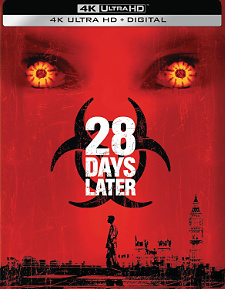
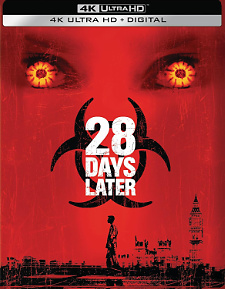
Sony’s 4K package is a single-disc Steelbook release that includes the remastered film in 4K on UHD only. No Blu-ray version is included. The 4K disc offers the following special features:
- Audio Commentary with Danny Boyle and Alex Garland
- Deleted Scenes with Optional Commentary (6 scenes – 9:32 in all)
- London Walk (Upsampled HD – 1:20)
- Abandoned Train (Upsampled HD – 1:49)
- Motorway Carnage (Upsampled HD – 1:19)
- Taxi/Sweden (Upsampled HD – 1:44)
- The Infected in the House (Upsampled HD – 2:26)
- Floorboards (Upsampled HD – :52)
- Alternate Endings with Optional Commentary (4 endings – 23:07 in all)
- Alternative Theatrical Ending (Upsampled HD – 4:25)
- Alternate Ending (Upsampled HD – 2:29)
- Radical Alternate Ending (Upsampled HD – 11:24)
- Hospital Dream (Upsampled HD – 4:48)
- Pure Rage: The Making of 28 Days Later (Upsampled HD – 24:22)
- Jacknife Lee Music Video (Upsampled HD – 6:23)
- Production Still Gallery with Danny Boyle Commentary (Upsampled HD – 18:11)
- Running Polaroid Gallery with Danny Boyle Intro (Upsampled HD – 4:16)
- Animated Storyboard (Upsampled HD – 1:32)
- Theatrical Trailer (Upsampled HD – 2:07)
All of these are carried over from the original 2002 DVD release (they were on the Blu-ray too) so they’re upsampled to HD from standard definition. It’s good content. The audio commentary in particular is an engaging conversation between two smart and effective genre filmmakers. Pure Rage is a reflective behind-the-scenes piece that deals more with conceptual ideas than actual production, but it’s certainly interesting. The storyboard and particularly the alternate endings are fascinating, for what they reveal about the characters. (Note that the Radical Alternate Ending was actually an Easter egg on the DVD release.) Missing from the original Blu-ray is the Theatrical Teaser (1:25) and a preview trailer for the sequel, 28 Weeks Later (2:14), which is of course a 20th Century title now controlled by Disney. A Movies Anywhere Digital Copy code is also included on a paper insert.
28 Days Later was successful enough that an explosion of zombie storytelling followed on the big and small screen, including Shaun of the Dead, World War Z, and AMC’s The Walking Dead TV series, not to mention direct sequels 28 Weeks Later (2007, produced by Boyle and Garland but directed by Andrew Macdonald), Boyle’s more recent 28 Years Later (2025), and Nia DaCosta’s 28 Years Later: The Bone Temple (2026). The latter two are also available on 4K disc, but 28 Weeks Later still needs an upgrade—here’s hoping Disney gets around to it eventually. In the meantime, while nobody’s likely to buy 28 Days Later in 4K for its image quality, they might buy it because the disc makes everything that’s good about the film a little bit better. They might also buy it because the film was essentially out of print on disc for years due to Disney’s purchase of Fox. Either way, Sony’s new 4K Steelbook is definitely recommended for fans.
-Bill Hunt
(You can follow Bill on social media on X, BlueSky, and Facebook, and also here on Patreon)