
Essential Film Noir Collection 7 (Blu-ray Review)
Director
Frank Tuttle/John Farrow/George Waggner/John BrahmRelease Date(s)
1942/1943/1946/1947 (September 9, 2026)Studio(s)
Paramount Pictures/Universal Pictures (Imprint Films/Via Vision Entertainment)- Film/Program Grade: See Below
- Video Grade: See Below
- Audio Grade: See Below
- Extras Grade: B-
- Overall Grade: B+

Review
[Editor’s Note: This is a Region-Free Australian Blu-ray import.]
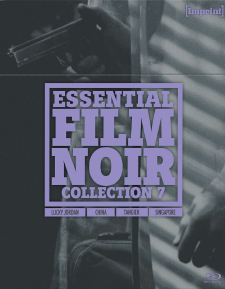
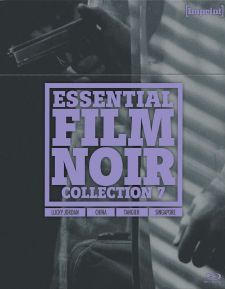
Australia’s Imprint’s Essential Film Noir Collection is back with Collection 7, four more titles, all region-free and fairly packed with extra features. As usual, it’s all packaged in a very sturdy box, each title getting its own Blu-ray case.

I’d argue that none of the films really qualify as noir: Lucky Jordan (1942) and China (1943) definitely aren’t even remotely noir, and while Tangier (1946) and Singapore (1947) contain noir elements, those elements aren’t quite enough to qualify those as noir, either. Nevertheless, if labelling them such helps ensure Blu-ray releases of these lesser-known titles, I’m all for that.
LUCKY JORDAN
Lucky Jordan is something of a cut-rate variation of All Through the Night, the hilarious Warner Bros. gangster-comedy-spy film released 11 months earlier, with Humphrey Bogart and myriad Warner contract players battling Nazi fifth columnists. Lucky Jordan is a Paramount title toplined by Alan Ladd in his first starring film, telling a similar tale, Ladd playing a gangster up against likeminded bad guys. Warners, what with their expertise with the gangster genre, pulled off an improbable script, but Lucky Jordan is merely silly and often ludicrous.
New York racketeer Lucky Jordan (Ladd) is drafted into the army, 1-A status despite the best efforts of his “mouthpiece,” attorney Ernest Higgins (Lloyd Corrigan), to get him deferred, even attempting to pass off local panhandler-drunk Annie (Mabel Paige) as Lucky’s dependent “Ma.” Lucky shirks his duties at basic training by hanging out at the base canteen run by plucky Jill Evans (Helen Walker, in her film debut) and eventually he goes AWOL, commandeering a car. Outside the camp, two thugs try to steal a briefcase left in the vehicle, and eventually Lucky’s on the lam with a kidnapped Jill in tow. Back at his New York office, he finds that ambitious, conniving lieutenant Slip Morgan (Sheldon Leonard) has taken over the firm, now specializing in selling military secrets to fifth columnist Nazis. In an incredible coincidence, Slip’s latest deal involves the contents of the briefcase from the stolen vehicle.
One problem with the film is that its gangsters act and talk less like Warner Bros.’ roster of racketeers than Damon Runyon types, speaking gangster jargon that was probably anachronistic even in 1942. Indeed, “Ma” Annie is an obvious steal of Apple Annie, from Runyon’s Madame La Gimp, adapted as Frank Capra’s Lady for a Day (1933). Conversely, Ladd’s circumspect screen persona isn’t really suited to the title character, which cries out for a more flamboyant, energized James Cagney type.
Ladd had been kicking around Hollywood for a decade, making his debut in 1932, but most of those appearances were uncredited bit parts. As late as 1941 he was still appearing without billing in small roles, including Citizen Kane (as a reporter), Disney’s The Reluctant Dragon (as a storyboard artist), and in the terrible Laurel & Hardy comedy Great Guns (as a soldier). But a big break, fourth-billed as hitman Philip Raven in the classic noir This Gun for Hire, likewise directed by Frank Tuttle, propelled him to stardom. Paramount seems to have hedged their bets on Lucky Jordan, Ladd’s first movie where he received top billing. The picture is bigger than their average B-movie, but still inexpensive—a “nervous ’A.’” It was probably shot in 20 days or so and cost less than $300,000. Tellingly, most of the film’s exteriors were shot on Paramount’s backlot New York street while Jordan’s underworld empire seems to consist of about three guys, and they all want him dead.
The best thing Lucky Jordan has going for it is the relationship between alcoholic Annie, who enjoys masquerading as Jordan’s “Ma” since she’s childless and lonely, despite her sunny disposition. Later in the story, Jordan also seems to enjoy having a doting surrogate mother to look after him. Paramount appears to have recognized this as the film’s main strength—a key scene has Lucky returning to Annie’s apartment, where the old lady has been badly beaten by the Nazi agents. (This, in turn, sheds Jordan’s selfishness and he does a complete turnabout, Jordan now a true American patriot. Of course.)
However, the awkward cutting of the scene suggests that it may originally had been filmed with Jordan finding Ma dead rather than badly beaten. His dialogue with the bruised Annie has the whiff of footage shot and inserted later.
Unlike Ladd, Helen Walker became an instant star with this, her first film. She excelled in both comedies and noir, in the latter genre most memorably in Nightmare Alley (1947). But, like Ladd, she had a troubled life and died at 47 in 1968, four years after Ladd’s untimely passing at 50. In a strange coincidence, they were buried virtually side-by-side. Further, Marie MacDonald, in a showy role as Jordan’s secretary, herself died at 42 in 1965, the end of yet another troubled life rivaling Ladd’s and Walker’s. At the start of promising careers, both Walker and MacDonald show much talent, and are lovely to look at.
Imprint’s Blu-ray, licensed from Universal, presents Lucky Jordan in its original black-and-white, 1.37:1 standard ratio. Presumably derived from the same new 2K video master of a 35mm fine grain as an earlier Kino release, the image is strong with good blacks, contrast, and resolution. The LPCM audio (2.0 mono) is likewise above average. Optional English subtitles are provided.
Unlike the Kino release, which had a pretty good audio commentary track by critic Samm Deighan, Imprint’s Blu-ray offers a 1951 radio adaptation of the film starring Ladd, for The Screen Directors’ Playhouse, while both versions include a theatrical trailer.
Lucky Jordan is reasonable diverting, but unexceptional, and its unreal (even by ’40s Hollywood standards) gangsters and improbable plot don’t help it.
LUCKY JORDAN (FILM/VIDEO/AUDIO/EXTRAS): B-/A-/A-/B-
CHINA
China is about as much film noir as Herbie Rides Again, but it’s undeniably impressive. Set in war-torn, Japanese-occupied China just prior to Pearl Harbor, it’s an exciting, lavish production with great special effects and stunt work. It’s brutal but comparatively accurate, for the most part avoiding racial stereotypes and, except for a hokey exchange near the end, sidesteps the usual Hollywood wartime propaganda, instead telling a story similar to John Ford’s later 7 Women. Significantly, other than stars Loretta Young, Alan Ladd (again), and William Bendix (and, very briefly, Tala Birell in the opening scene), the rest of the cast is entirely Asian, played by Philip Ahn, Victor Sen Yung, Marianne Quon, Richard Loo, and others.
Director John Farrow was justly famous for long, uninterrupted tracking shots, and China opens with a doozy, as dazzling as Orson Welles’s famous opening to Touch of Evil. A Chinese city is under heavy artillery fire, and the camera follows Johnny Sparrow (Bendix) as bombs fall around him, a bridge collapses behind him, he rescues a newly orphaned toddler, and he takes cover in a building, all in a single take. Presumably shot on the Paramount Ranch, the bombed-out city is a singularly elaborate set, like a dry run for 55 Days at Peking, yet this is nearly the last we see it. (For an “A” picture that reportedly cost $2 million, China has a B-picture running time—just 78 minutes. Nevertheless, at that length the story moves along at an impressively brisk pace.)
Johnny and his partner, mercenary American David Jones (Ladd), who has been selling oil to the Japanese, decide to make for Shanghai, the baby in tow. After dark, they unknowingly take on Chinese refugees, women students, who at the instruction of American teacher Carolyn Grant, clamor aboard the back of Jones’s half-ton truck unseen. As she knows the terrain, the men eventually let Carolyn guide them, aided by Lin Wei (Sen Yung), who rides on the front fender.
They reach the family farm of one of the students, Tan Ying (Quon), stopping there as the baby, christened “Donald Duck,” needs fresh milk. Carolyn tries to persuade Jones to take the girls to safety in Chungtu, but he sticks his neck out for no one, agreeing only to take them as far as the crossroads to Shanghai. On the road again, everyone realizes that Tan Ying has slipped off the truck to return to her family, despite the great risk of marauding Japanese. After a fight between Jones, Carolyn, and Johnny, the three decide to make the dangerous trip to get her.
The special visual effects, supervised by Gordon Jennings (later of War of the Worlds fame) are plentiful and mostly outstanding: matte shots, miniatures of a Japanese plane crashing into the mountains, a dynamite-triggered avalanche on Japanese troops, etc. The on-set special effects and stunt work is just as impressive. In one scene, a grenade is tossed at a Japanese troop transport carrying maybe 25 soldiers and the effect is flawless: men are seen moving within the truck just as the grenade reaches them and the explosion sends bodies flying everywhere. Not-easily-impressed me exclaimed “Whoa!” and I “rewound” the film several times to reexamine that moment—I’m still not sure just how it was done.
The picture is unusually violent but essentially accurate about Japan’s brutal occupation of China, while at the same time avoids the worst Hollywood wartime stereotyping of the Japanese as something less than human or, for that matter, of the Chinese as brave, noble, if slightly inferior victims. Only during the climax does this slip, a failing of an otherwise pretty honest film, when Ladd’s Jones converses with a Japanese officer.
Of course, a quasi-romance develops between Jones and Carolyn, but it’s standard stuff. Much more interesting is Bendix, Jones’s obvious conscience, who becomes emotionally attached to little “Donald Duck,” with Bendix’s sincere performance selling it. Later, there’s a good scene of Bendix overcome with homesickness at the farm, because it reminds him so much of his own family farm back in Oregon.
Licensed from Universal, inheritors of the pre-1948 Paramount library, the 1.37:1 standard frame, black-and-white China generally looks good on this Blu-ray. However, dark interiors and nighttime scenes (and there are a lot of those) appear to have been overly tweaked digitally, perhaps to look more like modern cinematographic standards rather than 1940s ones. Rather than let the lighting cameraman do his stuff, the tweaking tends to remove a lot of contrast, giving everything a distractingly too-dark look (like many 4K discs these days); everything looks washed out. It’s not ruinous, just pointless. As with all four titles, the disc is Region-Free, the LPCM 2.0 mono is robust, and supported by optional English subtitles.
Extras here consist of a trailer and a Lux Radio Theatre adaptation from 1951 starring Ladd, Young, and Bendix.
CHINA (FILM/VIDEO/AUDIO/EXTRAS): A-/A-/A/B
TANGIER
Tangier isn’t so much noir as a tepid knockoff of Casablanca (1942), whose popular and critical success resulted in scads of imitators, almost none of them good. The plot is entirely different but the iconography is the same: a smoke-filled, Rick’s Café American-type nightclub where much of the intrigue happens, a letters of transit-type valuable diamond everyone covets, a busting bazar choking with desperate refugees. Indeed, so blatant is this wannabe that its climax takes place an airport tarmac at night, characters trying to catch the last flight to Lisbon.
Added to that is a fusing with the cycle of exotic, sometimes campy Maria Montez films, Technicolor fantasies often with Jon Hall and/or, as here, Sabu. For Tangier, however, this Montez vehicle has been demoted to ordinary black-and-white.
At the Rick’s-like café in Spanish-occupied Tangier, immediately after the war, Rita (Montez) is the big attraction, star dancer with partner Ramon (Kent Taylor). A patron named Adolpho Fernandez (Reginald Denny), a Nazi diamond smuggler, turns up, prompting Rita to have friend Dolores (Louise Allbritton) to perform in her place, her identity unknown to the audience due to the shadowy lighting and her coy use of hand fans. This allows Rita to search Fernandez’s hotel room for a priceless diamond in Fernandez’s possession, but he catches her in the act, forcing Ramon to fatally stab the smuggler. This, in turn, prompts an investigation by local magistrate Col. Jose Artiego (Preston Foster), he ordering Rita, Dolores, Ramon, and disgraced American war correspondent Paul Kenyon (Robert Paige) to the police station to be questioned and searched, Rita cleverly hiding the diamond among the ice in a drink Artiego gives her. The diamond, it seems, was intended to pay for the smuggling of elusive Nazi war criminal, Balizaar, out of Tangier, but now everyone in Tangier is after the diamond and/or Rita’s affections.
Tangier isn’t bad, except that it invites comparison with Casablanca at virtually every step, and consistently falls way short on that score. Though competent, Robert Paige is no Humphrey Bogart, Preston Foster neither Claude Rains nor Conrad Veidt (his character is like the two combined), etc. Foster’s costume for most of the film is almost like a parody of Rains’s in Casablanca, complete with comical cap. The screenplay hasn’t an ounce of the cleverness of Casablanca yet somehow manages to be even more convoluted.
I’d always thought of Maria Montez as something of a one-trick pony, enjoyable for her flamboyant characters in earlier Universal hits like Arabian Nights and Cobra Woman but little else, yet she’s not half-bad playing, for once, something like a normal if exotically beautiful woman. Montez had been pushing for such a vehicle and, apparently, used her status as one of Universal’s biggest stars to get it. (Despite what the IMDb says, however, this was not filmed in 1943 and shelved, but shot in the fall of 1945 and released in 1946.) Sabu, on the other hand, is third-billed but wasted playing yet another variation of his eager-to-please energetic Indian, this time singing American standards like “She’ll Be Comin’ Round the Mountain” and “Polly Wolly Doodle” to bemused café customers. He fared far better in his next film, the light-years-ahead-of-this Black Narcissus (1947), for Powell & Pressburger.
Again, though, it’s not bad. Allbritton doubling for Montez and vice versa is well staged, especially when one considers they (along with Kent Smith) were also doubled by professional dancers. A shocking murder-suicide near the end is also well-done and exciting. Most of the picture, however, is derivative and uninteresting.
Imprint’s Region-Free Blu-ray of Tangier is a good encoding of this black-and-white, 1.37:1 standard release, while the LPCM 2.0 mono, supported by optional English subtitles, is above average. Supplements are limited to a trailer, in poor condition.
TANGIER (FILM/VIDEO/AUDIO/EXTRAS): C+/A-/A/D
SINGAPORE
After Tangier, I approached Singapore with some trepidation, with its reputation as yet another Casablanca clone. To my great surprise, I found it unexpectedly entertaining, even though its screenplay is even hokier than Tangier’s, its plot turning on that hokiest of narrative devices—amnesia. What makes it much more entertaining is, primarily, its superior cast.
After the war, trader and pearl smuggler Matt Gordon (Fred MacMurray) returns to Singapore to retrieve a cache of valuable pearls hidden above a ceiling fan in his former hotel suite. At the hotel, he pines for lost love Linda Grahame (Ava Gardner). In flashbacks the audience learns they were lovers just prior to the Japanese invasion and eventual occupation of Singapore. On their wedding day, their church is bombed, she apparently dead somewhere in the rubble, and he flees the city with other refugees aboard his schooner.
Five years later, Deputy Commissioner Hewitt (Richard Haydn) is convinced Matt has returned for the lost pearls, as are criminal Mauribus (Thomas Gomez) and his lackey, Sascha (George Lloyd); all keep their eyes glued on Matt’s movements. His efforts are delayed further when his regular suite has been allocated to American tourists Mr. and Mrs. Bellows (Porter Hall and Spring Byington).
Then, at the hotel’s nightclub, Matt is shocked to see Linda blithely dancing with plantation owner Michael Van Leyden (Roland Culver), now her husband, and she now using the name Ann. She later claims to have no memory of Matt or anything prior to the Japanese attack, but afterwards she and Michael became close during their five years in a Japanese concentration camp.
MacMurray and Gardner are far more watchable than Robert Paige and Maria Montez, he as a good-bad guy engaged in victimless larceny, and clearly ready to give all that up for Maria, and she a lost soul wondering about her past existence, a woman all but a stranger to her, a nice change from Gardner’s later screen persona as a worldly beauty surrounded by men who all desire her. The core question, Can passionate love be rekindled with a fiancée who no longer even remembers you? may be wildly improbable but it’s compelling nonetheless.
Richard Haydn would soon be typecast as nasally-voice, fussy and acidic types, almost a cartoon. (Like Jim Backus, voicing cartoons moved him in that direction.) Here, though, he’s not a caricature at all, playing a police commissioner whose modus operandi is methodical, subtle, and flexible; he comes off well. Thomas Gomez and George Lloyd pay stock baddies, but do so with color and verve, while Porter Hall and Spring Byington provide decent comedy relief.
Roland Culver looked old most of his career, an obvious hairpiece here not helping matters. He was only a few years older than MacMurray but appears old enough to be his father, let alone Gardner’s. In that sense he’s a bit miscast but his performance is strong, his characterization displaying much sympathy, intelligence, and understanding. All of these actors sell the material, making it compelling and inviting a suspension of disbelief for its occasionally ludicrous script.
Imprint’s Blu-ray offers a fine 1080p transfer of this 1.37:1 standard, black-and-white production. The film elements used appear to be a composite of original camera negative mixed with secondary sources, but it’s nearly seamless and entirely watchable. As before, the audio is LPCM 2.0 mono with optional English subtitles, and the disc, again, is Region-Free.
Extras this time include a 50-minute documentary, Fred MacMurray: The Guy Next Door (1996). Though older, it includes interviews with heavyweights like Jack Lemmon and Billy Wilder, plus scads of film clips. Also included is a Lux Radio Theatre 1947 adaptation of the film, with MacMurray and Gardner, and a trailer.
SINGAPORE (FILM/VIDEO/AUDIO/EXTRAS): B+/A-/A/B+
Though not really noir, the four titles in this set—one very good, one pretty good, and two worth seeing once—combined with Imprint’s excellent packaging and good extra features, is worth seeking out and recommended.
- Stuart Galbraith IV