
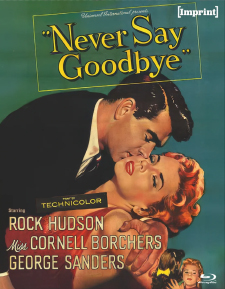
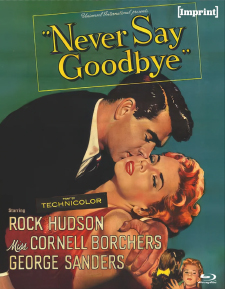
Never Say Goodbye (Blu-ray Review)
Director
Jerry HopperRelease Date(s)
1956 (August 26, 2026)Studio(s)
Universal Pictures (Imprint Films/Via Vision Entertainment)- Film/Program Grade: C+
- Video Grade: A
- Audio Grade: A
- Extras Grade: B

Review
[Editor’s Note: This is a Region-Free Australian Blu-ray import.]
Universal had a profitable run with Technicolor melodramas in the 1950s. Magnificent Obsession, All That Heaven Allows, Written on the Wind and the remake of Imitation of Life filled studio coffers with star-studded stories of self-sacrifice, forbidden love, and dysfunctional families. One entry in that genre, Never Say Goodbye, is about a woman long believed dead who comes back into the lives of her husband and child.
Dr. Michael Parker (Rock Hudson) is a successful California surgeon who’s raising his young daughter Suzy (Shelly Fabares) alone. He’s told her that her mother passed away years earlier.
On a trip to New York City to attend a medical convention, Dr. Parker unexpectedly encounters his German-born wife, Lisa (Cornell Borchers), very much alive and working as pianist accompanying artist Victor (George Sanders), her longtime companion, who draws caricatures for nightclub guests. Shocked at seeing Mike, Lisa runs out into the street and she’s struck by a car. Mike assists with her emergency surgery. During her recovery, Victor confronts Mike, accusing him of destroying Lisa’s life.
An extended flashback takes us to postwar Vienna in 1945 where Mike, then an army doctor, meets beautiful singer Lisa performing with Victor in a nightclub. After a brief, passionate courtship they marry and soon have daughter Suzy.
The happy family is shattered by Mike’s jealousy of Lisa’s friendship with Victor. After a blow-up over Victor, Lisa crosses over to Vienna’s Soviet occupied zone to visit family. Meanwhile, the Soviet authorities close the border and Lisa is arrested when she tries to sneak back to Mike and Suzy. After searching relentlessly for Lisa to no avail, Mike eventually assumes she has either abandoned him and Suzy or died and he takes the child with him back to the United States.
The third act returns to the present. Lisa and Mike reconcile after explanations are made and together they travel to Mike’s home. On advice from the family physician, Suzy isn’t told initially that Lisa is her mother. The child resists Lisa’s efforts to befriend her and a bond between them fails to develop.
This visually rich film is soap opera with a glossy veneer. Its appeal is primarily its lush Technicolor photography, picturesque settings, and Rock Hudson’s star power. Hudson and Borchers never strike sparks as the passionate lovers. In many of the scenes, characters speechify rather than deliver dialogue naturally, which damages credibility. Often, energy levels are pitched artificially high.
Rock Hudson was at the peak of his career in the 1950s. He made a series of melodramas at Universal and was about to make Giant at Warner Bros. after completing Never Say Goodbye. With an imposing physique and extraordinarily handsome face, Hudson was a genuine movie idol. His acting, however, is weak. We never get the impression he’s fully immersed in his character. There’s a stiffness in his portrayal that has the ring of amateur. When Mike first sees Lisa, Hudson’s attempt to look shocked is almost laughable. Wide-eyed and speechless, he resembles a kid caught sneaking cookies from the cookie jar. Mike and Suzy, we’re told, have a wonderful father/daughter relationship, but their closeness and affection never materialize on screen. Director Jerry Hopper fails to capture that special bond.
Cornell Borchers, brought from Germany to star in Never Say Goodbye, is attractive, but doesn’t generate much screen chemistry with Hudson. Her character is complex with misunderstandings to clear up, motives to explain, and behaviors to reconcile. Borchers has a lot of emotionally wrenching information to convey. Yet she’s sadly banal in many scenes. Sometimes, she elicits sympathy, as when Lisa attempts to hug Suzy, who instinctively recoils. I kept thinking how much better an actor like Susan Hayward would have been in this role. There should be some fire in her performance, but Borchers too often comes off as bland.
Shelley Fabares, who two years later would become part of the Stone family on The Donna Reed Show, has considerable screen time and is reasonably effective as conflicted Suzy despite the script’s shortcomings. Her role has her written as a little lady perpetually fussing over her father rather than a real child. She’s always in pretty dresses, never in casual, knock-about clothes and playing with other kids. Screenplay writer Charles Hoffman never bothered to give her dimension. She’s solely a key plot point.
George Sanders as Victor is always suave and well spoken but his character, too, is a plot device. Victor’s sole purpose in the script is to inspire Mike’s jealousy, since he’s always around, whether in Vienna or California. He’s Lisa’s companion, which is probably all the Hays Office would permit in the mid 1950s. Its hard to accept that his years-long relationship with Lisa is strictly platonic, but again that’s a script failing. Sanders is one of those actors you love to watch. Completely natural in front of the camera, his performances always add stature to the films he’s in, whatever their quality. I just wish Victor had sharper dialogue.
Never Say Goodbye is a loose remake of the 1945 Universal picture This Love of Ours. Both films were adapted from the Italian stage play Come Prima, Meglio di Prima by Luigi Pirandello.
Though Jerry Hopper received directorial credit on Never Say Goodbye, Douglas Sirk served as uncredited co-director. He began working on the film but had to leave to direct Written on the Wind. He also returned to the production to direct reshoots. He was personally responsible for bringing Cornell Borchers from Germany to star. Sirk and Rock Hudson made nine films together.
Never Say Goodbye was shot by director of photography Maury Gertsman on 35mm film, processed by Technicolor, Hollywood, and presented in the aspect ratio of 1.85:1. The Blu-ray has an aspect ratio of 2.00:1. Image quality is superb. The Technicolor photography is vibrant with both primary and pastel hues beautifully rendered. Perfectly manicured green lawns, a red dress that Lisa wears, and red roses in the garden especially stand out. Complexions are natural. The camera is flattering to Cornell Borchers’ make-up and smooth skin. Details such as patterns on dresses, a station wagon, decor in the Parker home, Mike’s military uniform, and Lisa’s opal ring are well delineated.
The soundtrack is English 2.0 mono LPCM. English SDH subtitles are an option. Dialogue is clear and distinct. Cornell Borchers speaks with a slight German accent. The score was written by Universal’s house composer, Frank Skinner. Typical of romantic melodramas of the period, his arrangements are emotionally charged and create a degree of tension. Occasionally, his ominous chords practically hit the viewer over the head with their over-emphasis, making sure we’re aware of the scene’s significance.
Bonus materials on the Region-Free Blu-ray release from Imprint Films includes the following:
- Audio Commentary with C. Courtney Joyner
Audio Commentary – Author/film historian C. Courtney Joyner offers an enthusiastic discussion of Never Say Goodbye. He refers to the film as a Douglas Sirk film that he didn’t make—a “weepy melodrama” typical of Universal’s 1950s films. Sirk started directing the film but left the production early to direct another Universal feature. He declined a co-director credit. This was a weird in-between period for the studio. It had successes with James Stewart movies as well as Westerns and monster flicks. It didn’t have major marquee stars as did MGM and Warner Bros. Its “backbone” was films that could be made on low budgets. Contract player Clint Eastwood is seen briefly as a lab assistant at the beginning of the film. Shelley Fabares, who plays Suzy, was later in three Elvis Presley movies and had a long career in television. Rock Hudson, starting in the late 1940s, made a large number of films, starting with director Raoul Walsh. In Never Say Goodbye, he plays a father with a daughter. Many leading men didn’t want to play characters with kids because they felt their romantic image would suffer. After the success of Giant, Hudson could pick his roles. His career was “accelerating to the sky.” He made three films with Doris Day that revealed his flair for comedy. Eventually, he formed his own production company which meant he owned a piece of the movies he starred in. The only other actor at Universal who was becoming hot was Tony Curtis. George Sanders’ career had slowed until All About Eve gave it a resurgence. The extended flashback of Never Say Goodbye provides the characters’ key backstory. Audiences felt the film fell short of more glamorous, star-studded showcases for Hudson. Critics’ reviews were mixed to lukewarm. The consensus was that the film was formulaic and overly sentimental.
Never Say Goodbye is a melodramatic romance. With a plot that involves a woman presumed dead coming back into the lives of her husband and daughter, it generates considerable soap opera elements. George Sanders’ confident acting partly makes up for the more tentative performances of the two leads. The film ultimately disappoints with unconvincing leads and a script that relies on expedience rather than characterization. To its credit, the film is beautifully photographed with Universal’s distinctive mid-1950s look.
- Dennis Seuling