
Go (4K UHD Review)
Director
Doug LimanRelease Date(s)
1999 (September 29, 2026)Studio(s)
Banner Entertainment/Saratoga Entertainment/Columbia Pictures (Arrow Video)- Film/Program Grade: A-
- Video Grade: A
- Audio Grade: A-
- Extras Grade: B+

Review
When Go landed in theatres back in 1999, it drew inevitable comparisons to Pulp Fiction due to its ensemble cast, interlocking storylines, and nonlinear structure. To be fair, there had been plenty of other Quentin Tarantino influenced films that followed in the wake of Pulp Fiction, and while that wave was starting to slow down by the end of the decade, memories were still fresh at that point. Yet directors like Robert Altman and Alan Rudolph had explored ensemble storylines long before Tarantino did, and others like Stanley Kubrick and Nicholas Roeg had dealt with a variety of different ways of fracturing chronologies. There’s nothing new under the sun, and while Tarantino may have felt like a breath of fresh air after Reservoir Dogs, Pulp Fiction, and Jackie Brown, he’s always borne the influence of those who came before him—when he wasn’t outright stealing from them, that is. So, while Go seemed like just another dip into the Tarantino well, its own roots lay much deeper than that.
Still, just five years after Pulp Fiction, it was hard to avoid making Tarantino comparisons when discussing Go. Yet the reality is that aside from minor details like one character spending time in the trunk of a car, Go doesn’t really look, feel, or sound like a Tarantino film—or a Tarantino knockoff, for that matter. It’s not really a pop culture pastiche; instead, it has a vibe, energy, and style that’s entirely its own. If there’s one defining characteristic for the film, it’s right there in the title: Go, indeed. While it has plenty of pithy dialogue, there aren’t any extended scenes of people just sitting around and talking. From the story to the cinematography, editing, and music, everything about Go is defined by forward momentum—enough so that it leaves viewers feeling like they’re always one step behind everything, unable to catch up with the flow of events until the very end of the film.
That’s by design, of course, and full credit for how well Go works belongs to director/cinematographer Doug Liman, writer/co-producer/2nd unit director John August, editor Stephen Mirrione, DJ/composer BT, music supervisor Julianne Jordan, and the eclectic cast. Liman was hot off the cult success of Swingers and looking for a new project when he was handed the script for Go, and August’s story (or rather stories) immediately clicked with him. Looking back at the film for The Ringer in 2019, he told Eric Ducker that “I had a charmed youth in that I did a lot of crazy things and no one ever got hurt. I had this belief that you have a get-out-of-jail-free card when you’re 18... What I saw in Go was a story that was celebrating: Do crazy shit while you’re young. You can get away with it when you’re young.”
There are a lot of things happening in Go, from L.A. rave culture to drug dealers, Ecstasy, undercover cops, sting operations, strip clubs, and general Las Vegas madness, but that’s still the core of the story: a group of young people do stupid shit, get in way over their heads, and somehow come out of it more or less in one piece. The reality is that the characters in Go are always one step behind what’s happening around them, so it made perfect sense to craft a style for the film that puts viewers in the same position. It’s the perfect visual, aural, and structural manifestation of what these charmed youth end up experiencing: a bad trip come to vivid life. That’s literally true, too, as one of the characters ends up tripping balls and the film trips balls right along with him. Form vs. content? There aren’t any such arbitrary distinctions in Go; it’s all one and the same.
Go kicks off with a psychedelic opening title sequence set at the rave that will soon become a key location for much of the story, accompanied by a remix of Lionrock’s Fire Up the Shoesaw that incorporates (appropriately enough) a brief sample of the iconic chromatic bass line from These Boots Are Made for Walkin’. And just like Nancy Sinatra, the film immediately walks all over the viewer by cutting to an unrelated scene where Claire (Katie Holmes) is sitting down opposite another unseen character and saying:
“You know what I like about Christmas? The surprises. You get this box and you’re sure of what’s inside. You shake it, weigh it. You’re convinced you have it pegged. No doubt in your mind. But then you open it and it’s different. You know. Wow! Bang! Surprise! I mean, it’s kind of like you and me here, you know? I’m not saying it’s anything it’s not. Come on, this time yesterday, who would’ve thunk it?”
There’s no context for this scene, not even a hint of who she is, where she is, or who she’s talking to, and Go won’t offer any real answers to those questions until near the end of the film. But Claire sets the stage by warning viewers not to be convinced that they have Go pegged, and right after that, the film rewinds—although once again, that chronology isn’t established until much later. Broadly speaking, Go tells the overarching story of one night in the lives of vaguely interconnected characters (there’s a lot of Six Degrees in the film), but from three different perspectives, including the aftermath the following morning. But rather than doing so in parallel, it tells each of their stories sequentially, backing up to relate the same night (and its consequences) from three different points of view.
The first section is Ronna, where teenage grocery store employees Ronna (Sarah Polley), Mannie (Nathan Bexton), and Claire get involved with drug dealer Todd Gaines (Timothy Olyphant) to score some Ecstasy and sell it at a rave. The second is Simon, where Simon (Desmond Askew), Marcus (Taye Diggs), Tiny (Breckin Meyer), and Singh (James Duval) go to Vegas and get into serious trouble with strip club owner Victor (J.E. Freeman). The third is Adam & Zack, where soap opera stars Adam (Scott Wolf) and Zack (Jay Mohr) get roped into a sting operation run by police officer Burke Halverson (William Fichtner)—and worse, into having dinner with Burke and his wife Irene (Jane Krakowski). All of that is followed by a coda where everything comes together and loose ends are tied up (more or less, anyway).
Looking at the film from that summary, all three segments sound like they’re completely unrelated. But the constant forward momentum in Go extends to the narrative structure, and every time that it rewinds to show the same night from a different perspective, the pieces of the puzzle start to click into place and the whole picture finally becomes clear. It’s just that August’s script doles those pieces out one at a time and trusts the viewer to put them together. Yet like many Doug Liman films, Go didn’t really come together until the editorial process, with his freewheeling, improvisatory shooting style leaving plenty of room to juggle things around further until it all cohered. Crucially, Liman did some reshoots in order to let each segment start at the same moment at the grocery store, which helped anchor the story and keep viewers oriented through all of the chronological shifts.
As a result, the various storylines in Go end up interlocking even more tightly than Quentin Tarantino and Roger Avery’s stories did in Pulp Fiction. Key plot points are even revealed early via seemingly throwaway lines of humorous dialogue that aren’t shown to be genuinely meaningful until much later (Claire ends up setting the stage in more ways than one). Saying anything more specific about Go is saying too much, because it’s best experienced the same way that the characters do: with no real idea what’s going to happen and only hindsight to put all of it together. So, sit back, strap in, and let Go take you on a magic carpet ride while constantly pulling the rug out from under you. Just like what Ronna, Simon, Adam, Zack, and all of their friends experience that one fateful night, it’s some crazy shit.
In the true spirit of independent filmmaking, Doug Liman served as his own cinematographer for Go, shooting everything just as guerilla-style as he had for Swingers. Similar to that film, he personally operated an Aaton 35-III camera with spherical Panavision Primo lenses, and since the noisy Aaton wasn’t designed for sync sound, he effectively “blimped” it by wrapping it in a down jacket. The difference this time was that he shot in Super-35 format, with the final results framed for 2.39:1 instead of the 1.85:1 of Swingers. (Release prints were anamorphic blowups.) This version is a new 4K master produced by Sony based on 4K scans of the original camera negative, with scanning and digital remastering completed by Prasad Corporation in India, while Roundabout in Santa Monica handled the grading (both Dolby Vision and HDR10 are included). The final results were approved by Liman.
It’s not clear what stocks that Liman used, but since he would have been shooting with available light much of the time, he obviously opted for something relatively fast, and Go has always been a particularly grainy film. That’s really evident during the optically-printed opening title sequence, but the rest of the film still has a significant sheen of grain throughout, one that’s managed well by the encode (disc authoring was handled in this case by Visual Data Media Services). Everything is as spotlessly clean as you would expect from a Sony-produced 4K remaster, and grainy stocks or not, it’s sharp as a tack. Fine textures like facial details and the weave of Taye Diggs’ infamous mustard yellow jacket are reproduced perfectly.
Speaking of that jacket, color reproduction is spot-on as well, with everything from the costuming to the skin tones looking essentially perfect. While the HDR grading strengthens the contrast range a bit, it doesn’t try to reinvent the wheel, but do be aware of the fact that the flashing lights during the rave sequences are particularly intense in HDR. (Exercise caution if you’re sensitive to that kind of thing.) It’s a bit of a cliché to say that a home video release is the best that a film has ever looked, but... this is unquestionably the best that Go has ever looked. While I wouldn’t presume to say that I can remember exactly what it looked like in the theatre when I saw it in 1999, it’s safe to say that between generational losses and the anamorphic blowup process, release prints couldn’t have held a candle to how Go looks on 4K Ultra HD. Digital or not, it’s a beautifully filmic presentation.
Audio is offered in English 5.1 DTS-HD Master Audio, with optional English SDH subtitles. Go was released theatrically in 5.1 (triple-format DTS, Dolby Digital, and SDDS), and this remastering of the original mix was handled internally by Sony Pictures Post Media Center in Culver City. For a film that revolves around rave culture, it’s an appropriately bass-heavy mix, with BT’s musical wizardry providing most of the sonic energy that drives the film (Go, indeed). But the dialogue is clear (at least when it’s supposed to be) and there’s plenty of surround activity from the crowd noises, gunfire, explosions, car crashes, and all of the other various bits of chaos that are part of the experience of Go. It’s all good enough that there’s no real need for an Atmos remix here.
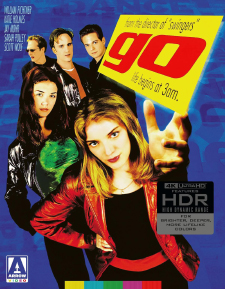
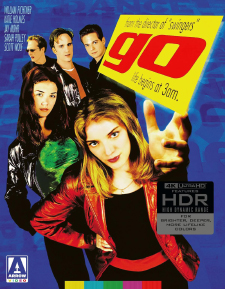
Arrow’s Limited Edition 4K Ultra HD release of Go is UHD only—there’s no Blu-ray included in the package. The insert is reversible, featuring the home video version of the theatrical poster artwork on one side and new artwork by Ben Beach on the other. It also includes a slipcover with the original video artwork and a 40-page booklet featuring essays by David Michael Brown and Michelle Kisner, plus the film’s original production notes and bios of the cast & crew. The following extras are included:
- Audio Commentaries:
- Bryan Reesman & Max Evry
- Doug Liman & Stephen Mirrione
- From the Word Go (HD – 21:54)
- A View Askew (HD – 20:41)
- Making of Featurette (Upscaled SD – 6:22)
- Deleted Scenes:
- Simon and Ronna Outside (Upscaled SD – 1:36)
- Ronna and the Beer (Upscaled – SD:47)
- Mannie on Drugs (Upscaled SD – 2:18)
- Gaines Pulls a Gun on Claire (Upscaled SD – 1:59)
- Singh and Tiny Ad Lib (Upscaled SD – 3:05)
- Simon and a Gun (Upscaled SD – :39)
- Porno and Kid (Upscaled SD – 1:46)
- Vic and Dinosaurs (Upscaled SD – 2:17)
- Elevator (Upscaled SD – 1:15)
- Burke and Girlfriends (Upscaled SD – 1:04)
- Sandra (Upscaled SD – 1:25)
- Gun Play (Upscaled SD – 5:26)
- Hunt for Keys (Upscaled SD – 1:49)
- Simon Gets Punched (Upscaled SD – :51)
- god (HD – 11:23)
- Theatrical Trailer (HD – 2:27)
- Image Gallery (HD – 2:21, 27 in all)
Arrow has added three new extras for this release, starting with a commentary by entertainment journalists Bryan Reesman and Max Evry. The start by exploring John August’s inspirations for the story and LA culture as presented in Liman’s films—actually, the latter becomes kind of a running theme in the track, where they spend much of the time talking about other films, sometimes comparing them structurally to Go, and other times just free associating about them. As a result, their commentary is a bit meandering, but they do discuss some specific details about Go like the casting, the score, and the convoluted process of getting the film made in the first place.
The rest of the new extras consist of interviews. From the Word Go is with John August, who describes Go as being the kind of film that he wanted to see as a viewer, suggesting that you should always write what you want to see. He also relates how he created the interlocking storylines and how he ended up signing on as co-producer and second unit director as well as the writer. He says that the experience was his film school, which resulted in him making his short film God using short ends from Go. A View Askew is with Desmond Askew, who explains how he got into acting by starting with modeling and music videos. He also explains how he got involved with Go and his appreciation for Liman’s guerilla style of filmmaking. The character of Simon was similar to him in many ways, so the role came naturally (although he did end up having to learn how to drive a car for the chase scene).
With one exception, the rest of the extras were originally produced for the Go DVD in 2000. There’s a commentary by Doug Liman and editor Stephen Mirrione, which is much more detail-oriented and practical than the new Reesman/Evry commentary. They explain how it was an independent, anti-studio film that inadvertently ended up becoming a studio film after all (which is why Mirrione cheekily cut into the Columbia/Tri-Star logo at the beginning). That also helped getting the feeling of doing ecstasy right from the opening moments, and they went with that feel for the entirety of Go. They played with the structure of the film during the editorial process, doing reshoots to help tie things together and dropping moments that they loved in order to keep the forward momentum moving. (Despite the reshoots, they kept the out-of-focus shot of Polley in the car because she never matched the same quality of performance.) They do describe their approach to Go as always being deliberately one step ahead of the viewer, which kept everything feeling off-kilter.
The Making of Featurette looks like the original theatrical EPK, offering cursory on-set interviews with Liman, August, Polley, Askew, Katie Holmes, Timothy Olyphant, Taye Diggs, James Duval, Breckin Meyer, Scott Wolf, Jay Mohr, and William Fichtner, plus some limited behind-the-scenes footage as well. There’s also a collection of Deleted Scenes that offer some of those darlings that Liman and Mirroine had to kill in the final cut.
The odd man out in the extras is god, August’s short film made from short ends (and starring an equally short Melissa McCarthy). It can be played with or without an optional commentary by August, McCarthy, and editor Douglas Cruise. god was originally included as an extra on the DVD for August’s 2007 film The Nines, but it’s presented here in full HD for the first time.
The only significant thing that’s missing here from the previous DVD and Blu-ray releases of Go are the music videos for New, Magic Carpet Ride, and Steal My Sunshine. Otherwise, it’s all the important archival extras plus a decent slate of new ones, and to say that this new 4K presentation is an upgrade over the aging Blu-ray master is a massive understatement—it’s a night-and-day difference. Go has been a favorite of mine ever since I saw it back in 1999, so needless to say I’m thrilled with Arrow’s new 4K Ultra HD set, and it’s highly recommended.
- Stephen Bjork
(You can follow Stephen on social media at these links: Twitter, Facebook, BlueSky, and Letterboxd).