
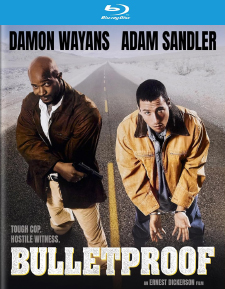
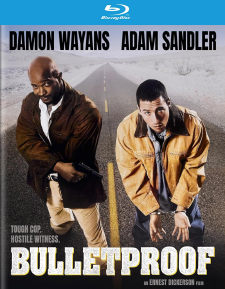
Bulletproof (Blu-ray Review)
Director
Ernest DickersonRelease Date(s)
1996 (September 22, 2026)Studio(s)
Universal Pictures (Kino Lorber Studio Classics)- Film/Program Grade: B
- Video Grade: A
- Audio Grade: A
- Extras Grade: B

Review
The 1990s was a good decade for Adam Sandler and Damon Wayans. Sandler scored hits with Billy Madison and Happy Gilmore, as did Wayans with Major Payne and The Last Boy Scout. In a Hollywood tradition that went back decades, producers felt casting the two stars together would result in box office gold. The resulting film, Bulletproof, drew upon buddy and road movies for its story about a good cop and a likable crook.
Moses (Sandler) and Keats (Wayans) are friends who hijack cars together. Moses persuades Keats to join him in working for major drug lord Frank Colton (James Caan). We don’t find out until about fifteen minutes into the film that Keats is actually an undercover cop using Moses to get to the real target, Colton. Moses confronts Keats when he leads the bust on Colton and his henchmen. Moses accuses Keats of betrayal as bullets fly between the criminals and the cops, and Moses accidentally shoots him in the melee.
After Keats completes a long recovery, Moses is arrested. As a makeshift bookkeeper for Colton with knowledge of all his criminal connections he agrees to testify against him in exchange for favorable treatment. It’s now Keats’ job to risk his own life transporting Moses safely to federal court as Colton sends his henchmen out to silence Moses for good. If Keats is in their way, he will be collateral damage.
The film’s strength is the chemistry between Sandler and Wayans. Sandler bounces one-liners off Wayans, the nominal straight man, who has plenty of witty responses up his sleeve. Sandler steps up his acting game from the childlike persona he’d been known for to the more challenging role of Moses. When Moses learns that Keats is really a cop, he’s incensed that the man he regarded as his best friend and confidante has been using him in an undercover sting. Keats repeatedly tells him, “I was only doing my job,” and he’s all business as he pulls a gun on Moses and tells him he’s under arrest. Sandler’s look of shock when he discovers Keats is a cop seems genuine. His realization is reflected in a look of wide-eyed disbelief and an expression that communicates the schoolboy protest, “It’s not fair.”
Wayans has the more subdued role. Quietly observant, he’s laid-back and low key unless his pal gets into trouble. His performance remains on the same level throughout. As the straight man, he has the job of acting seriously in order to get laughs... think of Bud Abbott of Abbott & Costello. The more frustrated or confused Costello became, Abbott was always the voice of sanity. Wayans is restrained from overplaying by director Ernest Dickerson (Juice, Tales from the Crypt Presents: Demon Knight), who allows Sandler and the chemistry between the two men to generate most of the laughs.
Bulletproof plays off the template of films like 48 Hours, Bad Boys, and Rush Hour. Even when we know Keats is a cop, a different sort of buddy film emerges. There’s a love-hate relationship between the two men. When many cops are assigned to the sting operation and there will likely be gunplay, Keats asks his superior to make sure Moses isn’t hurt. He will make the arrest. He’s grown to like Moses, yet he must divorce his personal feelings from his professional responsibility. As far as Moses is concerned, he can’t believe Keats blindsided him so completely. During a brush with would-be assassins on the way to the courthouse, they bicker, make excuses, and exchange insults, all while being forced to protect each other.
Director Ernest Dickerson creates some exciting action sequences which help to keep the pace brisk. A big shoot out, a car chase, and motorcycle stunts add production value. But Bulletproof never completely satisfies. Sandler is hard to accept as a career criminal involved in stolen cars and drug dealing. The script is also not as sharp as it could have been. Some jokes land, but others fall flat, and some of the dialogue might make you cringe because of the targets of certain gags. Wayans does a good job, while James Caan is great as the villainous Colton. With touches of his Sonny Corleone character, he’s convincing as a drug kingpin who doesn’t think twice about snuffing out anyone who threatens his business. It’s just a shame that he doesn’t have more screen time.
A highlight of the film involves nerdy motel manager Charles (Mark Roberts). In granny spectacles and a furry hat with earflaps, he steals his scenes from the leads with blank stares and monosyllabic answers to questions. When he later jumps into action, it becomes one of the picture’s best comic set pieces.
At a modest 84 minutes, Bulletproof blends a police procedural with comedy in a buddy flick format. That’s a lot to juggle and though Ernest Dickerson puts in a good effort, the film comes off more as a big-budget B picture. This was a transitional film in Adam Sandler’s career. He’s neither the goofy guy from SNL nor the polished actor of Uncut Gems or Jay Kelly. There are hints in his performance of an actor of depth, but his biggest successes would lie ahead. Bulletproof is an example of many fine elements that somehow never gel into a great movie.
Bulletproof was shot by director of photography Steven Bernstein on 35mm film in the Super 35 process with Panavision cameras and lenses, processed by DeLuxe, Hollywood, and presented in the aspect ratio of 2.35:1. The Blu-ray master is taken from a 4K scan of the original camera negative. The film looks great in this new restoration. Contrast is strong, images are sharp, and the color palette is broad. The red sports car Moses and Keats steal really pops. Details, such as decor in Colton’s palatial home, objects in the police station, a wound on Keats’ head, and elaborate machinery in a warehouse are well delineated. A nighttime chase sequence keeps backgrounds in focus and a suspenseful scene near a cabin in the woods is lit with deep shadows.
There are two soundtrack options: English 2.0 and 5.1 DTS-HD Master Audio, with optional subtitles in English SDH. Dialogue is clear and distinct and dominates ambient background noise and hip-hop music. The soundtracks are strong during action scenes with lots of gunfire, screeching vehicles, and a nose-diving airplane. The score is by veteran composer Elmer Bernstein (Ghostbusters). Songs heard on the soundtrack include Champagne (Salt-N-Pepa), I Wanna Know Your Name (Tasha Holiday), Until the Day (Nonchalant), Where You Are (Rahsaan Patterson), How Could You (K-Ci & JoJo), and others. In one of the funniest moments Sandler’s Moses, in the shower, belts out I Will Always Love You in a key that’s at least two octaves too high.
Bonus materials on the Blu-ray release from Kino Lorber Studio Classics include the following:
- Audio Commentary by Ernest Dickerson, Bryan Reesman, and Max Evry
- Audio Commentary by Mike Leeder
- A Character That Helps to Tell the Story (HD – 18:51)
- Deleted Scenes (Upscaled SD and HD – 2 in all – 7:36)
- Trailers:
- Bulletproof (HD – 2:19)
- Happy Gilmore (HD – 2:23)
- Billy Madison (HD – 2:00)
- Half Baked (SD – 1:54)
- Major Payne (HD – 2:05)
Audio Commentary #1 – Director Ernest Dickerson and entertainment journalists/authors Bryan Reesman and Max Evry share this commentary. Dickerson was a cinematographer and director of feature films and television. He was offered Bulletproof, a film intended to elevate Adam Sandler from starring in dumb comedies to dramatic thrillers. Patterned after 48 Hours, the budget was $18 million. Dickerson met with Sandler and Wayans to discuss his approach. He brought in top cinematographer Steven Bernstein. Together, they “put the film on its feet.” It was shot over a two-month period and released four months after filming was completed. Sandler and Wayans established a “really great rapport.” James Caan, who had played many movie heavies, told great stories about show business. The Malibu house standing in for Colton’s home was used in other movies and TV shows. There was occasional improvisation. Dickerson encouraged this so that actors could immerse themselves in their roles and add some of their own personality. Locations gave Dickerson additional ideas for an action sequence. The scene of Moses and Keats with bodyguards walking to the plane was storyboarded, so that every angle was planned and filming could progress quickly.
Audio Commentary #2 – Action film historian Mike Leeder says that Adam Sandler had been on Saturday Night Live and done the feature Happy Gilmore. Wayans was in the cast of TV’s In Living Color and starred in the feature Major Payne. Leeder speaks about earlier films that relied on the buddy formula in which there’s a clash that eventually leads to bonding. The Defiant Ones and Rush Hour are examples. Bulletproof was disappointing at the box office, earning only $22.5 million worldwide. Critics weren’t kind to the film, though Leeder refers to it as a “cool action movie.” The interplay between Wayans and Sandler works. The film presented an Adam Sandler never seen before in a more serious action/comedy. A sequel, Bulletproof 2, was a direct-to-video 2020 release that did not feature the original stars. Apart from several personal observations, Leeder doesn’t provide much background information on the making of the film, production details, or casting.
A Character That Helps to Tell the Story – In this interview, actor Xander Berkeley, who plays one of Colton’s henchmen in Bulletproof, talks about the value of character actors to help tell a story. He speaks about his childhood influences. As an adult working in theater he would create a look for each role. Make-up and costumes complete a character role. Film cultivates nuances rather than relying on broad strokes as in the theater. Berkeley was reticent about pursuing fame. Being a character actor allows him a degree of anonymity and privacy that he values. For auditions, he would rely on his acting “bag of tricks” to make an impression. Often, a producer will see in an actor only the roles he’s played. He took the role in Bulletproof because he’d heard good things about director Ernest Dickerson. Multiple takes give the director and editor many choices of how the final scene will look. Berkeley speculates as to why Bulletproof never clicked with the public.
Deleted Scenes – Two deleted scenes provided by director Ernest Dickerson from a VHS workprint are shown: Alternate Opening and Back From the Dead.
The only item not carried over is a set of production notes from the original DVD release in 1998.
Not being a fan of Adam Sandler’s earlier movies, I was pleasantly surprised by his performance in Bulletproof. He’s reigned in from his childlike persona. We may have trouble accepting him as a car thief and heroin dealer, but he avoids burlesquing the character and displays some serious acting chops. Buddy films tend to please audiences as long as there’s a fast pace, charismatic actors, good characters, and plenty of action. Bulletproof has all four.
- Dennis Seuling