
Throw Momma from the Train (Blu-ray Review)
Director
Danny DeVitoRelease Date(s)
1987 (April 28, 2026)Studio(s)
Orion Pictures (Kino Lorber Studio Classics)- Film/Program Grade: B+
- Video Grade: A
- Audio Grade: A
- Extras Grade: A

Review
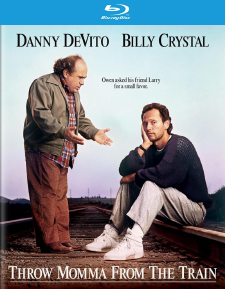
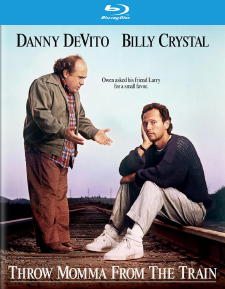
Throw Momma from the Train, starring Danny DeVito and Billy Crystal, is a film inspired by another. Thirty-six years after a Hitchcock film told the story of two men who conspire in a dastardly murder scheme, the plot was reworked into a broad comedy.
Would-be writer Owen Lift (DeVito) and his creative writing professor Larry Donner (Crystal), who’s afflicted with writer’s block, become a pair of unlikely confederates. Owen wants desperately to become a good writer but his stories fall flat. He bothers Larry endlessly in wildly inappropriate ways, until Larry finally tells him his stories lack a key ingredient of drama—motivation. He suggests that Owen check out Hitchcock’s films for a masterful guide in character motivation. Owen happens on a showing of Strangers on a Train, in which the notion of exchanging murders forms the plot.
A light bulb goes on. He knows Larry is bitter about his former wife Margaret (Kate Mulgrew) stealing and publishing his work as her own his recent book. Owen has the mother from hell (Anne Ramsey), a demanding, obnoxious harridan who’s dependent on him but treats him like a child. So Owen suggests to Larry that they exchange murders. Owen will kill Larry’s former wife and Larry will kill Owen’s mother, and because neither of them has a motive, they both will avoid detection.
Danny DeVito, who also directed the film, treats Throw Momma from the Train as a thriller comedy. Will the scheme go forward? Does Larry fully embrace the plan or does he shrug it off as the half-baked notion of a disgruntled son? DeVito builds suspense and keeps us guessing. Meanwhile, he provides snapshots of Larry in the throes of writer’s block and Owen’s home life with his dreadful mother, who addresses him in full-volume, demeaning diatribes often accompanied by a roundhouse slap. Owen endures the abuse, torn between hatred and duty to his aged mother.
DeVito and Crystal make an interesting odd couple. Both are life’s losers in a sense. The plan that Larry thinks is outrageous initially becomes more attractive to Larry as time goes on and Margaret receives accolades and rich royalties for the book he wrote. She’s even interviewed on TV by Oprah Winfrey. Owen, with each whack on the head, each demand for a cold drink, and each routine insult sees no other choice than to eliminate his awful mother once and for all.
DeVito never overplays. His Owen reacts to his mother’s harangues as just another day at home. He never shows outright anger, just annoyance, so we see the character’s anger is internalized and growing. But is his suggestion that he and Larry exchange murders à la Hitchcock serious? Does this timid little guy have the nerve to kill another human being?
Billy Crystal’s Larry is scripted as a rather bland individual stricken with self-pity and depression because he can’t get credit for his own book and he can’t function as writer. The irony is that he teaches a skill that has flummoxed him. Crystal underplays in many scenes where more zing is needed. We know from other films that he’s adept at repartee and delivering one-liners but, by comparison, he’s more subdued and sappy here.
With its hefty helping of dark humor, the film is engaging. The scenes with Anne Ramsey are especially funny in the exaggerated way her character treats Owen and Ramsey’s total commitment to the role. With a monstrous glare, a hulking body that towers over Owen, and the facility to toss out one-liners that squash any ego Owen has left, she’s the ingredient that makes the film sparkle. Though she doesn’t receive top billing, she’s the best thing in the film, and was deservedly nominated for a Best Supporting Actress Academy Award.
Throw Momma from the Train is in the tradition of screwball comedy. It’s intentionally silly, and the idea of a double murder is simply a plot device to build jokes on. There are scenes that seem far fetched, such as Larry’s willingness—even reluctance—to spend so much out-of-class time talking to Owen about his writing. The time Larry spends on vacillation about going through with the plan or taking the higher moral ground slows the pace, since we know which way the story’s heading. The film resorts to slapstick near the end, becoming a kind of Keystone Cops diversion aboard a speeding train. A few key excerpts from Hitchcock’s Strangers on a Train are shown as Owen watches it in a movie theater so the audience can see how the plot inspires him.
Throw Momma from the Train was shot by director of photography Barry Sonnenfeld on 35mm film with Panaflex cameras with spherical lenses. The scenes from Strangers on a Train are shown in the original black & white. Finished photochemically, the film is presented in the aspect ratio of 1.85:1. The Blu-ray from Kino Lorber Studio Classics features a brand new HD master from a 4K scan of the original camera negative, which has been approved by director Danny DeVito. Cinematographer Barry Sonnenfeld became famous for his distinctive visual style when working with the Coen brothers. His wide angle compositions stretch perspectives and emphasize the dark nature of the characters. The film avoids overly bright hues in favor of muted tones. It purposely steers clear of the overly bright, glossy look of many film comedies but never enters the realm of film noir with exaggerated shadows and gloomy lighting effects.
There are two soundtrack options, English 5.1 and 2.0 DTS-HD Master Audio. English SDH subtitles are an option. Dialogue is clear and distinct. Anne Ramsey hilariously roars Momma’s awful insults at Owen. Sounds of the speeding train enhance suspense when it looks as if Momma will fall off. A good deal of physical comedy is accompanied by sounds of a struggle and an occasional scream on the train. David Newman’s score is reminiscent of the work of Hitchcock’s frequent composer, Bernard Herrmann. His string arrangements suggest psychological instability, uncertainty, and inner turmoil. A specific motif accompanies Larry and Owen’s fantasies about murdering the women making their lives miserable.
Bonus materials on the Blu-ray release from Kino Lorber Studio Classics include the following:
- Audio Commentary by Joe Ramoni
- Wide Angle Dark Humor (HD – 23:31)
- Crafting a Dark Comedy Classic (SD – 17:11)
- Why Do You Hate Your Mother? (SD – 9:36)
- The Night Was... (SD – 3:56)
- Deleted Scenes (SD – 4 in all – 2:06)
- Theatrical Trailers:
- Throw Momma from the Train (HD – 1:27)
- Running Scared (SD – 1:30)
- Man on the Moon (HD – 2:35)
- Fletch (HD – 1:35)
- Dead Men Don’t Wear Plaid (HD – 2:01)
Audio Commentary – Commentator and film historian Joe Ramoni says that Orion made a number of inventive movies in the 1980s and prioritized the visions of their creators at a time when studio meddling was becoming more common. Throw Momma from the Train was Danny DeVito’s first feature film as director. He had directed episodes of Taxi, installments of TV anthologies, and made-for-TV movies, and was looking for a film that could be shot in and around Southern California so he could go home to his young daughters after a day of filming. Billy Crystal sent him the script, asking him to play the part of Owen. DeVito agreed if he could also direct. Cinematographer Barry Sonnenfeld gives the film an interesting look, using the widescreen to his advantage. DeVito saw his work in Blood Simple and offered him the job on Throw Momma from the Train. DeVito prioritized the film’s visual style. Scenes between Owen and his mother have a surreal quality. There’s a shared DNA between Throw Momma from the Train and its influences and inspirations. Sonnenfeld likes the comedy to play out in lengthy shots, without cutaways to reaction shots. He feels it’s like giving the audience permission to laugh, and prefers to let laughs emerge organically. We learn late in the film how Owen’s personality was formed by abandonment issues. He becomes an adult when he enters his adventure with Larry. The train sequence was shot on a train moving at only 15 mph for safety reasons and was speeded up in editing. Today, the train scene would be shot with green screen. In addition to the Hitchcock film Strangers on a Train, reference is made to the popular Patti Page song Mama from the Train (A Kiss, A Kiss).
Wide Angle Dark Humor – Director of photography Barry Sonnenfeld explains that the intention of the filmmakers was to make a “really funny movie about a guy and his mother,” not a ripoff of Hitchcock’s Strangers on a Train. Sonnenfeld started as a still photographer and was accepted to NYU’s film school. He bought a used 16mm camera and shot industrial films and documentaries. He loves using the wide angle lens. He eventually gained a reputation for the look of his movies and later accepted the job of cinematographer on Throw Momma from the Train when Big, which he had signed onto, was postponed to wait for Tom Hanks’ availability. DeVito and Sonnenfeld hit it off at once and spent a long time in pre-production. Sonnenfeld believes that the more a film is pre-designed, the freer one is to adapt and make changes on set. Having a plan is essential. The shooting schedule was 50 days but Sonnenfeld felt that, due to the nature of some of the shots, the film would need a 60-day shoot. DeVito used his clout to get Orion to agree to the extra ten days. Sonnenfeld hates steadicam because the steadicam operator tends to direct the shot. He prefers laying track for dolly shots and filming separate set-ups. A key scene that ordinarily would take time and cost a lot of money was shot on the stage using ingenuity. Anne Ramsey never tried to be funny which made her performance hilarious. In summing up, Sonnenfeld says that being a part of Throw Momma from the Train “was one of the greatest experiences of my life.”
Crafting a Dark Comedy Classic – Screenwriter Stu Silver says that while watching Strangers on a Train, he realized that the story could be pushed into comedy. Billy Crystal loved the idea. You have to play several levels when you play comedy. Shelley Winters and Bette Davis were considered for the role of Momma but Anne Ramsey was hired on the spot when she came to the audition in character. Off camera, she was completely sweet. She wanted to do as much of the rough and tumble part of the role herself. Black comedy is difficult to pull off. It necessitates striking the right tone and sustaining it for the duration of the picture.
Why Do You Hate Your Mother? – Therapists and psychologists discuss how some people have love/hate relationships with their mother. Owen is emotionally and intellectually challenged. He hasn’t grown up past a certain point and he has little ability to understand social cues.
The Night Was... – Writer Stu Silver talks about Larry’s efforts to find the perfect word, noting that this is a common problem for writers. Various people—young and old, male and female—finish the line and read excerpts of stories they’ve written that emerged from that first line.
Deleted Scenes – 4 short deleted scenes are shown, presumably from the network TV version.
Not carried over from the 2018 Region B Blu-ray release by Koch Media is a stills gallery and the teaser trailer.
Throw Momma from the Train was Danny DeVito’s directorial debut. The film is a one-joke extended black comedy. We empathize with both Owen and Larry—Larry for having his hard work stolen by his former wife and Owen for having to put up with constant brow-beating and physical and emotional abuse by a nightmarish mother. Stu Silver’s script builds suspense as we wonder whether a plot can become a reality and serve as means to murder without consequences. The early part of the film clearly establishes each man’s individual anguish. Anne Ramsey steals every scene she’s in. She’s letter perfect as Momma. It’s worth a viewing, if only to behold her unforgettable performance.
- Dennis Seuling