
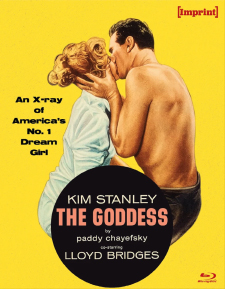
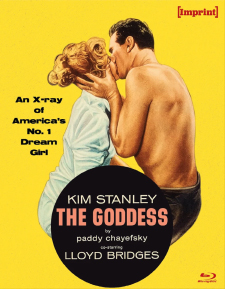
Goddess, The (1958) (Blu-ray Review)
Director
John CromwellRelease Date(s)
1958 (August 26, 2026)Studio(s)
Carnegie Productions/Columbia Pictures (Imprint Films/Via Vision Entertainment)- Film/Program Grade: B-
- Video Grade: A
- Audio Grade: A
- Extras Grade: D-

Review
[Editor’s Note: This is a Region-Free Australian Blu-ray import.]
The Goddess was writer Paddy Chayefsky’s first original screen drama. He had already won an Oscar for his adapted screenplay for Marty (1955) and would go on to win writing Oscars for The Hospital (1971) and Network (1976). The Goddess is a cynical tale about loneliness, the fragility of fame and its effect on those who achieve it. The film resonates with audiences because of its similarities to the real lives of stars, one in particular.
The Goddess begins in 1930 in a small Southern town where young Emily Ann Faulkner (Patty Duke) overhears her mother Laureen (Betty Lou Holland) telling her brother and sister-in-law that she wants to go away and leave the child with them. Instead, for reasons never stated, she stays, works in a shop in town, but pushes Emily away. As a teenager (now played by Kim Stanley), Emily has blossomed into an attractive young woman and uses her sexuality to interest boys. Eager to escape her cold family and snobbish small town, she rushes into a marriage with John Tower (Steven Hill), an alcoholic soldier and son of a famous actor. With restlessness and the conviction that she can make it as an actress in the movies, Emily abandons John and their infant daughter to pursue a career in Hollywood.
Emily struggles to succeed, taking menial jobs, posing for cheesecake photos, and sleeping with studio executives to advance her career. A second marriage, to former boxing champion Dutch Seymour (Lloyd Bridges), follows. Emily transforms into a hugely successful movie star, changing her name to Rita Shawn. But the adoration of millions can’t resolve her deep-rooted childhood trauma.
Life at the top isn’t what she expected. Rita is rich and famous but psychologically a mess. Her mother re-enters her life and Rita hires a stern secretary and companion, Miss Harding (Elizabeth Wilson), to shield her from outsiders.
Director John Cromwell has crafted an overwrought melodrama that never allows the viewer to breathe. It’s constantly at a fever pitch from Laureen’s rant to her brother and his wife to teenage Emily babbling on and on about what an impact she will make in Hollywood, adult Emily’s confrontations with her husbands, and a nervous breakdown. With long speeches filled with exposition that should have been replaced with visuals, Chayefsky’s script is theatrical rather than cinematic, On-screen titles even break down the film into three numbered parts, like acts in a play. We’re told that Emily/Rita has achieved great fame, but we never see how. There are no scenes of her performing, receiving awards, signing autographs, or attending gala premieres—activities usually associated with top stars.
Kim Stanley never convinces as high-school aged Emily. She was 32 at the time and looks it. A scene in a car with an actor who actually looks as if he’s 16 or 17 gives the scene a sense of bizarre imbalance. Maybe on stage with costuming and proper lighting, the illusion might have come off, but the movie camera is unforgiving.
Stanley is directed to play to the rafters. We seldom see her in a quiet, thoughtful scene. The lack of balance, with every scene at the same emotional level, diminishes the impact of them all. There are missed opportunities to show Emily/Rita at her peak, perhaps as a montage to keep the narrative brisk. Director Cromwell fails to take advantage of it.
When we should empathize with Emily, she grates on us with her pie-in-the-sky predictions of fame, the way she treats her husbands, and especially her rejection of her own daughter. Emily has had a rough childhood and her self-pity and inability to enjoy the fame she’s longed for reflect the self-loathing that maternal rejection and lovelessness have engendered in her.
Part of the problem with Chayefsky’s script is that the events occur so rapidly, we don’t have time to digest and react to them. The script covers an event-filled 27 years in glimpses rather than fully developed scenes. Think of the film as a series of snapshots rather than a complete photo album.
Betty Lou Holland is excellent in her first scene when Laureen pours her heart out to her brother and sister-in-law about how she hates motherhood. She’s a young attractive widow and wants to be free for adventures, partying and eventually marrying a prosperous man. With a youthful face and slender figure, Holland looks even younger than her character’s 26 years and could have looked far more convincing than Kim Stanley as a girl of 16. Later, when her character is supposed to have aged, Holland’s youthful face fails to convince that Laureen is much older despite the gray wig, frumpy dress and oxford shoes.
The men in the cast—Steven Hill and Lloyd Bridges—have little to do other than serve as place markers in Emily’s life. Scenes between Hill and Stanley and Bridges and Stanley are melodramatic and geared to highlight Emily’s unhappiness, restlessness, and feeling that she’s destined for a more fulfilling life.
The Goddess has elements that suggest the life and career of Marilyn Monroe. Both Emily and Monroe were neglected by unstable single mothers, both married a famous former athlete, both transformed from brunette into a blonde sex symbol, both had similar hairdos, and both suffered from substance abuse and mental breakdowns. These similarities have attracted viewers to the film for decades even though it’s a talky, scattershot overview of a troubled individual. Stanley, Chayefsky, and director Cromwell fail to elicit the intended compassion for the character because we see her only in isolated moments of her life. These moments would have been more revealing had we seen evidence of what led up to them. Instead, he hear an occasional few words about her indiscretions and her screen chemistry. Transitions are abrupt, and there’s often a sense of having missed key information.
The Goddess was shot by director of photography Arthur J. Ornitz on black & white 35mm film with spherical lenses, finished photochemically, and presented in the aspect ratio of 1.85:1. The Blu-ray has an aspect ratio of 1.78:1. Ornitz’s cinematography contributes to the film’s dark tone with a number of film noir-type compositions. Heavy shadows are used to illustrate Emily’s descent into a life of isolation, pills, and depression. Close-ups are frequent, and sharp, stark focus captures Emily’s most vulnerable moments. The widescreen image isolates young Emily, sitting alone in her aunt’s sparse kitchen with glass of milk and a cookie, and movie star Rita drinking alone in a luxurious mansion.
The soundtrack is English 2.0 mono LPCM. English SDH subtitles are an option. In this dialogue-heavy picture, all actors speak clearly and distinctly. Kim Stanley, playing teenaged Emily, is filled with enthusiasm about escaping her impoverished life. Later, as rich and famous movie star, she speaks with, a needy, sad quality. Virgil Thomson’s score provides a melancholy accompaniment to dramatic events in Emily’s life. Thomson composed the music that’s heard when characters turn on the radio, reflecting pop and jazz music of the different periods.
The only bonus material on the Region-Free Blu-ray release from Imprint Films includes the following:
- Theatrical Trailer (1:38)
The Goddess is an interesting entry in the oeuvre of Paddy Chayefsky. The writer brings his television experience to the script. Most scenes are on interior sets, there are few location scenes, close-ups are abundant, and there’s excessive exposition. There are moments when similarities between Chayefsky’s Emily and Marilyn Monroe are either on the mark or eerily prescient. Kim Stanley isn’t adequately reined in by director John Cromwell to provide a more nuanced portrayal of the girl from the wrong side of the tracks who makes it big in Hollywood.
- Dennis Seuling