
Red Sun (4K UHD Review)
Director
Terence YoungRelease Date(s)
1971 (July 14, 2026)Studio(s)
Les Films Corona/Oceania Films Rome/Producciones Balcázar S.A./Lightning International (Arrow Video)- Film/Program Grade: B+
- Video Grade: A
- Audio Grade: B+
- Extras Grade: B+

Review
[Editor’s Note: Stuart Gailbraith IV covers the film portion of this review while Tim Salmons delves into the video and audio quality, as well as the bonus materials.]
Almost irresistible, Red Sun (Soleil rouge, 1971) is a darkly comic Euro-Western teaming American Charles Bronson, the great Japanese actor Toshirō Mifune, French star Alain Delon, Swiss bombshell Ursula Andress, and French fashion model/actress Capucine in a film directed by Englishman Terence Young, best remembered for helming three of the first four James Bond movies.
Though Bronson was familiar to audiences for his supporting roles in movies like The Magnificent Seven, The Great Escape, and The Dirty Dozen, in 1971, in the U.S. Bronson was not yet a star. He was, however, a HUGE star throughout Europe and Japan. His first big success was Adieu l’ami (Farewell, Friend, 1968), an excellent heist thriller co-starring Alain Delon. More Euro-hits followed, including Once Upon a Time in the West (1968), Rider in the Rain, Violent City, Cold Sweat (1970), and Someone Behind the Door (1971), among others. Sergio Leone’s Once Upon a Time... was unpardonably cut and did disappointing business in the U.S., while the other films generally played downtown grindhouse theaters and drive-ins, Bronson steadily building a growing cult following in the U.S., but these movies otherwise did little to establish him as a mainstream American star until Death Wish (1974) changed all that.
Throughout Europe and Japan, though, Bronson was as big a name as Clint Eastwood or John Wayne, as was Alain Delon, while Toshirō Mifune was internationally famous for his films with Akira Kurosawa (Seven Samurai, Yojimbo, etc.), the Japanese actor having mixed results developing his own projects outside that country’s market.
When I wrote my joint biography of Kurosawa and Mifune, The Emperor and the Wolf, a quarter-century ago, I had mixed feelings about Red Sun. I didn’t care much for the way Mifune was used as a kind of comedy relief, and at that time, all home video versions of the film had mediocre video transfers. Arrow Video’s new 4K is a big improvement, making clearer the nuances of Bronson’s and Mifune’s performances, and the landscapes look better, among other things. Through this release, I like the film a lot more than I did then.
In 1870, bandits Link Stuart (Bronson), Gauche (Delon) and their men stage a daring train robbery, stealing a shipment of $400,000 in gold coins. Coincidentally on the train is a Japanese ambassador (Tetsu Nakamura, of The Manster, Mothra, and innumerable other Japanese productions) and his two samurai bodyguards. Bemused by their kimono and top-knots, Gauche decides to also steal the gold-handled Japanese sword intended as a gift for the U.S. President. Gauche also double-crosses Link, dynamiting a train car and leaving him for dead.
The surviving samurai bodyguard, Kuroda (Mifune) and Link, despite being at odds with one another (and culturally virtually opposites), are determined to track Gauche down. Kuroda, given one week to retrieve the priceless sword or be forced to commit seppuku, wants to kill Gauche upon finding him, while Link insists he needs time to get Gauche to tell him where he’s hidden the stolen money.
“My God, what a presence. If he could act in English, he’d conquer the world.” – Charlton Heston on Mifune
After forming his own production company nearly a decade before, Mifune reportedly approached Paramount Pictures as early as 1965 with the idea of him starring as a samurai in an American Western, but it’s more likely producer Ted Richmond came to Mifune, with a 15-page outline the following year. Richmond, a producer working in every conceivable genre and studio, recently produced Return of the Seven for MGM, and soon after made Villa Rides!, written by Sam Peckinpah and Robert Towne, and which featured Bronson. There was little interest, however, in a samurai Western—Paramount didn’t want it, and neither did Warner Bros.-Seven Arts, but an agreement was finally reached with French producer Robert Dorfmann and his Corona Films. (Italian and Spanish production entities also joined in.) Mifune, with director approval, met with Terence Young, Elia Kazan, and Peckinpah; reportedly only Young greeted Mifune warmly, so Mifune chose him. The fact that Young spoke English, French, Italian, and Spanish no doubt helped.
Mifune had mixed success both producing Japanese movies intended also for international consumption, and with his own appearances in English-language films. After finally settling on Grand Prix (1966) for his English-speaking debut, at the last-minute director John Frankenheimer reluctantly replaced Mifune’s thickly-accent, probably phonetically-learned English dialogue with that of voice actor Paul Frees. In Red Sun, those seeing the English-language version got to hear Mifune’s own voice, but his performance is compromised some because he’s still acting phonetically. He never did learn English, really, and he continued to be dubbed (often by Frees) in many of his English-language productions.
Nevertheless, the interplay between Mifune and Bronson is mostly delightful, two of the toughest tough guys alternately impressed and bewildered by one another, each eventually grudgingly respectful of the other, despite their Grand Canyon gulf of cultural differences. Alain Delon is a bit less of a success playing a stock Western villain, devoid of any scruples or humanity. He does seem to be enjoying himself, however, and maintained not only a lifelong friendship with Mifune, but often visited Japan; he was a frequent guest on Japanese talk shows for decades.
Ursula Andress, her hair and makeup never remotely credible as a woman in the Old West but undeniably gorgeous, exhibits a lot of fighting spirit but not much more than that. Capucine, as a prostitute, makes little impression. British character actor Anthony Dawson, a favorite of director Young, plays one of Gauche’s henchmen. Composer Maurice Jarre wrote a dreadful score for 5 Card Stud, but his music for Red Sun is a significant improvement, and more in line with the strange ambiance of this exotic, international Western.
The overly-expensive $4.5 million production (in production for a whopping 36 weeks, partly due to bad weather) barely made a dent in the U.S. box-office, but predictably did very well in Europe and Japan, playing some European theaters well into the 1980s. Richmond himself tried to reunite Mifune with Kurosawa for another “Eastern-Western” titled The Longest Ride, but it came to nothing.
Cinematographer Henri Alekan shot Red Sun on 35mm film (Eastman) with spherical lenses. The results were finished photochemically and framed theatrically at the aspect ratio of 1.85:1. Arrow Video brings the film to Ultra HD for the first time in the U.S. with StudioCanal’s 2024 4K restoration from the original camera negative, featuring additional color grading by R3Store Studios. This master has also been graded for High Dynamic Range in HDR10 and Dolby Vision, and encoded by Chris Anderson of The Engine House Media Services to a triple-layered BD-100 disc. I don’t have the StudioCanal disc on hand, but based upon Arrow’s mention of some additional color grading, I’m going to assume the palette was not entirely to their liking; and what little review coverage there is for that title seems to note a blue/teal push. That’s definitely not the case here as the overall palette is very natural and appropriate to the Western setting. Grain can be heavy but it’s well-resolved and never appears chunky or overwrought. It appears that StudioCanal chose to use the original camera negative as much as possible, going so far as re-creating the opening and closing credits instead of using opticals, though the organic transitions taken from interpositive elements remain. Those transitions aren’t seamless, but they blend a little better than most. Bitrates sit between 80 and 100Mbps, often in the upper registers, while the HDR soaks up the vistas with gorgeous blues, greens, and reds, as well as the varying browns and grays of the rocky desert landscapes. Blacks are deep with perfect contrast and the image is stable and clean. It’s a beautiful presentation.
Audio is included in English mono LPCM with optional subtitles in English SDH. The StudioCanal release features a split-channel option, and this track is likely taken from the same source. This is a film that definitely could use a multi-channel boost to widen out atmospherics and Maurice Jarre’s score as it feels pretty cramped in mono. Dialogue can sometimes be a little shaky, but it’s always discernible. The track is otherwise clean without any other issues.
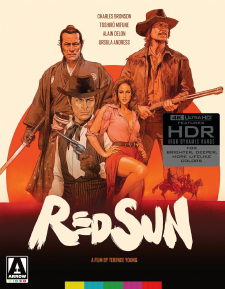
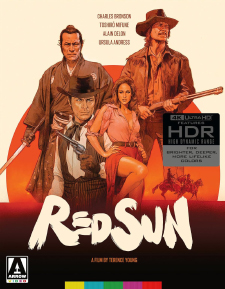
Arrow Video’s 4K Ultra HD release of Red Sun sits in a black Amaray case with a double-sided insert featuring the original theatrical artwork on one side and new artwork by Robert Sammelin on the reverse. Also included is a 36-page insert booklet containing cast and crew information, the essays Bronson: Red Hot in Red Sun by Paul Talbot and Ursula Andress by Moya Luckett, presentation information, productions credits, and special thanks. Everything is housed in one of Arrow’s standard slipcovers featuring the same new artwork. The following extras are included:
- Audio Commentary by C. Courtney Joyner and Henry Parke
- A Global Western: An Appreciation of Red Sun by Jose Arroyo (HD – 31:54)
- The Ghosts of the Samurai: A Red Sun Essay by Daisuke Miyao (HD – 31:12)
- The Man with the Gold Tooth: An Appreciation of Alain Delon and Red Sun by Mark Gallagher (HD – 14:56)
- Archival TV Promos:
- Pour le Cinéma (SD – 8:27)
- Un Journal du Cinéma (SD – 2:03)
- Theatrical Trailer (Upscaled SD – 3:32)
- Image Gallery (HD – 45 in all)
The audio commentary by writers and film critics C. Courtney Joyner and Henry Parke is an excellent and very active back and forth discussion about various aspects of the film and its cast and crew. Definitely worth a spin. In A Global Western, scholar Jose Arroyo is interviewed in the Arrow Video Store, expressing his appreciation for Red Sun while also delving into various details about it, examining the influence of world cinema on the film, and comparing it to other films that came before it. The Ghosts of the Samurai is an extended essay by author and Japanese film professor Daisuke Miyao who delves into the real life history of U.S. and Japanese relations and the film history of both in connection with each other, while also highlighting aspects of the samurai. In The Man with the Gold Tooth, film scholar Mark Gallagher examines Alain Delon and his performance in the film.
Next are a pair of archival French TV show excerpts about the film. Pour le Cinéma presents vintage behind-the scenes footage, as well as on-set interviews with Terence Young, Charles Bronson, Toshirō Mifune, Ursula Andress, and Alain Delon. Un Journal du Cinéma delves into the history of Japanese cinema with Henri Langlois, interviewing Terence Young and Toshirō Mifune, with an appearance by the late Keiko Kishi. Last is a full frame theatrical trailer and an Image Gallery containing 45 images of color and black-and-white promotional stills, posters, lobby cards, and other promotional items.
Not carried over from StudioCanal’s 2024 Blu-ray and 4K Ultra HD releases is Sunset: Steven Okazaki on Toshirō Mifune and the French theatrical trailer.
Arrow Video’s 4K upgrade of Red Sun definitely improves upon all previous releases of the film, one that’s been a favorite of many film fans for generations. The disc may be a little lacking in the audio and some of the bonus materials, but it’s a terrific release nonetheless. Highly recommended.
- Stuart Galbraith IV and Tim Salmons
(You can follow Tim on social media at these links: Twitter, Facebook, BlueSky, and Letterboxd. And be sure to subscribe to his YouTube channel here.)