
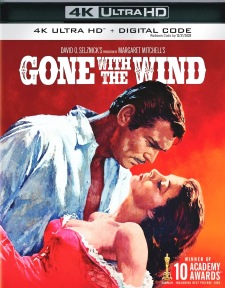
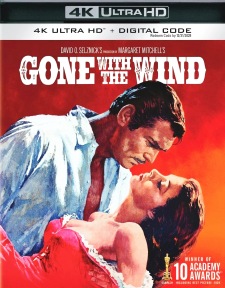
Gone with the Wind (4K UHD Review)
- Review Date: Oct 30, 2026
- Format: 4K Ultra HD
-


Director
Victor FlemingRelease Date(s)
1939 (November 3, 2026)Studio(s)
Selznick International Pictures/Metro-Goldwyn-Mayer (Warner Bros. Home Entertainment)- Film/Program Grade: A+
- Video Grade: A
- Audio Grade: A
- Extras Grade: A


Review
[Editor’s Note: The film commentary here is by the late Barrie Maxwell, adapted from his reviews of Warner’s original 2004 DVD and 2014 Blu-ray releases. The 4K Ultra HD disc comments are by Bill Hunt.]
For anyone at all interested in classic films, the mere mention of Gone with the Wind instantly evokes the era of classic Hollywood. For many, it is their favourite classic film, for others it’s the best classic film, and for some it’s neither, just a film they enjoy for its impressive level of craftsmanship and attention to detail. By virtue of the immense publicity that accompanied the film’s production and original release, not to mention subsequent successful releases and numerous books, articles, and documentaries on the making-of the movie, this is a film that’s remained high in our collective memory for 87 years. Is there any classic enthusiast who’s unaware of the extensive search for the right actress to play Scarlett; the negotiations that finally assured that Clark Gable (then under contract to MGM) would play Rhett Butler; the question of whether Gable would be able to utter the word “damn” in his final line of dialogue (a months-long negotiation with the Hays Office); the parade of directors that included Victor Fleming, George Cukor, Sam Wood, Cameron Menzies, and Reeves Eason; and the overriding presence and influence of producer David O. Selznick throughout the production process? These are some of the most often-cited activities that arose during the more than three-year process that led from Selznick’s offer for the screen rights in mid 1936 to the film’s premiere in Atlanta in late 1939.
At just two minutes under four hours in length, Gone with the Wind was and remains among the longest films ever released. Yet it doesn’t seem that long, for it’s blessed with a compelling narrative and a cast that never takes a wrong step (despite some people’s carping over Leslie Howard being too old to play Ashley Wilkes). The story is that of Scarlett O’Hara (Vivien Leigh), the daughter of the owner of a southern plantation named Tara, who must overcome her own immaturity and numerous hardships to rule Tara herself at the time of (and immediately after) the Civil War. Her principal suitor and later husband (number three actually) is the charismatic Rhett Butler (Gable), but it’s Ashley Wilkes with whom she’s really in love. The film is based on the 1,037-page novel of the same name by Margaret Mitchell that was such a phenomenon at the time, and it was readers’ great love for the story and its characters that posed the most difficulty for a successful translation to the screen. Everyone had their own image of the characters, and it was Selznick’s greatest success that he was able to satisfy people’s expectations with the casting. Vivien Leigh justly received the Academy Award as Best Actress for 1939 for her work as Scarlett, but too often overlooked is the contribution that Clark Gable made as Rhett. He was surprisingly beaten out for the Best Actor Oscar by Robert Donat (for his performance in Goodbye, Mr. Chips), and while Donat’s work was worthy, repeated viewings of Gable’s efforts stand the test of time and only reinforce Gable’s strong and vital work that provides in Rhett the necessary counterforce to Scarlett. Gable made it look easy and, as so often in such situations, got overlooked. No other actor of the time could have come close to him in that particular role.
Selznick poured immense resources into the film, from a massive cast (best embodied by the Atlanta railyard scene but also evident in the longest list of credited parts in any film up to that time) to the use of Technicolor (at one point employing all seven existing Technicolor cameras), the employment of numerous writers, and the marshaling of crew from his own studio as well as MGM. It all amounted to an expenditure in excess of $4 million, an immense total for the time and potentially a disastrous investment. But from the very first sneak preview, it was apparent that the film would be a hit, and the official gala previews in Atlanta and New York that resulted in glowing reviews confirmed it. The film was nominated for 13 Academy Awards, winning in eight categories (Picture, Actress [Vivien Leigh], Supporting Actress [Hattie McDaniel], Director [Victor Fleming], Screenplay, Art Direction, Colour Cinematography, and Film Editing). A special award went to production designer William Cameron Menzies for his work with colour on the film and a scientific/technical award went to mechanical effects supervisor Don Musgrave. Selznick was also recognized individually by being awarded the Irving Thalberg Award. To be so dominant in the year often considered to be the peak of the Hollywood Golden Age was a true testament to Gone with the Wind’s greatness.
Gone with the Wind was photographed by cinematographer Ernest Haller (Jezebel, Mildred Pierce, Rebel without a Cause) on 35mm photochemical film using the Mitchell Camera Corporation’s Three-Strip Technicolor Cameras with Bausch and Lomb Baltar spherical lenses. (Technicolor’s Ray Rennahan was also involved, and Lee Garmes worked on the film for a month before departing the production.) These cameras used a prism block and semi-transparent mirror to expose three separate film records, one each for green, blue, and red. It was released theatrically at the 1.37:1 Academy aspect ratio. For its release on Ultra HD, Warner MPI has scanned the original camera negatives in 16-bit 8K and utilized its own “Ultra Resolution” digital realignment process to sharpen the individual color records and to properly align the combined image (in a 4K workflow). Careful restoration and high dynamic range color grading have been completed, compatible with both Dolby Vision and HDR10, to create a new 4K Digital Intermediate. The film is presented on 4K UHD split over two 100GB discs to allow of the best possible data rates (averaging around 80Mbps).
The resulting image is, without question, the finest representation of Gone with the Wind on disc to date. This isn’t immediately obvious, as the opening credits, establishing matte/VFX shots, and early dissolves do exhibit the usual softness and generation loss of detail. A shot of Scarlett greeting her father beside a creek on Tara (at 10:04) is particularly rough, as is the approach of carriages to Twelve Oaks (at 17:55). Once you get past them (and the composite shot of Scarlett and her father at sunset) however, MPI’s efforts truly begin to shine (starting at about 12:44). The overall image for this film has always had a kind of velvety softness, but there’s surprising detail visible here—more than ever before in 4K. You see it not only in subtleties of delicate lacy fabrics, wallpaper, and costume jewelry, but the fine pattern of Rhett’s jackets. More visible here than ever are truly subtle nuances of skin texture and facial features. Photochemical grain is light-moderate, organic, and well managed. Given that this film is nearly ninety years old, it’s frankly stunning that it looks this good—especially when you consider how popular it is, which means the negatives have been handled often. The color accuracy, saturation, and broad palette is, frankly, astonishing, and the wider HDR gamut really benefits this. Shadows are truly deep, yet retain a remarkable amount of subtle detail. And the highlights here are truly luminous. To be clear, the image isn’t quite at the level of say Ryan’s Daughter or The Searchers on 4K Ultra HD, but again its a revelation for a film of this vintage… and sometimes it’s truly remarkable. A particular standout section is the “Monster Bazaar” scene that begins at about 38:00—detail abounds in every frame, yet there’s a romantic softness, sublime and glowing colors, and the whole sequence is an HDR showcase—but there are visual marvels from start to finish here.
And no, there is no longer a sensitivity message at the start of the film. (One assumes you’re all adults and capable understanding the film’s historical context. Younger viewers would be well advised to do a little reading, and to embrace the notion that all art is a product of its time; sanitizing it for modern sensibilities is no better than rewriting history textbooks to erase dark periods of the past rather than trying to understand them.)
The film’s original Western Electric mono audio has been remastered and included in lossless English DTS-HD Master Audio format in both 2.0 and 5.1. The 2.0 mono is obviously the most authentic experience, but the surround mix is quite good too—it retains much of the film’s original sonic character while expanding the soundstage into the surrounds in subtle and immersive ways. Whichever you choose, you’ll not be disappointed, as the dialogue is more clear and discernible than ever before. Audio restoration work made good use of the original dialogue stems. Age-related issues have been largely cleaned away, but without degrading the mix’s character—there’s still a warm analog quality to the sound. And Max Steiner’s beloved score is well represented, with pleasing fidelity. The original scoring stems were also utilized here, allowing the restored music to exhibit more sonic range and resolution than ever before. Additional audio options on the 4K discs include 5.1 Dolby Digital in French, German, Italian, and Castilian Spanish, as well as 2.0 Dolby Digital in Latin Spanish and Polish Voiceover. Subtitles are available in English for the Deaf and Hard of Hearing, French, German for the Hearing Impaired, Italian for the Deaf, Castilian Spanish, Dutch, Chinese, Korean, Latin Spanish, Danish, Finnish, Norwegian, Polish, and Swedish.
Warner’s 4K Ultra HD package is a 3-disc set, featuring the film on a pair of 4K discs with a Blu-ray of special features. It can be purchased in both Elite/Amaray and Steelbook packaging. A more elaborate Steelbook Collector’s Edition box set is also available containing a 12-page booklet, poster, ticket, and lobby card reproductions and other paper swag. (Of course, this film has been—and remains—available separately on Blu-ray since 2009.) All 4K editions feature the same disc-based special features. These include…
Discs One & Two: The Film (4K Ultra HD)
- Audio Commentary by Rudy Behlmer
Disc Three: Special Features (Blu-ray)
- Turner Classics Movies Intro Hosted by Jacqueline Stewart (HD – 4:31) – NEW (2019)
- Gone with the Wind: The Influence that Endures (HD – 8:22) – NEW
- Scarlett O’Hara: A Woman Ahead of Her Time (HD – 8:09) – NEW
- Gone with the Wind: Restoring and Preserving an Epic (HD – 7:13) – NEW
- The Making of a Legend: Gone with the Wind (Upsampled HD – 123:15)
- Gone with the Wind: The Legend Lives On (Upsampled HD – 32:42)
- Melanie Remembers: Reflection by Olivia de Havilland (Upsampled HD – 38:43)
- The Supporting Players (Upsampled HD – 28:41)
- Dixie Hails Gone with the Wind (Upsampled HD – 4:01)
- Atlanta Civil War Centennial (Upsampled HD – 3:41)
- International Prologue (Upsampled HD – 1:17)
- Foreign Language Versions (Upsampled HD – 2:37)
- Gone with the Wind: Hollywood Comes to Atlanta (HD – 12:36)
- TCM Presents: The Complicated Legacy of Gone with the Wind (HD – 56:03) – NEW (2019)
- TCM Presents: A Conversation about Slavery in Film (HD – 7:10) – NEW (2019)
The actual 4K discs carry over the excellent legacy audio commentary by film historian Rudy Behlmer, who provides a steady stream of informative and entertaining information throughout the film’s four-hour running time. Behlmer has a tremendous background in classic film and his wealth of knowledge is on full display here.
Switching to the Blu-ray bonus disc: Newly-created just for this edition are a trio of HD featurettes, including The Influence that Endures and A Woman Ahead of Her Time. Participants include Leonard Maltin, Jessie Maltin, Karie Bible, Mary Mallory, Steven C. Smith, and Dr. Emily Carman. Also new is Restoring and Preserving an Epic, my favorite for obvious reasons, featuring Warner MPI’s Jan Yarbrough and Warner Post Production Creative Services’ John Yanez and John Aspinall, who walk you through the restoration process.
Also relatively new here are the TCM intro to Gone with the Wind by film historian Jacqueline Stewart, as well as an excellent panel discussion called The Complicated Legacy of Gone with the Wind from the 2019 TCM Classic Film Festival (featuring Stewart with historians Donald Bogle, Stephanie Allain, and Molly Haskell), and finally A Conversation about Slavery in Film from TCM featuring host Ben Mankiewicz and Bogle.
The Blu-ray also contains additional legacy content from past editions, including the 2009 DVD release and 2014 75th Anniversary Edition Blu-ray. The centerpiece is the 1989 documentary The Making of a Legend: Gone with the Wind which in just over two hours thoroughly documents the whole process of putting together the film (casting, financing, direction, special effects, publicity), its premiere and subsequent reissues. Narrated by Christopher Plummer, the film is a superb example of what such making-of pieces should be. Also included are Gone with the Wind: The Legend Lives On, Melanie Remembers: Reflection by Olivia de Havilland, The Supporting Players, Dixie Hails Gone with the Wind, Atlanta Civil War Centennial, International Prologue, Foreign Language Versions, and Gone with the Wind: Hollywood Comes to Atlanta. A Digital Copy code can also be found on a paper insert in the packaging.
Sadly missing from past editions are Warner Bros. Home Entertainment Presents 1939: Hollywood’s Greatest Year (86 mins), Gable: The King Remembered (65 mins), Vivien Leigh: Scarlett and Beyond (46 mins), The Old South (11 mins), Movieola: The Scarlett O’Hara War (98 mins), Gary Leva’s Old South, New South (25 mins), and the 6-hour, 3-part MGM: When the Lion Roars documentary (which was narrated by Patrick Stewart). It maybe that other legacy offerings are not represented here as well, so if you have past editions of Gone with the Wind on disc you should considering keeping them. Nevertheless, the contents that Warner has included on this 4K release are substantial indeed, well worth your time, and they ground this film well.
Gone with the Wind was certainly not the first big screen studio epic, but it’s one of the most beloved and it represents classic Hollywood at its most Hollywood, if you will. Even by today’s standards, its production and artistry are extraordinary. Having nearly stretched the resources and skill of producer David O. Selznick nearly to the breaking point, the film is a magnificent tribute to the talents of Vivien Leigh, Clark Gable, Olivia de Havilland, Hattie McDaniel, and others. Warners’ new 4K Ultra HD edition of Gone with the Wind is a marvel, offering the film in its best video and audio presentation quality to date, and it belongs on the shelf of anyone who professes to be in the least bit a classic film enthusiast. Highly recommended!
-Barrie Maxwell and Bill Hunt
- Bill Hunt
(You can follow Bill on social media on X, BlueSky, and Facebook, and also here on Patreon)