
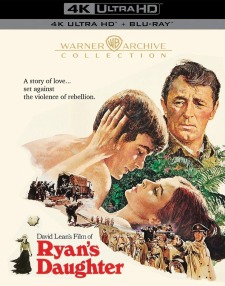
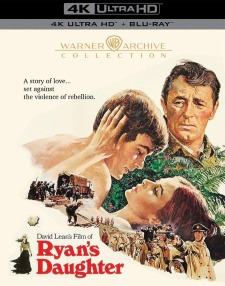
Ryan’s Daughter (4K UHD Review)
- Review Date: Oct 29, 2026
- Format: 4K Ultra HD
-


Director
David LeanRelease Date(s)
1970 (October 13, 2026)Studio(s)
Faraway Productions A. G./Metro-Goldwyn-Mayer (The Warner Archive Collection)- Film/Program Grade: B-
- Video Grade: A+
- Audio Grade: A
- Extras Grade: B

Review
Based loosely on the plot of Gustave Flaubert’s 1857 French novel Madame Bovary, with an original screenplay by Robert Bolt, David Lean’s Ryan’s Daughter is set 1917 and tells the story of a naive young Irish girl, Rosy Ryan (Sarah Miles, Those Magnificent Men in Their Flying Machines, also Bolt’s wife), who’s bored with life in her remote coastal village and spends her days strolling the beach dreaming of romance. Her only viable marriage prospect is the local school master, a middle-aged widower named Charles Shaughnessy (Robert Mitchum, The Night of the Hunter). But just when Rosy finally gets everything she wants, she realizes it’s not enough. Salvation of a kind appears in the form of a British Army major named Randolph Doryan (Christopher Jones, The Looking Glass War), who’s just back from the front lines in France. Suffering from shell shock, Randolph’s been sent to take command of the local Army outpost as he recovers. But when Rosy and Randolph meet and begin an affair, only the local Catholic priest, Father Collins (Trevor Howard, The Third Man), seems to realize that nothing good will come of it.
After the rousing critical and commercial success of Lawrence of Arabia (1962) and Doctor Zhivago (1965), director David Lean essentially had carte blanche to make any film he wanted. But Ryan’s Daughter turned out to be much more difficult than he expected, both in terms of find its story and mounting the actual production on location on the Dingle Peninsula in County Kerry, Ireland (a planned 10-week shoot eventually expanded to 52, and required finishing in Cape Town, South Africa). Some 200 Irish workers built the village setting from scratch, with nearly every structure having complete interiors, lighting, and at least partial plumbing. But the film is mostly set outdoors, and the weather rarely cooperated. The actors here are accomplished to be sure, but their casting proved somewhat less than successful. Mitchum is good as ever, but he’s playing against type—typically a rugged and charismatic man’s man, he’s a tough sell as an uninspired milquetoast. Miles too is good, but she has very little chemistry with Jones, which makes their affair a tough sell. The only actor that truly shines in Ryan’s Daughter is Trevor Howard, who’s not only the film’s conscience but oddly brings the most passion and energy to his scenes, though Leo McKern (Rumpole of the Bailey) and Barry Foster (Frenzy) are also solid as the local publican (Rosy’s father) and a local IRB resistance leader.
But the problems with Ryan’s Daughter run deeper still and are endemic to Bolt’s screenplay (which he and Lean worked on together for months, and struggled with mightily)—there’s not enough actual story and the characters are thinly drawn. To start with, Rosy never feels three-dimensional, nor like someone who could have grown up in this village. She seems to have no friends, indeed we rarely see her interacting with the locals beyond Father Collins and the village idiot, Michael (John Mills, who won the Best Supporting Actor Oscar for this part). Rosy’s relationship with her father is never really fleshed out. The objects of her desire are equally undeveloped. Charles is kind, decent, and cultured, but has few interests beyond listening to records and pressing wildflowers. More to the point, he has no carnal desire for Rosy, which is hard to believe. Meanwhile, Doryan barely says a word. The first time he and Rosy meet at her father’s pub, he has a PTSD episode and collapses to the floor. When Rosy goes to help, suddenly they’re kissing madly and he’s grabbing her breast—it feels terribly contrived. What’s more, the people of Kiarray are as mean-spirited and odious as they come. We never see them working at their occupations. Are they farmers or fishermen? Maybe. Mostly they lurk in doorways waiting to descend upon and harass hapless passers-by, while their elders grouse in the local pub. These are some of the most underdeveloped characters you’ll ever see in a film.
Thankfully, a subplot involving a German effort to smuggle weapons to fighters from the Irish Republican Brotherhood, with whom the locals are allied, adds a bit of intrigue and a good set piece. But there’s really only 60-70 minutes of actual story here, which would be a problem in a 120 minute film. It’s a catastrophe in a 206-minute epic. The development and consummation of Rosy and Charles’ relationship takes up most of the film’s first half, with Doryan’s arrival driving the rest—by the intermission break, he’s already stolen the girl’s heart. Unfortunately, the scene where they make love for the first time—while exquisitely photographed—is oddly clichéd. The second half open with Charles discovering what’s happening under his nose, at which point the IRB vs. British Army subplot finally kicks in with its various consequences. But it’s sadly not enough to save the film. What is almost enough, however, is some of the most extraordinary landscape photography you’ll ever see, courtesy of Lean and his go-to cinematographer, Freddie Young. More on that in a moment.
Ryan’s Daughter was photographed by Young on 65 mm film (Eastman 100T 5254 stock) in Metrocolor using Super Panavision 70 cameras with Panavision lenses. It was finished in a traditional physical A/B roll post-production process standard for large-format films of the day. For its debut on both Blu-ray and 4K Ultra HD, the team at Warner Bros. Motion Picture Imaging scanned the original 65 mm A/B camera negative in 8K resolution. Remastering took nearly a year, with fully a month each devoted to color grading and sound restoration. The resulting image has been graded for high dynamic range compatible with both Dolby Vision and HDR10, and it’s framed at the proper 2.20:1 aspect ratio. The Warner Archive Collection has chosen to include the Roadshow Version (complete with overture, intermission, entr’acte, and exit music) on a pair of 100GB UHD discs to allow for maximum data rates (averaging between 90-100 Mbps), with disc authoring and encoding by David Mackenzie of Fidelity in Motion.
The result is absolutely breathtaking. Frankly, it’s difficult to imagine that any 4K disc could ever look better than this. First of all, the large-format negative appears to be in pristine condition, with very little age-related defects or handling wear. MPI’s scan and restoration work is top notch as always, and the result is exquisite fine detail. The gently boiling clouds in the film’s opening sunrise shot over the mountains (behind the titles) exhibit lovely depth and dimensionality. And when the image then shifts to reveal Rosy walking on the high cliffs overlooking the ocean, you simply can’t help but marvel at the detail visible in the rocks and the refined shimmering of overcast sunlight on the ocean waves below, all as tiny birds soar around in between. The HDR grade is not only subtle, the wide gamut lends striking naturalism to the imagery. Clouds are luminous from within, oceans mists have a soft glow. Blacks are deeply black, yet retain impressive detail. And the colors! Seemingly every possible shade of green, green-blue, blue, gray, and brown is visible. Skin, hair, clothing, and building materials exhibit wonderfully subtle texturing. And the photographic grain is very fine indeed, yet ever-present. Seldom has the landscape itself been more of a character in any film. Freddie Young won the Academy Award for Best Cinematography for his work on Ryan’s Daughter, and after viewing this 4K image, you’ll damn well know he deserved it. By God is this disc gorgeous!
Audio is included in a new English 5.1 DTS-HD Master Audio mix, sourced from the original 70mm 6-track elements. The soundstage is big, wide, and natural sounding, with the dialogue centered up front and the surrounds used for light music expansion and immersive environmental sound effects. Also included is the actual 5.0 6-track 70mm audio in remastered DTS-HD MA format. The former is perhaps just a bit smoother and more full sounding, and there’s noticeably more immersion in the rear channels, whereas the latter is flatter and more forward biased. But tonally, they’re very similar, and you really can’t go wrong with either. Dialogue is clean and well staged, though the Irish brogue is strong enough that you might occasionally want to use the optional English SDH subtitles provided. Composer Maurice Jarre’s score for this film is one of his most unabashedly romantic, by turns ethereal and dramatic, and occasionally downright charming. It’s offered here in terrific fidelity and is layered cleanly and pleasingly throughout the mix.
Warner Archive’s 4K package is a 4-disc set containing the film in 4K on a pair of UHD discs and 1080p HD on a pair of Blu-rays (note that a Blu-ray version is also available separately). Each disc contains some special features as follows…
Discs One (4K) & Three (BD) – The Film: Part One
- Audio Commentary by the Cast and Crew, Moderated by Laurent Bouzereau
- Announcement Trailer (Upscaled HD – 2:22)
- Theatrical Trailer (Upscaled HD – 2:56)
Discs Two (4K) & Four (BD) – The Film: Part Two
- Audio Commentary by the Cast and Crew, Moderated by Laurent Bouzereau
- Ryan’s Daughter: Rising Storm (Upscaled HD – 27:47)
- Ryan’s Daughter: Storm Chaser (Upscaled HD – 20:56)
- Ryan’s Daughter: The Eye of the Storm (Upscaled HD – 14:12)
- Film Night Special: We’re the Last of the Traveling Circuses (Upscaled HD – 20:04)
- Ryan’s Daughter: A Story of Love (Upscaled HD – 6:16)
All of these features have been carried over from Warner’s original 2006 DVD release. The audio commentary is moderated by longtime Spielberg documentarian Laurent Bouzereau, and it includes Sarah Lean (the director’s wife), actor Sarah Miles, Petrine Day Mitchum (Robert Mitchum’s daughter), second unit director Roy Stevens, art director Roy Walker, assistant editor Tony Lawson, location manager Eddie Fowlie, stuntman Vic Armstrong, biographer Stephen M. Silverman (author of David Lean), filmmakers John Boorman (Excalibur) and Hugh Hudson (Chariots of Fire), and film critic Richard Schickel. It’s really quite a good ensemble commentary, with each participant recorded separately yet contributing valuable insights.
All of the DVD’s documentary featurettes are here as well, AI upscaled from the original SD (to mostly good effect, though there are occasionally times when small print in a photo has been turned into gibberish). A pair of upscaled trailers has also been included. As is typical of Warner Archive titles, there’s no Digital Copy code, but the package does include a mini booklet reproduction of the film’s original Roadshow souvenir program, as well as a cardboard slipcase.
Unfortunately, David Lean was so discouraged by the critical reaction to this film that it would another fourteen years before he’d direct again, and for the final time. But Ryan’s Daughter is not without merit. In fact, the chance to revisit this film in 4K has proven it to be better than I remembered. And while its merits are mostly photographic, they are considerable indeed. Honestly, this might be Warner Archive’s finest 4K release yet; it’s certainly right up there with The Searchers (reviewed here) in terms of sheer image and sound quality. For that reason alone, it’s well worth the purchase price and easy to recommend.
- Bill Hunt
(You can follow Bill on social media on X, BlueSky, and Facebook, and also here on Patreon)