
Autopsy of Jane Doe, The (4K UHD Review)
Director
André ØvredalRelease Date(s)
2016 (October 13, 2026)Studio(s)
42/Impostor Pictures/IM Global/IFC Midnight (Severin Films)- Film/Program Grade: B+
- Video Grade: A
- Audio Grade: A
- Extras Grade: B+

Review
“Everybody has a secret. Some just hide them better than others.”
So says coroner Tommy Tilden (Brian Cox) to his son Austin (Emile Hirsch) near the beginning of The Autopsy of Jane Doe. Austin is serving as Tommy’s assistant at the morgue, and his father is trying to pass on the knowledge needed not just to become a coroner, but to take over the family business as well. Yet unbeknownst to Tommy, Austin is planning to skip town with his girlfriend Emma (Ophelia Lovibond) since he doesn’t feel any real affinity for the work. But those plans go awry when Sheriff Burke (Michael McElhatton) brings in the body of an unidentified Jane Doe (Olwen Catherine Kelly). She was discovered at the scene of a brutal mass murder, partially buried in the cellar—although it looks like she was actually dug up, not buried. Burke wants answers, so he sets Tommy on the task of uncovering her secrets, even if it takes all night. Austin tables his plans in order to stay with his father to examine the body, and they end up discovering that there are more things in heaven and on earth that are dreamt of in either of their philosophies.
Taken at face value, that description may sound like a police procedural (or an episode of Quincy, M.E.), but it’s actually nothing of the sort. Everybody does indeed have a secret, but this particular Jane Doe’s secret will bring Tommy and Austin to the brink of another world. Or does it really? Aye, there’s the rub. That’s because The Autopsy of Jane Doe isn’t a police procedural at all, but rather a horror film (or perhaps it could be termed a horror procedural). And in the best spirit of psychological horror, there’s the distinct possibility that everything may be taking place in the imaginations of the protagonists. Yet this isn’t Val Lewton’s brand of psychological horror, but something far more direct and visceral. Nothing is left to the imagination, at least as far as the autopsy itself is concerned; The Autopsy of Jane Doe definitely isn’t for the faint of heart (or weak of stomach). And the horrors that arrive later in the film seem tangible enough, even though there’s still room for doubt about what’s really happening.
With all due respects to the talents of everyone involved with The Autopsy of Jane Doe, full credit for how well all of that works belongs to director André Øvredal. Øvredal had made a splash in 2010 with his found footage horror comedy Trollhunter, and he was eager to prove that he wasn’t just a one-trick pony. Far too many directors who find success in the found footage genre have a difficult time transitioning to a different style, essentially becoming typecast as filmmakers. That’s what happened to The Blair Witch Project directors Daniel Myrick and Eduardo Sánchez, who never achieved the same level of success with any other kinds of films (although to be fair to Sánchez, his return to the genre with Exists in 2014 was a real banger of a found footage Bigfoot movie). Øvredal was looking for a project that would demonstrate that he had more tools in his arsenal, and Ian Goldberg & Richard Naing’s script for The Autopsy of Jane Doe fit the bill perfectly.
One challenge with the found footage genre is that in order to be effective and believable, the films need to look like they’re not being directed at all. That was literally true with The Blair Witch Project, where Myrick and Sánchez handed the cameras to their cast, set up the situations around them, and let the chips fall where they may. Not so with a film like Trollhunter, which may look like the camera crew was simply following the action, but in reality it was all carefully orchestrated. Yet it doesn’t look that way since Øvredal did his job so well. The Autopsy of Jane Doe, on the other hand, gave him the opportunity to let his talent for precise staging operate front and center.
The Autopsy of Jane Doe is essentially a haunted house story, albeit of the psychological variety where it’s fair to question the veracity of what the characters are experiencing. Øvredal chose to treat it as slow-burn horror, too, carefully establishing the situation and the characters before gradually pulling a Sarah McLachlan and building a mystery. A morgue is an inherently evocative environment, aided greatly in this case by a looming storm outside. But eerie or not, it’s still grounded in reality, and Øvredal leans into that tangibility during the first act of the film. Tommy Tilden is patient and methodical in his work, and we’re shown his autopsy step by step in excruciating detail. Yet as those steps progress, everything slowly starts getting stranger and more otherworldly, with the environment breaking down around Tommy and Austin the more that they discover. As a result, by the time that the horrors turn fully eldritch, it feels like a natural progression rather than a sudden left turn.
In other words, Øvredal is every bit as methodical in establishing the horrors of The Autopsy of Jane Doe as Tommy is during the autopsy itself. Yet it’s fair to point out that Goldberg & Naing’s script provided the template, and the film wouldn’t have worked at all without the right cast to bring the characters to life. Emile Hirsch is solid if unexceptional as Austin, but Brian Cox displays his usual impeccable professionalism as Tommy. Still, the undersung hero of The Autopsy of Jane Doe is Olwen Catherine Kelly. While there are plenty of prosthetic effects and digital enhancements in the film, the bulk of the time it’s the real Kelly lying naked on the autopsy table, never twitching or moving a muscle but somehow expressing cognition beneath the frozen veneer of death. Jane Doe’s eyes are occluded, and yet there’s an intelligence behind them that makes the horrors that Tommy and Austin experience, real or imagined, seem all too plausible. It’s uncanny how well that Kelly embodies the, well, uncanniness of Jane Doe, and she’s the linchpin that holds the film together as Tommy and Austin’s world falls apart.
If there’s one flaw with The Autopsy of Jane Doe, it’s that the ultimate explanation for what’s happening may not match the expectations set up by the sense of mystery in the rest of the film. Some secrets are best left hidden. But it’s worth remembering that this is psychological horror, however visceral that it may seem, and Tommy & Austin are trying to rationalize an experience that’s inherently irrational. The Autopsy of Jane Doe originally ended with a coda clarifying that they did indeed imagine everything, but Øvredal wisely decided to dial that back and leave things more ambiguous. The simplified ending implies that Jane Doe’s influence on the lives (and minds) of others will continue, regardless of whether it’s real or imagined. Some may hide their secrets better than others, but no one hides them better than her.
Cinematographer Roman Osin captured The Autopsy of Jane Doe digitally (in ProRes 4:4:4 format) using Arri Alexa cameras with Cooke S4 lenses. While the capture resolutions would have been higher, it’s not clear if post-production work was completed as a 2K or a 4K Digital Intermediate, but either way, it was framed at 2.39:1 for its theatrical release. There’s no information about the 4K master that Severin is using other than their statement that the film is “now scanned in 4K,” which is a curious choice of phrase for a film that was captured digitally. It may mean that the original DI was only 2K and that this is a 4K rebuild, but that’s just speculation. In any event, it’s graded here for High Dynamic Range in HDR10 only.
The reality is that with higher capture resolutions and upscaling done at the uncompressed source rather than on a compressed Blu-ray at the user’s end, it’s not always easy to tell the differences between native 4K and upscaled 2K these days. The image here is clear, sharp as a tack, and free from artifacts like aliasing. Fine textures are beautifully resolved, from the mold marks on the rubber gloves and threads on the surgical gowns to all of the subtle imperfections on Olwen Catherine Kelly’s skin. (Øvredal has stated that it was important to use a real actor in extreme closeups rather than prosthetic dummies precisely because those details are impossible to recreate believably.) Still, the biggest improvements here over Blu-ray are in the contrast range, with genuinely deep blacks that fall off into inky darkness—digital capture or not, there aren’t any elevated blacks here despite the low-light shooting conditions. Regardless of source, this is a great 4K upgrade for The Autopsy of Jane Doe.
Audio is offered in English 5.1 and 2.0 DTS-HD Master Audio, with optional English SDH subtitles. The Autopsy of Jane Doe was released theatrically in—well, therein lies a bit of a mystery of its own. Crowdsourced online sources like IMDb say that it was released in Atmos, and the closing credits do list the film as being available in Atmos “at select theatres.” But the posters for the film just have standard logos for Dolby and DTS, with no reference to Atmos at all. Intrepid Bits researcher Michael Coate tried looking for newspaper advertisements that may have listed Atmos, but unfortunately, print advertisements for movies were already going out of style by 2016. In lieu of any hard evidence to the contrary, I’m going to have to assume that the film was actually released in 5.1 only—and it’s worth noting that Øvredal’s next two films were also 5.1 only (he doesn’t appear to have made the leap to Atmos until The Last Voyage of the Demeter).
In any event, The Autopsy of Jane Doe provides a strong reminder of just how immersive that a good 5.1 mix can be. There’s a fantastic use of subtle atmospheric effects to keep everything feeling creepy, and once all hell breaks loose in the later stages of the film, all channels are fully active as the morgue is torn apart around the viewers. In other words, the surrounds are always present, but they only draw attention to themselves whenever it’s appropriate for them to do so. That’s exactly how a multichannel mix should be done regardless of the number of channels. There’s also plenty of dynamic impact in the mix (again, only when appropriate) and a fair quantity of deep bass in the rumbling thunder and other similar effects. It’s a great mix that perfectly supports what The Autopsy of Jane Doe is trying to achieve—and for those who insist on having more channels, it upmixes beautifully.
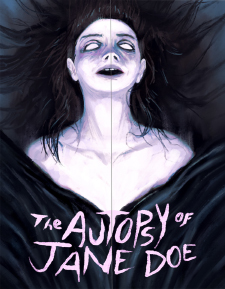
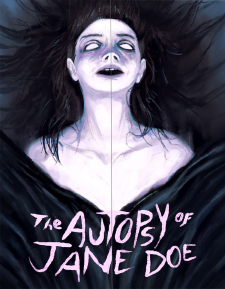
The Severin Films 4K Ultra HD release of The Autopsy of Jane Doe is a two-disc set that includes a Blu-ray with a 1080p copy of the film. The Limited Edition version is currently available directly from Severin with a rigid slipcase designed by Trevor Henderson that splits vertically down the middle; pulling it apart reveals the inner workings (in more ways than one). There’s also a standard version available elsewhere. Either way, the insert on the disc case is reversible, featuring alternate poster artwork on each side, and the following extras are included (all of them in HD):
DISC ONE: UHD
- Trailer (2:06)
DISC TWO: BD
- Head Examiner (17:13)
- Next of Kin (12:41)
- Undead on Arrival (9:50)
- Coroner’s Report (18:01)
- Postmortem Procedure (28:51)
- Tools of the Trade (7:17)
- Father in the Family Plot (6:00)
- Second Degree (5:35)
- Body Processing (4:56)
- Trailer (2:06)
Refreshingly, there’s no perfunctory podcaster commentary track here; the extras consist of new interviews with the cast and crew, mixed with a few archival interviews that were recorded on the set. Even better, they’re all professionally shot and edited segments produced in-house at Severin, mixing the interviews with clips from the film, behind-the-scenes footage, on set photographs, and clips from other relevant sources—these aren’t your standard point-and-shoot “talking head” interviews. Instead, they end up feeling more like segments from a proper making-of documentary.
Head Examiner is with Øvredal, who explains that after Trollhunter, he specifically sought out a project that would allow him to be in more control as a director rather than feeling like he was being constrained by the found footage format. The script for The Autopsy of Jane Doe immediately appealed to him, but the process of putting the project together had a few hiccups along the way like losing cast members and financing. He also discusses the cast and crew; dealing with the nudity and general gruesomeness; filming strategies like shooting in sequence and altering the lenses used as the story progresses; and changing the ending to something more ambiguous. Øvredal acknowledges that The Autopsy of Jane Doe is what started his career properly, leading to bigger and better things rather than getting pigeonholed as a found footage director (although Autopsy is still his personal favorite of his own films).
Next of Kin is with Emile Hirsch, who describes how he got involved with the project, what appealed to him about the script, and his experiences prepping for the film by touring the L.A. morgue. He also offers plenty of praise for Brian Cox’s professionalism and addresses the legacy of the film after its less than successful theatrical release.
Undead on Arrival is with Olwen Catherine Kelly, who explains how she was cast and her own fascination with witches. Since they created the prosthetic dummy for her prior to the film going into production, she didn’t think that she was going to be seen as much as she was, and she ended up standing by on set every day just in case. Her ability to lie perfectly still resulted in much less VFX touchup for her scenes that may have been necessary otherwise. (And yes, she does address the merkin that she had to wear.)
Coroner’s Report is with cowriter Ian Goldberg, who discusses his collaboration with Richard Naing and says that they made the conscious decision not to focus on the gore, but rather let the morgue feel like a workaday environment. Their conception of who (or what) Jane Doe was evolved as they wrote the script, and they didn’t have any experience with that kind of work other than what they saw on television, so they also toured the L.A. morgue as part of their research. He credits producers Eric Garcia and Fred Berger for setting the film up as an independent production so that they could stick to the script without compromises.
Postmortem Procedure is with the aforementioned Naing, Garcia, and Berger. Naing mentions what influenced him when they wrote the script, while Garcia and Berger note how the references in the story appealed to them. It all came together when André Øvredal was hired, with the director insisting that his two priorities were building the right set and having enough time to shoot on it (the schedule was extended to accommodate his wishes). They were all amazed to see everything come to life, and then horrified when they realized they now had to pull off shooting a film where one of the lead characters is a naked corpse.
The rest of the extras consist of the on-set interviews, although they’ve been reedited here by Severin to turn them into something more dynamic. Tools of the Trade is with Emile Hirsch, who talks about his love of horror and the process of making the film. Father in the Family Plot is with Brian Cox, who describes what attracted him to the script, the nature of the character he was playing, and the technical accomplishments in the film. Second Degree is with Ophelia Lovibond, who offers her own thoughts about the script and her character’s part in the story. Body Processing is with producer Ben Pugh, who praises Øvredal’s understanding of genre films and discusses the influences on the film.
As far as domestic releases go, the 2016 Shout! Factory Blu-ray was bare bones aside from trailers (although it did have TV spots that aren’t included here), so this is an automatic upgrade regardless of the improvements in video quality. The Canadian Blu-ray from Distribution select included a Q&A and Øvredal’s short The Tunnel, while the Australian Blu-ray from Umbrella Entertainment offered the raw on set cast & crew interviews and a behind-the-scenes featurette (the same extras were also included on the German Blu-ray from Universum Film). But the extras here still beat them all, and the new 4K master is a clear improvement over any and all previous releases, so this 4K Ultra HD release from Severin is highly recommended for fans of The Autopsy of Jane Doe—and if you’re not one already, it’s an excellent place to start.
- Stephen Bjork
(You can follow Stephen on social media at these links: Twitter, Facebook, BlueSky, and Letterboxd).