
Duplicity (Blu-ray Review)
Director
Tony GilroyRelease Date(s)
2009 (October 27, 2026)Studio(s)
Relativity Media/Universal Pictures (Kino Lorber Studio Classics)- Film/Program Grade: C
- Video Grade: A
- Audio Grade: A
- Extras Grade: B

Review
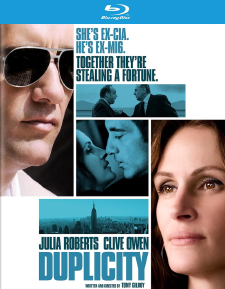
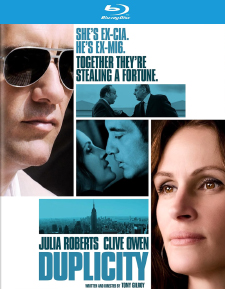
Duplicity stars two marquee names in a caper laced with intrigue. In a high-stakes game that requires deception and feigned identities, a lucrative job becomes an opportunity to scam millions from a huge corporation.
Claire Stenwick (Julia Roberts) is a CIA officer and Ray Koval (Clive Owens) is an MI6 agent. They meet for the first time in Dubai, where their encounter begins with flirtation and ends with Claire stealing Ray’s classified documents. Three years later, the two reunite in Rome and explore the possibility of leaving government service to pursue more remunerative careers in corporate espionage. Claire takes a job in counterintelligence with a health and beauty products company to infiltrate its chief competitor. More than a year into her assignment, she arranges for Ray to join her team.
Burkett & Randle’s CEO, Howard Tully (Tom Wilkinson), and Equikrom’s CEO, Dick Garsik (Paul Giamatti), are ruthless rivals. Both play dirty and steal each other’s secrets while spending huge amounts to protect their own. In a comically absurd slow-motion title sequence, the two CEOs, faces distorted in rage, battle it out on an airport tarmac, jabbing and kicking each other in the shin and awkwardly grappling on the ground.
Equikrom is about to launch an enormously profitable new product. No one knows what it is because of the intense security to guard its identity until its official public debut. CEO Garsik hires Claire and Ray to spy on Burkett & Randle and learn whether they have discovered anything about the new product and what new products they are developing.
As the competing corporations attempt to uncover each other’s secrets, Claire and Ray come up with a plan to double-cross both companies and steal the formula. They must stage an elaborate cat-and-mouse game while keeping their partnership secret. Their growing romantic involvement adds to the complications, since neither is entirely certain how much to trust the other.
Duplicity bounces back and forth between present and past events at various times in various places. This technique slowly allows the story to take shape but can be confusing and seems more gimmicky than essential. A linear story flow would have clarified how one event leads to the next and why Claire and Ray’s relationship has highs and lows. Instead, director Tony Gilroy places two celebrities in exotic locations around the world, juggles their experiences with intrigue involving bedroom scenes, and incorporates several twists along the way. Though reminiscent of Charade, Duplicity fails to achieve that film’s lucid plot and smooth polish.
Julia Roberts, as movie-star radiant as ever, lacks warmth as Claire. This may be Gilroy’s choice. After all, her character must be unflappable in dealing with powerful corporate types, a secret formula, and an agent that may not be 100% trustworthy. However, one of Roberts’ best attributes—an open, joyful personality—is in very short supply. Her weak chemistry with Clive Owen doesn’t help us warm to her character. Had the script (also by Tony Gilroy) been lighter, the role of Claire likely would have been a better fit for Roberts.
Clive Owen plays Ray on a similarly dispassionate level throughout, whether in a tense scene between Ray and Claire, a romantic interlude, or a suspenseful sequence when time is critical. His expression and demeanor never change to suit the moment. The problem once again boils down to the script. Should he be playing Ray like Cary Grant or more like Lee Marvin? Owen tries to have it both ways, his character remaining enigmatic, to accommodate the twists in the plot and the mundane dialogue. Consequently, Ray comes off as insipid when he should register craftiness and strong romantic appeal.
Director Tony Gilroy drags scenes out instead of using a brisk editing style, more suitable to this kind of film. The switches from present to past interrupt narrative flow and cause confusion instead of piquing interest. The film lumbers ahead so sluggishly that suspense suffers. Wilkinson and Giamatti are both excellent in roles that should have been expanded. They capture what was probably the intended mood of the film better than the leads. But neither they nor the lush cinematography can save this flawed picture.
Duplicity was shot by director of photography Robert Elswit on 35mm film with Panavision Panaflex Platinum cameras and Panavision E- and G-series lenses. It was finished as a 2K Digital Intermediate by EFILM Digital Laboratories, and presented in the aspect ratio of 2.35:1. The Blu-ray by Kino Lorber Studio Classics has an aspect ratio of 2.40:1 and is sourced from a brand new HD master of a 4K scan of the original camera negative. The film features a rich theatrical texture, wide horizontal framing, and smooth camera movements that reflect an old Hollywood vibe. Production design and international locations add glamour. The narrative shifts between time periods sometimes leads to confusion. One scene which is repeated nearly word-for-word is an example.
There are two soundtrack options, English 2.0 and 5.1 DTS-HD Master Audio. English SDH subtitles are available as an option. Dialogue is clear and distinct. The score by James Newton Howard is jazzy and upbeat, reminiscent of 1960s caper films such as Charade and How to Steal a Million. Because many scenes take place within interiors such as hotel lobbies and corporate offices, the driving tempo of the music gives them energy.
Bonus materials on the Blu-ray release from Kino Lorber Studio Classics include the following:
- Audio Commentary by Tony Gilroy and John Gilroy
- Criminal Defense: Interview with Actor Dan Daily (9:43)
- Theatrical Trailers:
- Duplicity (2:29)
- Inside Man (2:14)
- I’ll Sleep When I’m Dead (2:20)
- In Bruges (2:29)
- Eastern Promises (2:22)
Audio Commentary – Writer/director Tony Gilroy and editor/co-producer John Gilroy deliver this commentary from New York City’s famed Brill Building, where Duplicity was edited. Director Gilroy was able to make Duplicity after his success with Michael Clayton. He wanted Julia Roberts to play Claire but she was pregnant at the time. She would eventually agree to star. He met Clive Owen and felt he would be perfect for the role of Ray Koval. He’s comfortable enough as an actor to look weak as a “beaten man.” Gilroy speaks highly of the entire cast and talks about filming from a character’s point of view. In terms of the script, “You really had to be on your toes to know what was going on.” Split screen was used to help orient the viewer. He says that Julia Roberts is a generous actor and cites the emotional scene between her and a secondary character played by Carrie Preston. Roberts knew this scene was Preston’s and did not attempt to co-opt it. The fight on the airfield between Paul Giamatti and Tom Wilkinson was shot in one day in rainy, cold weather. The relationship between Claire and Ray changes. Who’s on top? Who has power? Who’s in control? A late night shoot on Grove Street in Greenwich Village had to continue on a second night because as dawn was breaking, the sound of birds chirping was so loud it interfered with dialogue. Many different office buildings stood in for the headquarters of Burkett & Randle. Director and editor speak about building a scene as the film is being shot. Director Gilroy wonders whether he should have been more of a “jerk” by asking actors for additional takes. He felt a key romantic scene shouldn’t undermine the cynicism of the story.
Criminal Defense: Interview with Actor Dan Daily – Dan Daily plays an unnamed associate of the Richard Garsik (Paul Giamatti) character in Duplicity. Daily speaks about some of the roles he’s played on film. With Tony Gilroy, Daily always felt he was part of a repertory company. Gilroy made you feel you had value and were an important, integral part of the ensemble. Combining dialogue and movement is “like a dance.” It has to look natural but is complex to set up and shoot. It has to have the “precision of a Swiss watch.” He makes a point of saying that Paul Giamatti is a generous actor, not at all like the character he plays.
Duplicity is a multi-genre film—part corporate satire, part espionage thriller, part romantic comedy. The blend isn’t smooth. We never quite know if the romantic sequences are intended to lighten the satire or do the reverse. Director Tony Gilroy is ambitious in not limiting the story to a single focus, but the complexity makes it hard to follow, especially with frequent shifts between different time periods. The main characters’ hostile tendencies and personality traits distance rather than draw in the viewer. Their minimal charm makes it a difficult handicap for Julia Roberts and Clive Owen to overcome.
- Dennis Seuling