
Hunted, The (4K UHD Review)
Director
William FriedkinRelease Date(s)
2003 (September 30, 2026)Studio(s)
Paramount Pictures (Imprint Films/Via Vision Entertainment)- Film/Program Grade: B
- Video Grade: A
- Audio Grade: A-
- Extras Grade: B+
Review
[Editor’s Note: This is a Region Free Australian 4K Ultra HD import.]
The late great William Friedkin’s neglected 2003 film The Hunted is a fascinating example of a lost art that’s getting pretty scarce these days: efficiency. Films seem to be getting longer and longer, but they’re not necessarily getting better and better. Encouraged by the success of serialized storytelling on streaming channels, filmmakers keep stretching everything out like butter scraped over too much bread (and yes, we’re looking at you, Mr. Jackson). Home video has provided an avenue to stretch things out even further, with extended versions of theatrical cuts serving as marketing tools even though they’re often not really director’s cuts. Longer is frequently equated with better, but in the immortal words of Ira Gershwin, it ain’t necessarily so.
Friedkin himself has hardly been immune to that kind of temptation. When he remade the Henri-Georges Clouzot classic The Wages of Fear in 1977 as Sorcerer, he actually shortened the running time, but he still added a lengthy prologue that provided the backstories for the main characters that had been omitted by Clouzot. Sorcerer may be a masterwork in its own right, but there’s no getting around the fact that this kind of information isn’t really necessary for the relatively simple story to work. (Here’s a thought experiment: if you were to remove the prologue entirely and start the story where Clouzot did, would it alter the primary narrative in any significant way?) In the case of The Exorcist, Friedkin has even gone back and tinkered with his original cut to create a longer version that may add more texture, but it just doesn’t improve anything about the heart of the film.
Yet with The Hunted, Friedkin bucked the trend of modern action movie bloat by taking a simple story and, well, keeping it simple. The Hunted runs a lean, mean 94 minutes, with very little wasted fat on its lanky bones. Audiences are given just enough information about the characters for the narrative to function, no more, no less. Even the title is efficient, because The Hunted is a chase story featuring a hunter pursing his quarry, and that’s about it. The hook in this case is that there’s a metaphorical father/son connection between the two of them, with the hunter having once been a mentor to the hunted. William Friedkin was hardly a subtle filmmaker, so he makes that point crystal clear by opening the film with Johnny Cash’s haunting voice reciting the first stanza of Bob Dylan’s Highway 61 Revisted:
God said to Abraham, “Kill me a son”
Abe says, “Man, you must be puttin’ me on”
God say, “No.” Abe say, “What?”
God say, “You can do what you want Abe, but
The next time you see me comin’ you better run”
Well Abe says, “Where do you want this killin’ done?”
God says, “Out on Highway 61.”
That’s arguably a bit too on-the-nose, yet it’s still a powerful way to set the stage. It’s pure Friedkin, too, because it wasn’t present in the original script by David and Peter Griffiths. Friedkin had met the professional tracker/trainer Tom Brown and wanted to tell a story that utilized his unique skillset, but he wasn’t sure what direction that should take. The spec script by the Griffiths brothers provided a good framework, but Friedkin had Art Monterastelli rewrite it to incorporate details that he had learned from Brown. The whole father/son angle was also a contribution from Friedkin, inspired by the story of Abraham and Isaac. And just in case anyone missed that point from the Dylan lyrics, Friedkin later shows a King James Bible open to Genesis 22:6: “And Abraham took the wood of the burnt offering, and laid it upon Isaac his son; and he took the fire in his hand, and a knife; and they went both of them together.”
It’s the Isaac figure in The Hunted who has been contemplating that passage, with the Abraham figure discovering it while he’s out in the wilderness in pursuit of the man who he once mentored. Abraham in this case is L.T. Bonham (Tommy Lee Jones), a former special forces combat and survival trainer. Despite his specialized skills, L.T. is a civilian who hasn’t actually seen any combat of his own, and he retired after losing faith in what he was doing. When one of his former trainees Aaron Hallam (Benicio del Toro) has a mental breakdown and starts killing people indiscriminately, L.T. is brought out of retirement to track down his student, putting his own theoretical skills to the test in a real-world fight for survival.
There’s a bit more to the story than that, but despite the presence of Connie Nielsen, John Finn, José Zúñiga, and Ron Canada as various FBI agents involved in the pursuit, at its core, The Hunted remains a simple mano a mano between L.T. and Hallam. Given the obvious age difference between the two actors, it should be completely implausible that the much older Jones would be able to hold his own against Benicio del Toro in his prime, but Jones does a surprisingly good job of selling the years of experience that manage to keep L.T. in the fight. From the way that he’s constantly scanning every corner of a room, checking for potential threats, to his incessant OCD finger-twitching, Jones always remains believable in the role.
That believability extends to the survival and fighting skills on display in The Hunted. Tom Brown served as a technical advisor, teaching both actors how to look like they know what they’re doing. That even extended to the knives that are used, with Brown contributing a survival knife of his own design. Yet it was fight coordinators Rom Kier and Rafael Kayanan who choreographed the elaborate knife fights, incorporating Sayoc Kali and other disciplines to craft some memorable action scenes (and yes, even Jones acquits himself nicely). There are still a few inevitable Hollywood-style moments (and some of the traps laid by Hallam are a little too elaborate), but thanks to the efforts of everyone involved, The Hunted accomplishes its mission of telling a simple story as simply and directly as possible. It’s an efficient tale of efficient killers and equally efficient survivors, and that’s all it needs to be. Sometimes, less is more.
Cinematographer Caleb Deschanel shot The Hunted on 35mm film using Panavision cameras with spherical lenses, framed at 1.85:1 for its theatrical release. This version is based on a 4K scan of the original camera negative, graded in High Dynamic Range for both Dolby Vision and HDR10, but there’s no other information available about the master that Paramount provided. Paramount can be hit or miss sometimes, but fortunately this one is an unqualified hit. The image is razor sharp and finely detailed, especially in the closeups, where the facial textures are beautifully resolved. There are some digital effects present, and if the compositing was also performed digitally, it was at relatively low resolution, so those shots to tend to stand out. In all other respects, the contrast range, black levels, and color reproduction are all outstanding. The Hunted has never looked this good.
Even better, while there’s also no information regarding what company handled the encode for this release (and no, it wasn’t Fidelity in Motion), it’s a significant improvement over Kino Lorber’s previous UHD. When viewed from up close while stepping through frame-by-frame, sometimes the textures were sharp in one frame but a little smeared in the next—for example, wrinkles on Tommy Lee Jones’ face could jump around from frame to frame. There are no such compression issues here, with everything staying sharp throughout.
Audio is offered in English 5.1 DTS-HD Master Audio and 2.0 LPCM, with optional English SDH subtitles. The Hunted was released theatrically in 5.1, with 2.0 surround as a backup for theatres that still weren’t equipped for it, so 5.1 is unquestionably the way to go here. It’s an aggressive multichannel mix that announces its intentions right from the opening Kosovo flashback, with the sounds of gunfire and explosions surrounding the viewer from all directions. In quieter moments like when Bonham is tracking Hallam through the wilderness, the sounds of the forest serve the same purpose. (And if 5.1 just isn’t good enough for you, the track responds quite well to the Dolby Surround or DTS:X upmixers.) Bryan Tyler’s score tends to be dialed back a bit to prioritize the sound effects, but it’s still got plenty of depth, and Johnny Cash’s When the Man Comes Around was an inspired choice of source music (Friedkin beat Zack Snyder to the punch in that regard).
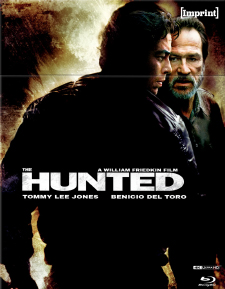
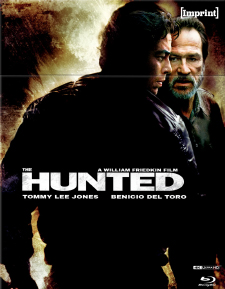
The Via Vision Region Free Limited Edition 4K Ultra HD release of The Hunted is #683 in their Imprint Collection. Limited to 1,500 units, it’s a two-disc set that includes a Blu-ray with a 1080p copy of the film and 60-page hardcover booklet featuring an essay by David Michael Brown and a reproduction of the original pressbook. Everything housed in one of Imprint’s rigid hardboxes that opens up at the top. The following extras are included:
DISC ONE: UHD
- Commentary by William Friedkin
DISC TWO: BD
- Commentary by William Friedkin
- Pursuing The Hunted (SD – 8:06)
- Filming The Hunted (SD – 9:24)
- Tracking The Hunted (SD – 4:17)
- The Cutting Edge (SD – 8:32)
- Deleted Scenes (SD – 9:47, 6 in all)
- Theatrical Trailer (SD – 2:22)
All of the extras here have been ported over from Paramount’s previous DVD and Blu-ray releases of The Hunted. That includes Friedkin’s commentary, and as anyone who has ever listened to one of his commentaries can attest, they tend to be something of a mixed bag. He was more than capable of delivering fascinating insights about his films, but he also had a tendency to devolve into simply narrating what’s happening onscreen. Many of his tracks are effectively Descriptive Audio rather than being a true commentary. For good or for ill, this one falls in the middle of the pack. Friedkin offers plenty of information about the history of the project, like how meeting Tom Brown inspired him to make a film about a tracker, but he couldn’t figure out a story until he encountered the spec script by the Griffiths brothers. He also explains that the Abraham/Isaac motif was his idea, as was getting Johnny Cash to recite the lyrics to Bob Dylan’s song. Friedkin still ends up describing the action sometimes, but in this case, he actually digs deeper into story details that aren’t necessarily obvious onscreen. It’s a worthwhile track, but one that will test your patience occasionally.
There are four featurettes about the making of The Hunted that include interviews with Friedkin, Tommy Lee Jones, Benicio del Toro, Connie Nielson, Caleb Deschanel, co-screenwriter/co-producer Art Monterastelli, Tom Brown, stunt coordinator Buddy Lee Hooker, and knife fight coordinators Rom Kier and Rafael Kayanan, among others. Pursuing The Hunted covers the story concept and building the characters for it, with Friedkin noting that Jones has always been an instinctive actor while del Toro likes to do his research. Filming The Hunted focuses on the stylistic mandates for The Hunted, with Friedkin complaining that modern action thrillers tend to be too long and too long winded when they should be as lean and mean as possible. He worked with Deschanel to create an induced documentary style for the film, letting the cameras follow the action rather than imposing themselves upon it. Tracking The Hunted features Tom Brown explaining how he wanted to make sure that the actors were able to track and evade as authentically as possible, and he also explains his thought process behind the creation of the knives that were used. Finally, The Cutting Edge covers the actual knife fights and the stunts for the film. Kier and Kayanan explain that they were trying to tell a story with the way that the characters fight.
There are also six different deleted scenes. They’re not labeled here, but on other releases, they’re listed as: FBI Sting Section, Chenoweth Arrives at Zander’s, Bonham Climbs Tree, Van Zandt Says Hallam’s Gone, Bible Reading and Loretta’s Bedroom, and Rock Trap in the Woods. They’re actually pretty illuminating, though not in the way that you might think. While they all serve to expand the story and provide more detail about some of the characters and their motivations, they would have made the film, well, too long and too long winded. They’re interesting, but not essential, so Friedkin and editor Augie Hess made the right decision to leave them on the cutting room floor. Sometimes, less is indeed more.
As with many late-period William Friedkin films, The Hunted slipped through the cracks during its theatrical release in 2003, and it didn’t get much love from its own studio on home video (frankly, Paramount’s Blu-ray was pretty terrible). Kino Lorber stepped up to the plate with their UHD version, but still fumbled the encoding. Via Vision solved that problem, making this the definitive home video release of The Hunted to date. Highly recommended for those who appreciated efficiency in action filmmaking.
- Stephen Bjork
(You can follow Stephen on social media at these links: Twitter, Facebook, BlueSky, and Letterboxd).