
Mars Attacks! (Steelbook) (4K UHD Review)
Director
Tim BurtonRelease Date(s)
1996 (August 11, 2026)Studio(s)
Tim Burton Productions/Warner Bros. Pictures (Warner Bros. Entertainment)- Film/Program Grade: B+
- Video Grade: A
- Audio Grade: A-
- Extras Grade: D

Review
“I want the people to know that they still have two out of the three branches of the government working for them, and that ain’t bad.”
Three decades after Jack Nicholson first uttered those immortal words, maybe it wouldn’t be so bad if we had at least two branches of government still working for us, but sadly, life doesn’t always imitate art. Yet that’s the central genius of Mars Attacks!: it’s a 1996 film based on a notorious 1962 series of Topps trading cards that somehow manages to feel timeless. In other words, Mars Attacks! is a product of its time that was inspired by a product from a previous era, but it captures something that (unfortunately) never goes out of style. The film’s seemingly exaggerated displays of governmental dysfunction are hilarious, but they pale in comparison to just how ridiculous that things can really get. To paraphrase the famous quotation usually attributed to J.B.S. Haldane, the government is not only stranger than we suppose, but stranger than we can suppose. There are more things in the halls of Washington D.C. than are dreamed of, or can be dreamed of, by any filmmaker.
To be fair, some of the core conflicts in Mars Attacks! are as old as government itself. On the one side, you have the hammer of a military-industrial complex that sees everything as a nail. While General Decker (Rod Steiger) was likely inspired by infamous hawks like Curtis LeMay, he foreshadowed Dick Cheney’s “One Percent” doctrine that if there’s even a 1% chance that a threat is real, it must be taken as an absolute certainty—or, as Decker puts it far more pithily, “Annihilate! Kill! Kill! Kill!” On the other side, you have the advisors and scientists who are prone to appeasement, represented in this case by Professor Donald Kessler (Pierce Brosnan), who assumes (wrongly) that any technologically advanced species must by definition be peaceful. Caught between the two extremes, you have the ineffectual President James Dale (Jack Nicholson), who is only worried about how his decisions will make him look to the public, so he’s more focused on the advice from his press secretary (Martin Short).
Naturally, you also have a complicit media complex with vain reporters like Jason Stone (Michael J. Fox) and the utterly vacuous Nathalie Lake (Sarah Jessica Parker). Stuck at the margins, you do have a few relatively normal people like the President’s bored daughter Taffy (Natalie Portman) and common folk like Ritchie (Lukas Haas), former boxer Byron Williams (Jim Brown), and his ex-wife Louise (Pam Grier). But timeless conflicts or not, Burton and screenwriter Jonathan Gems couldn’t resist throwing in at least one topical reference with the hapless General Casey (Paul Winfield), who is obviously based on the far too malleable Colin Powell (at one point, Casey tells his wife “Didn’t I always tell you honey, if I just stayed in place and never spoke up, good things were bound to happen!”) But for the most part, the satire in Mars Attacks! is more generic, so the fact that it still hits so hard today is simply because governmental dysfunction is one of the immutable laws of the universe.
The fact that Mars Attacks! turned out that way is due to another immutable law of the universe: Hollywood development hell. Improbably enough, the project started more than a decade earlier when the no less idiosyncratic Alex Cox vainly tried to bring it to fruition. It was writer Jonathan Gems who later brought the idea to Tim Burton, but after Warner Bros. greenlit the production, the screenplay went through a tortuous period of rewrites, some of them involving Gems, some not. Ultimately, the final script fused together a mélange of elements from the Topps Mars Attacks trading cards, classic science fiction like Earth vs. the Flying Saucers, and the warped imagination of Tim Burton. The fact that Burton was already hard at work on Ed Wood certainly didn’t hurt, since that put him in the right frame of mind for this kind of tongue-in-cheek fantasy pastiche.
Granted, one of the other obvious inspirations for Mars Attacks! was the disaster movie cycle of the Seventies, and in that vein, Burton assembled an appropriately all-star cast. In addition to Nicholson (twice), Steiger, Winfield, Fox, Parker, Brosnan, Portman, Brown, Grier, and Haas, he also included Glenn Close, Annette Bening, Danny DeVito, Sylvia Sydney, Tom Jones, Joe Don Baker, O-Lan Jones, Christina Applegate, Rance Howard, and a young Jack Black. Oh, and naturally Burton’s then-current muse Lisa Marie makes an appearance as well. Everyone gets into the spirit of the proceedings, with Steiger at his scenery-chewing best (his reaction to the First Lady’s response to the alien attack is priceless), and Portman is also at her snarky slacker teen best (“Guess it wasn’t the dove.”) But let’s face it: we’re all here for the gleefully sadistic aliens getting their no less gruesome comeuppance.
Burton originally intended to realize the Martians via stop-motion animation, but like Steven Spielberg with Jurassic Park two years earlier, the digital hand of fate intervened. Yet ILM intentionally reduced motion blur to give their CGI Martian animation a slightly staccato quality, and like the best traditional animators before them, they infused the nasty little beasts with plenty of personality. These Martians are genuinely sadistic sons of bitches, and that’s a big part of what makes the film so enjoyable. With the exception of Ritchie, Taffy, Byron, Louise, and a few others, most of the human characters in Mars Attacks are simple folk, the common clay of Washington D.C.—you know, morons. Aside from one rather leaden trans joke, most of the humor at the expense of these idiots is to the benefit of the film.
The twisted humor in Mars Attacks! even extends to the structure of the narrative. After all, how do you deal with a technologically advanced alien species that can laugh off your nuclear arsenal? There’s no way to do it without a Deus ex machina, as H.G. Wells already demonstrated in The War of the Worlds. But while he waited to introduce it until the very end of his story, Mars Attacks! sets it up right at the beginning of the film. In hindsight, the solution should have been obvious. Although to be fair, there are actually two different Deus ex machinas in Mars Attacks!. If only Slim Whitman could defeat technologically advanced aliens, then only Tom Jones could lead people to safety first:
“You know how to fly a plane?”
“Sure, you got one?”
That exchange serves as a litmus test for Mars Attacks! as a whole. Tom Jones appears only when the story needs him to, and for his supposed piloting skills, not for his voice. If that idea sounds inherently funny to you, then congratulations: you’re part of the club. Enjoy the show. (What he does before the closing credits is just the icing on the cake.) If you think that the whole thing sounds stupid, well, maybe you’re better off looking elsewhere for entertainment. But for those who are in on the joke, Mars Attacks! remains a hilariously demented comedy that just happens to understand more about governmental dysfunction than the people who keep trying and failing to fix it—and cinematically speaking, that ain’t bad.
Cinematographer Peter Suschitzky shot Mars Attacks! on 35mm film using Panavision Panaflex Platinum cameras with anamorphic Primo lenses, framed at 2.39:1 for its theatrical release. (While they initially considered shooting spherical Super-35 instead to facilitate the planned stop-motion work, the switch to digital effects allowed Suschitzky to go back to anamorphic.) The bulk of the interiors were shot on Kodak 100T 5248 stock, while the exteriors were shot on 200T 5293 or 500T 5298 instead (mostly the former). While there may be a few digital composites in the film, miniature and other effects plates were shot using horizontal VistaVision cameras in order to facilitate optical compositing with less obvious generational loss. Par for the course from Warner Bros., there’s no information available regarding this new 4K master, but it does indeed appear to be based on 4K scans of the original camera negative, graded for High Dynamic Range in Dolby Vision and HDR10. It’s also been encoded onto a BD-100 with a consistently high bitrate, so there aren’t any obvious issues with compression artifacts.
Due to the complicated effects work, Mars Attacks! was never going to be the last word in fine detail, but there are still noticeable improvements in that regard. The old Blu-ray version looks subtly fuzzier and less distinct, but everything here is as crisp and clear as is humanly (or Martianly) possible. The grain does vary a bit depending on the levels of optical work involved, but it’s refined in the fully live action material. Speaking of opticals, while you might expect the early digital effects work to stick out like a sore thumb in 4K, it integrates better than you might think. While much of it was digitally composited, those shots still would have been scanned back out to film, so despite the relatively low-resolution textures on the CGI models, the layer of film grain on top provides the illusion of detail and makes them blend better into their surroundings. A few of the closeups of the Martian faces do suffer a bit, and the Martian girl mask removal is as janky as ever, but Mars Attacks! looks pretty impressive in 4K.
That extends to the new HDR grading, which takes the riotous color palette of Mars Attacks! to the next level—not Speed Racer levels, but it’s definitely more intense than the old Blu-ray version. None of the subtle variations in the colors have been lost (Wide Color Gamut still does the heavy lifting here), but the bright reds, greens, oranges, and purples are more vivid than ever. It doesn’t look oversaturated—there’s none of the overcooked reds like the ones preferred by a certain indie label—but it’s entirely in keeping with the candy-colored comic book look that Burton and Suschitzky intended.
Primary audio is offered in English Dolby Atmos and 5.1 DTS-HD Master Audio. Mars Attacks! was released theatrically in 5.1, triple format Dolby Digital, DTS, and SDDS (I couldn’t verify if the latter was 8-track or not). According to Warner Bros., the 5.1 track here is the original version, and while I didn’t test it extensively, that does appear to be the case. The newly remastered Atmos track takes the existing sound design and expands it into the broader Atmos soundstage, steering effects overhead when appropriate (helicopter flybys, for example). It also sweetens the bass considerably, so this definitely isn’t your typical “neutered for streaming” Atmos mix. In fact, it arguably pushes things a bit too far at times—while it gives the sound effects more dynamic punch, it can make the bottom end of Danny Elfman’s score sound a bit muddy. Taken as a whole, however, it’s still a more satisfying and immersive mix than the original theatrical 5.1.
Additional audio options include French (Canada), French (France), German, Italian, and Spanish (Spain) 5.1 Dolby Digital, plus Spanish (Latin America) and Czech 2.0 Dolby Digital. Subtitle options include English SDH, German SDH, Italian SDH, French, Spanish (Spain), Dutch, Chinese, Korean, Spanish (Latin America), Czech, Danish, Finnish, Norwegian, and Swedish.
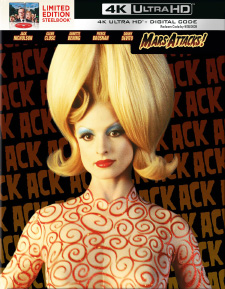
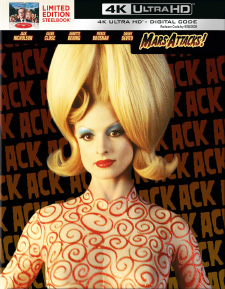
The Warner Bros. 4K Ultra HD 30th Anniversary Steelbook release of Mars Attacks! Is UHD only—there’s no Blu-ray included in the package, but it does offer a Digital Code on a paper insert tucked inside. While armchair cover art critics will doubtless still find something to complain about, it’s a nice design that includes a clear plastic slipcover that offers a transformation: Lisa Marie’s “Martian girl” is featured, but when you pull off the slipcover, her mask comes with it, revealing the real Martian underneath it. Oh, and yes, there are plenty of “Ack acks.” There’s also a J-card cardboard slipcover with the disc details. (Note that Warner Bros. is also offering a standard version if the Steelbook is unavailable.) The following extras are included, both of them in HD:
- Looking Back on Mars Attacks! (7:26)
- Ack! Ack! Aesthetic (10:50)
They’re not much, but two new extras for Mars Attacks! are two more than it’s ever had before (unless you count the isolated score track and Martian dub from the DVD)—although realistically, there was no reason why they couldn’t have been edited into a singe featurette. In any event, between the two of them, they include interviews with Jonathan Gems, Peter Suschitzky, editor Chris Lebenzon, miniature DOP Patrick Sweeney, associate producer Mark S. Miller, production designer Wynn Thomas, and sound designer Randy Thom, as well as visual effects supervisors Michael Fink, David Andrews, and James Mitchell. What they don’t include, interestingly enough, is any audio of Indian Love Call despite showing multiple clips from the film where it should have appeared, so Warner Bros. must have cheaped out on music licensing. Looking Back is mostly some retrospective thoughts about the film while Ack! Ack! Aesthetic offers a few more glimpses behind-the-scenes, especially some of the Martian props (including ones that weren’t used in the film).
While a few more in-depth extras would have been appreciated, we’re talking about a film where the Martians chew nitrogen gum to survive Earth’s atmosphere despite the fact that our atmosphere is indeed 78% nitrogen (and it’s virtually nonexistent in the scant atmosphere on Mars). In other words, Mars Attacks! isn’t the kind of film that should be thought about too deeply, just enjoyed. And it’s very enjoyable indeed in 4K with Atmos, so this is a recommended upgrade.
-Stephen Bjork
(You can follow Stephen on social media at these links: Twitter, Facebook, BlueSky, and Letterboxd).