
Ivy (Blu-ray Review)
Director
Sam WoodRelease Date(s)
1947 (March 30, 2026)Studio(s)
Sam Wood Productions/Interwood Productions (Indicator/Powerhouse Films)- Film/Program Grade: A-
- Video Grade: A-
- Audio Grade: A
- Extras Grade: B+

Review
[Editor’s Note: This is a Region B-locked British Blu-ray import.]
Sometimes what elevates a film is not so much its content but in the telling. Such is the case with Ivy (1947), a period crime drama with noir elements, similar in many ways to David Lean’s later Madeleine (1950). Ivy’s Sam Wood was the credited director of many great films, including A Night at the Opera (1935), Goodbye, Mr. Chips (1939), The Pride of the Yankees (1940), and King’s Row (1942), but few would argue Wood an unheralded auteur. Those films and others, including the parts of Gone with the Wind he directed without credit, were memorable for reasons other than Wood’s direction, particularly in the areas of production design, music, and cinematography. He knew how to surround himself with immensely talented people.
In the case of Ivy, the production design by William Cameron Menzies, also credited here as producer, is what provides the film with its distinctiveness. Wood and Menzies collaborated on a number of Wood’s best films, to the point where, reportedly, Menzies didn’t just design the sets, but laid out their entire visual design, storyboarding whole sequences and reportedly even every shot in the film. Journeyman Wood had no consistent visual style, but Ivy looks a lot like the movies Menzies made as director-production designer. Visually, it’s closer in style to the Menzies-directed Invaders from Mars and The Maze (both 1953) than other Sam Wood movies.
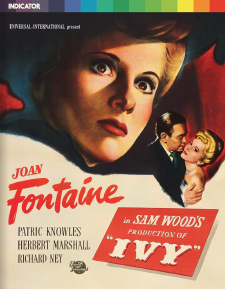
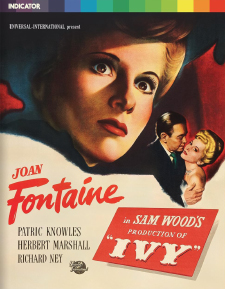
In Edwardian England, Ivy Lexton (Joan Fontaine) is unhappily married to Jervis (Richard Ney), the poor couple living beyond their meager means. Determinedly upwardly-mobile, Ivy sets her sights on wealthy Miles Rushworth (Herbert Marshall), though former lover Dr. Roger Gretorex (Patric Knowles) lives in hope she’s come back to him. Rushworth is attracted to Ivy, but will not allow himself to become involved with a married woman, and Jervis refuses to agree to a divorce.
At Gretorex’s private apothecary, Ivy steals poison, hiding it in a concealed compartment in the ruby-encrusted purse Rushworth gave her. After poisoning her husband, Gretorex makes an inopportune visit to the dying Jervis, diverting suspicion toward him and away from Ivy following Jervis’s death. During Gretorex’s trial for murder, Scotland Yard Inspector Orpington (Cedric Hardwicke) and his sergeant (Gavin Muir) notice that Ivy subtly seems to be in a hurry to see Gretorex convicted...
Menzies’s sets are distinctive and disorienting, such as the octagonal vestibule leading to various other rooms in Ivy’s home, and the weirdly designed passageway leading to Gretorex’s pharmacy, the latter like something in a German expressionism-influenced Frankenstein film. Much of it resembles the nightmarish qualities Menzies brought to Invaders from Mars, but with significantly more money at his disposal.
More than the sets, though, it’s clear Menzies storyboarded entire sequences to complement his sets. Russell Metty’s cinematography favors very tightly- and atypically-framed close-ups, sometimes with Menzies’s sets drifting off deep into the background. And, further, the unusual, sometimes awkward but often very effective cutting together of these shots give Ivy a very distinctive feel quite different from the usual Hollywood production. Even simple conversation scenes show that Wood shot an enormous amount of coverage, cut together to reflect Ivy’s psychological state-of-mind.
The story itself is generally good if predictable, though it works up considerable steam in its second-half. Joan Fontaine is likewise, good, not great, as the scheming Ivy, with Cedric Hardwicke coming off best as the police inspector. Herbert Marshall’s character reminds viewers of his role in William Wyler’s The Letter with Bette Davis. Also memorable is Una O’Connor (The Bride of Frankenstein, Witness for the Prosecution) as a fortune teller at the beginning, an atmospheric, almost supernatural opening that has little to do with the plot but whose nearly surreal Menzies sets establish the picture’s unusual tone.
Universal all but shut down its B-picture unit shortly before this, so it’s amusing to see so many regulars from the studio’s Sherlock Holmes film series appearing here, including Alan Napier (as a prosecuting barrister), Paul Cavanagh (as an outraged doctor), Gerald Hamer, Muir, and others. Lilian Fontaine, mother of Joan and Olivia de Havilland, appears as a socialite.
Powerhouse Films/Indicator’s Region “B” encoded Blu-ray of Ivy presents the film in its original black-and-white, 1.37:1 standard ratio. The video transfer is good but short of greatness, a bit less pristine than what one might have hoped, but certainly serviceable. The LPCM 1.0 mono likewise is fine, not exceptional, supported by optional English subtitles. As noted above the disc, an edition limited to 3,000 copies, is Region “B” locked and a U.K. premiere.
Extras consist of a new audio commentary by Eloise Ross; The Unappreciated Director, a 20-minute look at director Sam Wood by writer Neil Sinyard; a 1945 radio adaptation running 27 minutes and starring Ann Richards; a trailer and image gallery. Alas, The Digital Bits was sent only a check disc, and not the final product containing a 36-page booklet of essays and articles.
The unusual visual design of Ivy is its greatest asset, though the screenplay is generally good, and the performances are all above average. Definitely worth seeing.
- Stuart Galbraith IV