
Birds of Prey (1968) (Blu-ray Review)
Director
José GiovanniRelease Date(s)
1968 (June 9, 2026)Studio(s)
Production Artistique et Cinématographique/Valoria Films/Da.Ma. Cinematografica/Producciones Marte/Cinétel (Kino Lorber Studio Classics)- Film/Program Grade: B
- Video Grade: A-
- Audio Grade: A
- Extras Grade: B-

Review
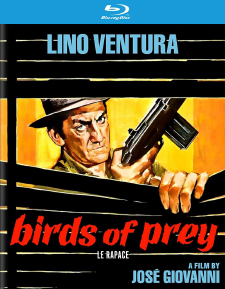
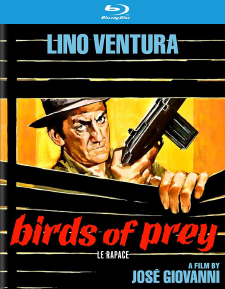
The cover art for Kino’s Blu-ray of Birds of Prey (Le Rapace), with star Lino Ventura readying an automatic weapon, peering through window blinds, suggests a late ’50s French film noir, made during Ventura’s early career when he often played gangsters. In actuality, the film is a 1968 release, a French-Italian-Mexican co-production set in sunny Central America in 1938.
In Mexico, the contract killer played by Ventura, variously called “The Italian” or “The Raptor,” but mostly “the Stranger” in the English subtitles, clandestinely enters Guatemala. Actually, the movie is cagey about just where the Stranger is supposed to be, but Guatemalan flags and other country-specific clues are in plain sight.
He’s been hired by a group of revolutionaries to assassinate the country’s president, whose fascist-like government uses its brutal police force to crack down on the peasantry. In an early scene, the revolutionaries resolve to ultimately kill the Stranger whether he succeeds or not; they also partner him with Miguel (Xavier Marc), the grandson of a former president, with the intention of crediting Miguel with the assassination, presumably to help ensure a smooth transfer of power.
More than one-third of Birds of Prey’s running time has the Stranger and Miguel holed up in room across the street from wealthy Camito (Rosa Furman), the president’s mistress, the Stranger planning to kill him upon his arrival there. Camito is a real Melania-type, blithely unconcerned with the rampant poverty and brutality all around her, she decked out in garish if bejeweled fashions, often with her pet leopard in tow.
For this third of the film, the movie operates, not very well, as a character study, the hardened, apolitical Stranger ridiculing the idealistic, naïve Miguel. The movie picks up considerable steam as the assassination attempt finally gets underway, and during the fallout of that attack.
Novelist-screenwriter-turned-director and, in 1948, a convicted murderer at one point sentenced to death, José Giovanni, of Corsican descent but Paris-born, was released from prison in 1956, after serving more than 11 years. Soon after, he became a popular writer of crime fiction, his early works adapted into screenplays by Giovanni himself into classic French films including Le Trou and Classe tous risqué. For other directors he wrote Symphony of a Massacre, Le deuxième soufflé, and the over-the-top but entertaining The Sicilian Clan. As a director, his credits include the outstanding Last Known Address, also with Ventura, and Le Scoumoune, with Jean-Paul Belmondo.
Despite being lavishly produced on location in Mexico (with some interiors shot in Paris), Birds of Prey is, for both Giovanni and Ventura, a lesser work. Whether Guatemala or someplace else, the movie doesn’t offer enough background on either side of this political struggle to truly understand it or empathize much with its players. The contrasting attitudes of the Stranger and Miguel is obvious but moderately interesting, and the blurring of good guys and bad guys is okay if overly familiar: the Stranger initially seems mercenary and heartless but his humanity eventually peaks out, while the revolutionary leaders are corrupt, means-to-an-end types. The film works better as an action-thriller yet, oddly, plays less like a French crime film than one of director Sergio Corbucci’s “Mexican Revolution” spaghetti Westerns.
The great Lino Ventura is in fine form here, circumspect with the men hiring him—a good moment has the Stranger refusing to enter the room until a henchman moves away from the door, a henchman the Stranger can’t possibly see from that vantage point, yet somehow realizes is there. One suspects that, like Clint Eastwood, Ventura cut his own dialogue, aware he was often more imposing the less he spoke. But it’s a character type Ventura played many times before and after, often in better films. Rosa Furman was a busy Mexican actress who, during this period, played small roles in a few Hollywood films (Guns for San Sebastian, Two Mules for Sister Sara). Xavier Marc, also in Two Mules for Sister Sara, had a similarly long career in Mexico, in both TV and films.
Kino’s release is welcome given the film’s relative obscurity, surprising given its relative elaborateness, at least in European production terms. (Without big Hollywood bucks, a few anachronisms appear, such as post-WWII trains, etc.)
Kino’s Region “A” Blu-ray of Birds of Prey is derived from a 4K scan by licensor StudioCanal of the original camera negative. Presented in 1.66:1 widescreen, the image is a wee bit on the yellowish side, but this may have been intended on the part of the director and/or cinematographer, as it gives the film an antique-like glean. Audio is DTS-HD Master Audio (2.0 mono), in French and Spanish with optional English subtitles.
Extras are limited to a French trailer and new audio commentary by film historian Samm Deighan. The trailer is interesting as it seems to use alternate takes and footage unused in the final cut.
Not at all what I was expecting, Birds of Prey is a little disappointing given the caliber of its writer-director and star, but it’s well worth seeing and, overall, not great but not bad.
- Stuart Galbraith IV