
Prom Night (4K UHD Review)
- Review Date: Jul 16, 2026
- Format: 4K Ultra HD
-


Director
Paul LynchRelease Date(s)
1980 (August 3, 2026)Studio(s)
Simcom Productions/Prom Night Productions (Synapse Films)- Film/Program Grade: B
- Video Grade: A
- Audio Grade: A
- Extras Grade: A
Review
It’s easy to think of Prom Night as another one of the wave of slasher films that followed in the wake of Friday the 13th in 1980, but its roots go much deeper than that. Any similarities with Friday the 13th were just a matter of timing anyway, since both films were in production more or less simultaneously, and Sean S. Cunningham’s film just happened to reach the theatres first. In reality, they were both intended to capitalize on the success of John Carpenter’s Halloween—although only Prom Night had a genuine connection to that film. Director Paul Lynch had brought his idea for a horror movie titled Don’t Go See the Doctor to Halloween executive producer Irwin Yablans, who didn’t care for the concept and suggested doing something holiday-related. Lynch ended up taking the project to producer Peter Simpson instead, but he still took Yablans’ suggestion to heart. So, he bought the story of a warped childhood game gone wrong from his acquaintance Robert Guza Jr., hired writer William Gray to expand it into a feature film set on a day of celebration, and thus Prom Night was born.
Prom Night opens in flashback, when a young Kim Hammond, her brother Alex, and their sister Robin encounter another group of children playing a particularly perverse game of hide-and-seek in an abandoned building. Before long, Robin ends up dead, with only Nick, Kelly, Jude, and Wendy knowing the dark secret why (or so it seems, anyway). Six years later, the Hammond family is still traumatized by the tragic events of that day. Kim (Jamie Lee Curtis) and Alex (Michael Tough) are trying to get ready for the school prom, but their mother (Antoinette Bower) can’t move on, and their father Mr. Hammond (top-billed Leslie Nielsen), who also happens to be the school principal, is stuck somewhere in the middle. Kim is still friends with Kelly (Mary Beth Rubens) and Jude (Joy Thompson), but her growing relationship with Nick (Casey Stevens) has driven a wedge between her and Wendy (Anne-Marie Martin). Oh, and naturally there’s an escaped killer on the loose, with Lt. McBride (George Touliatos) and Dr. Fairchild (David Gardner) on the case. But when some of the students start receiving threatening phone calls, this particular prom night threatens to turn deadly.
Prom Night is really something old, something new, something borrowed, and something—well, not exactly blue, but more shades of yellow. The holiday-adjacent timeframe was intended to capitalize on Halloween, and it even borrows the escaped killer, police lieutenant, and psychiatrist from that film. Yet the prom setting was clearly inspired by Carrie, right down to having a subplot where Wendy convinces school misfit Lou (David Mucci) to help her sabotage Kim’s moment of triumph at the prom (although it ain’t no pig that gets chopped up this time). Yet while the overall structure and story for Prom Night puts it firmly into slasher movie territory, its actual roots go even deeper than Friday the 13th, Halloween, or even Carrie. For all of the time that fans have wasted arguing about whether or not Suspiria is a giallo, they’ve tended to neglect the clear influence that the genre had on Prom Night.
To be clear, Prom Night isn’t really a giallo, but if the basic setting for the story is holiday-adjacent, then the plot can be seen as being giallo-adjacent. Paul Lynch has repeatedly made the point that he always thought of Prom Night as more of a mystery than a horror film (which may be a misguided attempt to distance himself from the genre), but he’s overlooking the fact that horror and mystery have always gone hand-in-hand—and nowhere more so than in the world of gialli. While Lynch may have taken his own path, stylistically speaking, Gray’s script for Prom Night follows the giallo template by being peppered liberally with red herrings and other false clues in order to mislead viewers. There are numerous potential suspects, even a creepy groundskeeper (David Cronenberg veteran Robert A. Sykes) who is usually wielding phallic tools like trimmers and screwdrivers. But like many gialli, the actual killer in Prom Night is driven by past trauma, even using artifacts from that trauma first to intimidate and then later to mark the bodies of the victims. And the fact that the artifacts in this case are shards of glass from broken mirrors is the yellow icing on a giallo cake.
Still, Prom Night does ultimately find its own path, one that sets it apart from the world of giallo and even the slasher subgenre as well. While there are a couple of bodies early on, the actual killings don’t start until more than two-thirds of the way into the film. And while Lynch did add one graphic decapitation in order to make distributor Avco Embassy Pictures happy, he generally cuts away from the killings instead of relying on gore (the first ax murder relies entirely on gruesome offscreen sound effects). And crucially, the killer in this case isn’t an unstoppable supernatural force like Michael Myers or Jason Voorhees (or even a nearly unstoppable one like Jason’s mother). Instead, the killer is constantly getting knocked down, kicked to the curb, and sometimes suffers nearly as much as the victims do—in fact, the overweight schlub Seymour “Slick” Crane (Sheldon Rybowski) might have escaped his fate if he hadn’t forgotten about the obvious Chekhov’s gun that was set up just a few minutes before he accidentally drives right over it. All of that serves to humanize the killer, which finally makes sense at the end after the identity is revealed (in a genuinely poignant scene).
So, no, Prom Night isn’t just another Friday the 13th knockoff. In fact, in the long run, it may have actually suffered from the fact that it was released shortly after that film. Oh, not in terms of box office; thanks to a solid marketing campaign, Prom Night rode the Friday the 13th wave to turn a tidy profit in 1980. No, the problem was that the critical knives that that were kept sheathed once Halloween became a runaway success were sharpened and ready after the release of Friday the 13th. The real slasher backlash didn’t start until later, but Friday the 13th still managed to get that ball rolling, and Prom Night got caught in that particular wake as well. While it quickly developed a cult following of its own, it still doesn’t have the same reputation as other horror classics from that era. And to be fair, no, it’s not a misunderstood masterpiece. Yet Lynch still managed to deliver an entertaining hybrid horror movie that’s a cut above the Friday the 13th knockoffs that it should never have been grouped with in the first place.
Cinematographer Robert C. New shot Prom Night on 35mm film using Panavision Panaflex cameras with spherical lenses, framed at 1.85:1 for its theatrical release. This version is based on a 4K scan of the original camera negative, cleaned up and graded for High Dynamic Range in Dolby Vision and HDR10 (it’s also been opened up slightly to 1.78:1). The results are simply gorgeous, with clear improvements over all previous home video versions. Robert New employed heavy diffusion during the opening flashback sequence and lighter diffusion in many of the later glamour shots, so it’s not always the sharpest 4K presentation, but the fine textures are still resolved beautifully here (especially in the less filtered shots). It’s nearly spotless, too (if there are any remaining blemishes or other types of damage visible, I didn’t catch them). Contrast, densities, and color reproduction are essentially perfect—in lieu of any reference material to the contrary, I see nothing to complain about with this grading. The black levels are also excellent, and the glittering peaks from the star-filtered lighting on the dance floor are vivid without ever looking blown out. (Although fair warning to those who are sensitive to flashing lights, as the HDR grade is just intense enough that the strobes may cause issues for you.)
The grain levels vary a bit depending on the shots in question—optical dupes like the opening titles look a little coarser, and the step printed slow-motion shots of the killer’s feet at 62:20 look chunky as hell, but that’s just the nature of the source. Fidelity in Motion handled the encode, so there aren’t any noteworthy issues, at least as far as the actual film grain goes. The only criticism that I have (at least on my setup, which consists of an Oppo UDP-205 feeding a JVC RS2000) could be as much to do with the HDR grade as with encode itself: I’m seeing a touch of chroma noise in bright white backgrounds like the reflection of the sky in the opening shot of the mirror, between the trees at 1:38, behind the flag at 11:47, and during the whole walk-and-talk on the bluffs with Kim and Nick. It’s not visible on the accompanying Blu-ray, so the HDR grade must be involved one way or the other.
I had someone else check the disc with Dolby Vision on a flat panel, and he didn’t notice any noise. So, it could be only the HDR10 layer, or it could be something to do with my particular setup. We’ll keep investigating and update this if we can. Regardless, even if it is an issue with the disc and not my system, it’s a minor nitpick that probably won’t be visible on all displays. In all other respects, this 4K version of Prom Night is damned near reference-quality. It’s beautiful.
Audio is offered in English Dolby Atmos and 2.0 mono DTS-HD Master Audio, with optional English SDH subtitles. Prom Night was released theatrically in mono, and this mono track was restored from the original mag DME stems. It’s clean, crystal-clear, and well balanced, with a decent amount of heft to the score and the songs. But the pleasant surprise here is the new Atmos mix, which was also derived from the same stems. It does add some sound effects, like pigeons in the building during the opening sequence and helicopters flying overhead during the aftermath. A few mono effects like thunder may have been replaced with stereo versions, but if so, they match nearly perfectly, and there’s also some bass sweetening for effects like the crashing door at 4:14. But the original effects still predominate, and it’s all pretty seamless—you’ll probably never notice the additions without switching back-and-forth between the two.
In other words, the Atmos track displays the same kind of balance that the mono version exhibits, just expanded to fill the rest of the soundstage in truly immersive fashion. Best of all, the music stems were in true stereo, and it’s impossible to overstate how much of an impact that has on the film as a whole. Yes, the disco songs are still a little dicey—and it doesn’t help that the chorus to Tonight Is Prom Night sounds eerily similar to Madonna’s “Starlight, star bright, first star I see tonight” in Lucky Star (was Madonna a Prom Night fan?) But Paul Zaza and Carl Zittrer’s score is an underrated element in the film, and it really springs to life in multichannel—Prom Night actually feels more suspenseful with score opened up like this. All that, plus tastefully remixed sound effects. What’s more could you want? Well, the original mono, of course, and thankfully that’s present here as well, sounding better than ever. Audition both and choose for yourself, but even purists might be surprised by the quality of this Atmos remix.
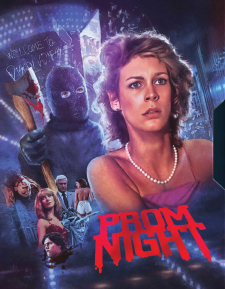
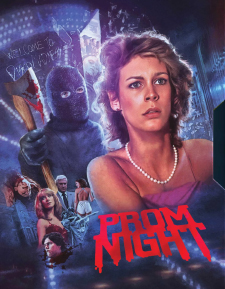
The Synapse Films Limited Edition 4K Ultra HD release of Prom Night is a two-disc set that includes a remastered Blu-ray with a 1080p copy of the film. The insert is reversible, featuring alternate poster artwork on each side, and there’s also a rigid slipcase with new artwork by Sean Longmore (plus a J-card slipcover). The set is limited to 3,000 units. The following extras are included, all of them in HD:
DISC ONE: UHD
- Commentary by Paul Lynch, William Gray, and Paul Jankiewicz
DISC TWO: BD
- Commentary by Paul Lynch, William Gray, and Pat Jankiewicz
- The Horrors of Hamilton High: The Making of Prom Night (41:02)
- Horror’s Hallowed Grounds: Prom Night (43:40)
- Additional Scenes for Television Broadcast (11:11, 7 in all)
- Rare Outtakes (23:15)
- Original Theatrical Trailer (1:45)
- Television Spots (3:17, 6 in all)
- Radio Spots (1:37, 3 in all)
- Still Gallery (6:20)
Most of the extras are ported over from Synapse’s 2014 Special Edition Blu-ray, starting with a commentary featuring Paul Lynch and William Gray, moderated by Pat Jankiewicz. It’s a lively track, with all three of them offering enthusiastic contributions, if not always factually accurate ones (during the opening flashback, they repeatedly misidentify one of the children as being culpable for what happens to Robin). They do discuss the story, the cast, the locations, and many other elements of the production, and tell a few choice stories along the way, although they also spend some time watching and reacting to what’s happening onscreen. It’s still worth a listen.
The Horrors of Hamilton High is a making-of documentary produced by Michael Felsher for his Red Shirt Pictures. It includes interviews with Paul Lynch, Mary Beth Rubens, Joy Thompson, Michael Tough, Jeff Wincott, Paul Zaza, art director Reuben Freed, and prosthetic makeup artist Warren Keillor. It also includes some fleeting behind-the-scenes footage courtesy of outtakes from the film, and Keillor brings along an old friend (fans of the film can probably guess which one). Lynch is front and center for most of The Horrors of Hamilton High, explaining how the project evolved from his original loose concept for Don’t Go See the Doctor to the final form of the film. The cast shares stories about the production (needless to say, Leslie Nielsen brought his infamous “fart machine”); Freed discusses some of the locations; Keillor explains how he created a key prop; and Zaza bemoans how the disco songs were handled wrong during the production, forcing him to scramble to come up with new music to match. Everyone also offers plenty of praise for producer Peter Simpson, and Lynch credits much of the success of Prom Night to Jamie Lee Curtis and the quality of the advertising campaign.
Speaking of outtakes, they’re included here in full in a reel titled (appropriately enough) Rare Outtakes. It consists of raw takes, with slates, arranged in chronological order as they would have appeared in the story. There’s no audio, so it’s all set to musical selections from the film.
The Additional Scenes for Television Broadcast are introduced by Michael MacLaverty, who served as the editor for the television version. As was typical for that era, he ended up pruning material that wouldn’t pass muster for television and then adding in unused footage to pad the film back out again. The whole process lasted two weeks, with his own contribution only taking a few days. Much of the added material consists of a deleted subplot involving Mr. Hammond’s temp secretary, but there are a few other pieces of miscellany as well: an extra scene with Mr. Hammond and Dr. Fairchild; Hammond’s first encounter with the temp; the girls passing notes in class; Kim searching for her dad and encountering the temp instead; the secretary taking a break to work out; and some extra Hammond family time (if you’ve ever wanted to watch Leslie Nielsen chopping wood, rejoice).
Finally, in addition to a Trailer, Television Spots, Radio Spots, and a Still Gallery, there’s one new extra, at least one that’s new to this edition: the 2023 episode of Sean Clark’s Horror’s Haunted Grounds devoted to Prom Night. Joined by Scott Carmen, aka Scott On Tape, Clark visits most of the original shooting locations for the film—and as usual, “No Trespassing” signs are no problem. Carmen talks about his own indirect connection to Prom Night, and Clark gives his reasons for believing why the abandoned hospital from the opening was located in a slightly different place than many fans think—oh, and never fear, Clark also gets to stand in for Jamie Lee Curtis in the infamous bra shot outside the school door (although he only wears an air bra, so don’t get your hopes up too much).
That’s all of Synapse’s previous extras plus one new one. The only things missing here come from various overseas editions, most of them on the 2019 Region B Blu-ray from 101 Films in the U.K.: an additional commentary by Paul McEvoy and Jake West; the Chasing the Final Girl featurette; and an interview with Paul Lynch. (There’s also an interview with William Gray that appeared on the Region B Blu-ray from Rimini in France.) But Synapse’s extras package beats them all, and as far as the audio/video quality goes? It’s no contest. It’s hard to imagine Prom Night looking and sounding any better than it does now thanks to Synapse. This release gets the highest possible recommendation.
- Stephen Bjork
(You can follow Stephen on social media at these links: Twitter, Facebook, BlueSky, and Letterboxd).