
Elephant Man, The (4K UHD Review)
Director
David LynchRelease Date(s)
1980 (July 7, 2026)Studio(s)
Brooksfilms/Paramount Pictures (The Criterion Collection – Spine #1051)- Film/Program Grade: A
- Video Grade: A
- Audio Grade: A
- Extras Grade: A

Review
“Manners. Maketh. Man.”
– Harry Hart, Kingsman: The Secret Service, 2014
“I am not an animal! I am a human being!”
– John Merrick, The Elephant Man, 1980
What makes us Man (in the capital M sense of the word) is a question that has been asked all throughout human history—what, exactly, is it that defines us as human beings? What separates us from the animals? Facile definitions like our ability to use tools have quickly proven to be erroneous. What about the wonders of human civilization? Well, given our animalistic propensity to misuse and abuse damned near everything that we create, there’s an argument to be made against that one as well. It’s all a matter of perspective, as Douglas Adams taught us:
“Man had always assumed that he was more intelligent than dolphins because he had achieved so much—the wheel, New York, wars and so on—whilst all the dolphins had ever done was muck about in the water having a good time. But conversely, the dolphins had always believed that they were far more intelligent than man—for precisely the same reasons.”
Unfortunately, shallow, ignorant creatures that we are, mankind has often defined humanity in terms of physical appearances. And all throughout history, we’ve mistreated those who don’t conform to cultural expectations of beauty, defining them not by who they are, but rather by what they look like. Manners alone aren’t enough to fit into polite society; you have to look the part. That’s readily apparent with the cinema in general, where beauty has been celebrated and deformity has been frowned upon with suspicion. Horror movies in particular have often proceeded from the assumption that monstrous-looking individuals will end up behaving monstrously. Yet the same principle has frequently held true in other genres as well. There are exceptions, of course, but it’s no coincidence that one of the most noteworthy of all of them, The Elephant Man, came from a director who had long been fascinated by the monstrous: David Lynch.
The Elephant Man was Lynch’s second feature film, but it was his first experience working for someone else—in this case, for Brooksfilms, under the aegis of none other than Mel Brooks. Producer Jonathan Sanger read the original script by Christopher De Vore and Eric Bergren and brought it to the attention of Brooks, who set it up at his production company with Lynch at the helm. Lynch rewrote the script to suit his own tastes, and despite some inevitable flights of fancy, the results still followed the broad strokes of the true story of Joseph Merrick, aka The Elephant Man. Merrick (John Hurt) is a horribly disfigured man living as a circus freak under the control of the abusive Mr. Bytes (Freddie Jones). He’s rescued from that life by Dr. Frederick Treves (Anthony Hopkins), who brings him to the London Hospital. Yet at first, he’s still treated as something of a freak by Treves and the staff, but they eventually come to realize the intelligence and dignity that’s buried beneath Merrick’s deformed exterior. The hospital’s administrator (John Gielgud) and head matron (Wendy Hillier) both defend him against those who think he’s little more than a sideshow attraction, and he even befriends some outsiders like Treves’ wife Ann (Hannah Gordon), famed actress Madge Kendall (Anne Bancroft), and even the Princess of Wales (Helen Ryan). But Bytes and an unscrupulous porter at the hospital (Michael Elphick) are waiting in the wings, leading to some bumps on the road in Merrick’s journey out of the darkness of degradation and into the light of basic human decency.
De Vore and Bergren based their draft on The Elephant Man and Other Reminiscences by the real Frederick Treves, as well as The Elephant Man: A Study in Human Dignity by Ashley Montagu. Brooksfilms made every effort to distance the film from the 1977 play The Elephant Man by Bernard Pomerance, even adding a disclaimer during the end credits: “This has been based upon the true life story of John Merrick, known as The Elephant Man, and not upon the Broadway play of the same title or any other fictional account.” Yet curiously enough, they retained Pomerance’s change of Joseph Merrick’s first name to John instead. Regardless, the wording of the disclaimer is interesting, because The Elephant Man may or may not be based on any other fictional accounts, but it’s very much a work of fiction of its own. De Vore, Bergren, and Lynch greatly altered the characters and events in order to suit the story that they wanted to tell, even inventing a few characters (like Mr. Bytes) out of whole cloth. Yet while some of the details may be inaccurate, The Elephant Man as a whole does a remarkable job of getting to the central truth of the human condition. Even the most melodramatic of moments ring so true that the film works on an emotional level that’s unlike anything else in Lynch’s filmography save perhaps for The Straight Story.
Lynch has always been attracted to the grotesque, but it’s not the grotesquery that gives The Elephant Man its power, but rather its humanity. The real monsters in The Elephant Man are Mr. Bytes, the hospital porter, and all of the people who react irrationally toward Merrick—and they all look perfectly “normal” in terms of physical appearances. Harry Hart may have been right: manners do maketh the man after all. Frankenstein’s monster behaved monstrously not so much because of his nonconformist appearance, but rather because of the unmannerly way that he was treated by his creator and everyone else around him. Merrick never behaved monstrously, but he still retreated into his shell and acted like an animal as long as he was treated like an animal. But thanks to the mannerly treatment from Dr. Frederick Treves others, Merrick’s essential humanity emerged from that shell, physical appearances be damned. What makes us human comes from within, but we still judge others based on what we can see on the outside. We’ve come a long way since Merrick’s time, but we’ve still got a long way left to go.
The Elephant Man was nominated for eight Academy Awards including Best Picture, Best Actor, Best Director, Best Adapted Screenplay, Best Art Direction, Best Costume Design, Best Film Editing, and Best Original Score. Unsurprisingly, it didn’t win a single one of them. As John Hurt once noted, it was Robert De Niro’s year for Raging Bull (and yet it still wasn’t Martin Scorsese’s year, as top honors went to Ordinary People instead). The only silver lining was that the Academy’s refusal to honor Christopher Tucker’s makeup caused a backlash that resulted in them finally creating a makeup category the following year. Regardless, it isn’t the awards that make a masterpiece, but rather the filmmakers, and The Elephant Man is a remarkable achievement by any measure. Manners maketh man, but it took an iconoclast like David Lynch to break the unmannerly mold with The Elephant Man.
Cinematographer Freddie Francis shot The Elephant Man on 35mm film using Panavision cameras with anamorphic lenses, framed at 2.39:1 for its theatrical release. This version utilizes StudioCanal’s 4K master, which was based on 4K scans of the original camera negative that were done at Silver Salt restoration in London. Digital remastering was performed by L’Immagine Ritrovata in Italy, while final grading was handled by FotoKem in Burbank—and therein lies a tale, so let’s go there. StudioCanal’s 2020 UHD release offered HDR grades in Dolby Vision and HDR10, while Criterion’s is SDR only (although it’s still 10-bit color as opposed to the 8-bit color of standard Blu-ray, but more on that in a moment). Both StudioCanal and Criterion state that David Lynch supervised the remastering work despite the differing grades. It does seem likely that Lynch did indeed approve the basic SDR master, but does that mean that he didn’t give the same stamp to the HDR grade? Or did he approve both, despite the fact that there are visible differences between the two? Either way, Criterion isn’t talking about why they opted for SDR only. Yet it’s a defensible choice.
I’m on record as having stated my preference for SDR over HDR with older black-and-white films that were shot on nitrate stock, like The Wages of Fear, I Walked with a Zombie, and The Seventh Victim. Vintage nitrate negatives simply didn’t have the kind of exposure latitude that could benefit from the expanded contrast of an HDR grade, and they tend to look more natural and filmic in SDR. The Elephant Man wasn’t shot on nitrate stock, of course, but... the same principle seems to hold true here. StudioCanal’s version does offer sharper contrast and brighter highlights, but arguably too much so with instances like the closeup of the light bulb at 21:30. The contrast between the lightest and the darkest elements may be lower via Criterion’s SDR grade, but the differences are also smoother and more natural-looking—in other words, it’s more like projected 35mm film and less like 4K video. Forgetting the improvements in fine detail from 4K resolution (which are readily apparent in this case regardless of grade), one of the biggest improvements that the Ultra HD format can offer for a black-and-white film is the move to 10-bit color, which offers quadruple the gradations between pure white and pure black compared to 8-bit Blu-ray. The benefits from the expanded grayscale greatly exceed the benefits from expanded contrast, and comparing back-and-forth between Criterion and StudioCanal, it’s arguable that the latter’s HDR grade occasionally masks some of those subtle gradations.
Granted, if you’re in the “no Dolby Vision, no sale” camp, all of that may all be meaningless to you. But keep in mind that the film’s the thing, not the delivery medium. 4K Ultra HD exists to serve the needs of the film, not the other way around. You may well prefer StudioCanal’s HDR grade, and that’s fair. But if you can compare both versions with an open mind, and no preconceptions about the superiority of HDR to SDR, you might be surprised at the results.
Side note: StudioCanal’s UHD and Blu-ray versions both contained an authoring error at 100:18 when a fade to black was incorrectly encoded as a hard cut instead. That’s been fixed for Criterion’s release, on both UHD and Blu-ray, although due their additional up-front logos, it appears at 100:43 here. A minor detail, but another win for Criterion. (The flipside is that they still respect Lynch’s wishes regarding chapter stops, so there aren’t any of them here.)
Audio is offered in English 2.0 stereo DTS-HD Master Audio, with optional English SDH subtitles. The Elephant Man was released theatrically in Dolby Stereo, and while that mix was eventually expanded to 5.1 on DVD, Lynch wasn’t happy with it. This version is from the original matrix-encoded magnetic printmaster, with digital remastering performed by StudioCanal under Lynch’s supervision. The creative sound design by Lynch and Alan Splet is similar to what they did for Eraserhead, but expanded into the wider palette offered by the four-channel Dolby Stereo matrix. There’s constant surround ambience throughout the film, like the crowds and other noises in the opening carnival scene, or rain and thunder effects later on. There’s also a low industrial drone in most of the industrial cityscapes that’s very reminiscent of the similar soundscapes in Eraserhead—Lynch and Splet doubtless dipped into their catalogue of sound effects from that film. The bass is deep when it needs to be (Lynch had some of it re-EQed for this presentation), the dialogue is clear, and the music by John Morris sounds as superb as ever. The Elephant Man has always been an outstanding Dolby Stereo mix, and it’s never sounded better than it does here.
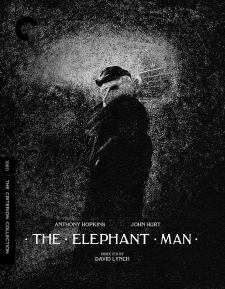
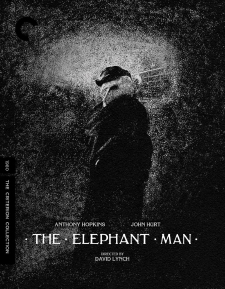
The Criterion Collection 4K Ultra HD release of The Elephant Man is a two-disc set that includes a remastered Blu-ray with a 1080p copy of the film and all of the extras. It also includes a 40-page booklet featuring an interview with David Lynch excerpted from Chris Rodley’s Lynch on Lynch, and an 1886 letter to the editor of The London Times by Francis Culling Carr Gomm, chairman of the London Hospital. Everything is housed in Digipack packaging with a rigid slipcover, with artwork designed by Drusilla Adeline/Sister Hyde. The following extras are included on the Blu-ray only:
- Room to Dream (HD – 69:52)
- Interviews:
- John Hurt, 2009 (Upscaled SD – 20:04)
- Frank Connor, 2019 (HD – 25:18)
- Jonathan Sanger at the BFI (HD – 24:27)
- David Lynch, 2009 (Upscaled SD – 24:40)
- Archival:
- David Lynch at the AFI (HD – 50:45)
- The Terrible Elephant Man Revealed (Upscaled SD – 30:11)
- Joseph Merrick: The Real Elephant Man (Upscaled SD – 19:50)
- Mike Figgis and David Lynch, 2006 (Upscaled SD – 19:51)
- Clapper Board: John Hurt (Upscaled SD – 11;42)
- Skintricks: Christopher Tucker and John Hurt (Upscaled SD – 13:39)
- Trailer (HD – 2:42)
- Radio Spots (HD – 1:23, 3 in all)
Room to Dream is an audio-only reading from David Lynch’s 2018 memoir of the same name, which he co-authored with Kristine McKenna. Lynch and McKenna take turns reading a selection from the book that revolved around the making of The Elephant Man, with McKenna handling the narrative portion and Lynch taking over to share his reminiscences. It’s the same basic story from two different perspectives, the one analytical and the other personal.
There are also four different Interviews, the oldest of which were both recorded in 2009. John Hurt covers the design of the character; why he prefers to stick to the script and avoid improvisation; his experiences with the other actors in the film; the difficulties of the shoot; the Oscar campaign; and his own feelings about the meaning of the film. David Lynch explains how he became involved with The Elephant Man after his failure to raise money for Ronnie Rocket; the working relationship that he had with Mel Brooks; his involvement in rewriting the script; the cast and crew; the way that Merrick was depicted; the look of the film; and the reactions to it after its release. Lynch also gives his reasons for turning his back on celluloid and why he now prefers to shoot digitally.
Jonathan Sanger at the BFI is a question-and-answer session with the producer after a screening of The Elephant Man for a John Hurt retrospective at the BFI Southbank in 2018, moderated by Ian Hayden-Smith. He tells the story about how he discovered the script thanks to his babysitter, and also talks about how Lynch became involved with the production, especially the uncomfortable experience of having to show Eraserhead to Mel Brooks. He also covers his experiences with the makeup, and explains the reasons why they shot the film in black-and-white. The newest interview is a 2019 session with unit still photographer Frank Connor, who discusses how he got into the business, his experiences on the set of The Elephant Man, and why he didn’t shoot any color stills for the production.
Aside from the trailers and some radio spots, the rest of the extras consist of various archival featurettes. David Lynch at the AFI is an audio-only recording of a Q&A session from 1981, with Lynch answering questions from the moderator and audience (more of the latter than the former). He’s pretty forthright about the making of The Elephant Man and his love of black-and-white film—saying that he loves texture, and was worried about being able to find the same kind of textural glue to hold a color films together (if only he knew the challenges that he was going to face making his first color film, Dune!)
The Terrible Elephant Man Revealed is a 2001 documentary about the making of The Elephant Man featuring interviews with Jonathan Sanger, Mel Brooks, John Hurt, Freddie Francis, and Christopher Tucker. It covers the development of the film, the script, Lynch’s participation, the cast, the makeup, and the shutout at the Academy Awards. While brief, it provides a nice overview of the history of the production, and the presence of Brooks and Francis alone makes it essential viewing.
Joseph Merrick: The Real Elephant Man is a 2005 interview with Jonathan Evans, archivist at the Royal London Hospital Museum. He examines how the film compares to what is known about Joseph Merrick, including the historical context in which the man lived. Evans refers to the film an interpretation of the real story, and notes many of the changes that it makes in both the details and the chronology. For example, it was Merrick himself who had first approached the circus sideshow as a way to make money—he wasn’t necessarily victimized by any kind of a Mr. Bytes, either real or fictional. Evans also talks about the mystery of Merrick’s death.
Mike Figgis and David Lynch doesn’t relate directly to The Elephant Man, but it does provide a suitably quirky look at Lynch describing his own no less quirky creative process. Figgis shot the interview himself in a bare hotel hallway with a single light bulb between them, and Lynch appears to respond well to the offbeat setting—he even shows his admiration for the bulb that Figgis chose.
Finally, there are two different archival interviews with John Hurt. Clapper Board: John Hurt was first aired on Granada Television in 1980 as a segment of the long-running series Clapperboard, with host Chris Kelly asking Hurt about his experiences making the film. Skintricks: Christopher Tucker and John Hurt is from a Dutch television broadcast in 1988, with Hurt joined by Christopher Tucker to discuss the challenges of the makeup effects. Tucker also shows off some of the molds and appliances.
The only things that are missing here from the StudioCanal set is a Still Gallery and the featurette The Air Is on Fire, which was a look at an exhibition of Lynch’s artwork and short films at the Cartier Foundation in Paris in 2007, with author and composer Michael Chion meeting Lynch for the first time. It doesn’t involve The Elephant Man, but was a rare example of Lynch actually interpreting his own art. On the other hand, StudioCanal was missing Room to Dream, David Lynch at the AFI, Clapper Board, and Skintricks. But aside from StudioCanal’s additional extras and a brief Christopher Tucker-narrated photo gallery from various DVD releases, Criterion has included all of the previously available extras here. So, they clearly have the edge in regards to their supplemental package. Their lack of an HDR grade will unquestionably bother some people, but for my money, you can’t beat Criterion’s video quality, either. No, I’m not going to get rid of my StudioCanal version, but when I’m in the mood to rewatch The Elephant Man, I’ll be reaching for Criterion first. Highly recommended.
- Stephen Bjork
(You can follow Stephen on social media at these links: Twitter, Facebook, BlueSky, and Letterboxd).