
Stingray: The Complete Series (Blu-ray Review)
Director
VariousRelease Date(s)
1964-1965 (November 26, 2025)Studio(s)
AP Films/Associated Television/ITC Entertainment (Imprint Television/Via Vision Entertainment)- Film/Program Grade: A-
- Video Grade: A-
- Audio Grade: A
- Extras Grade: A

Review
[Editor’s Note: This is a Region-Free Australian Blu-ray import.]
“Stand by for action!”
Sandwiched between Fireball XL5 and Thunderbirds, the 39-episode Stingray (1964-1965) was the third of Gerry & Sylvia Anderson’s programs in “Supermarionation” (though besides the first, Supercar, some include the show that preceded it, Four Feather Falls), and it was the very first British television series to be made entirely in color. In the Anderson’s typically imaginative, kinetic title design, the show briefly opens in black-and-white, a title card announces that it’s being presented in “Videcolor,” and the program bursts into bright, primary colors.
A kind of puppet show version of Irwin Allen’s Voyage to the Bottom of the Sea, that TV series premiering the same year, one could argue that Stingray’s acting is less wooden, and its sci-fi/fantasy scripts more credible. It’s a fun show, if inherently limited by its mostly underwater setting. Imprint’s Region-Free boxed set is another winner: the restored (from the original 35mm negatives) video transfer looks great, if not quite as splendiferous as their boxed Blu-ray set of Captain Scarlet and the Mysterons (a later Anderson series), and likewise packed to the gills with extra features.
Set a hundred or so years into the future (the 2060s), Stingray has the World Aquanaut Security Patrol (WASP) policing the world’s oceans. Stingray, an exploratory-combat submarine, is crewed by Captain Troy Tempest (voiced by Don Mason, and modeled after actor James Garner), navigator Lt. “Phones” (Robert Easton) and, usually, Marina (modeled after both Ursula Andress and Brigitte Bardot), a beauty from an undersea race. She’s also mute, which makes for some awkward puppetry since she never speaks and must pantomime to communicate.
Stingray’s home port is WASP’s headquarters in Marineville, somewhere along the west coast of North America. (Like other Andersons shows, this HQ can move underground in the event of an emergency.) Their boss is Commander Sam Shore (voiced by Ray Barrett), who moves about seated in a “hoverchair,” making him, possibly, the first disabled regular character in a TV series. His daughter, Lt. Atlanta Shore (Lois Maxwell, modeled after... Lois Maxwell) helps out; she and Marina vie for Troy’s affections in a furtive love triangle.
The premise presupposes myriad humanoid races living in vast undersea cities, waging war against the encroaching “terraneans” on land, threatening their technologically advanced but otherwise medieval kingdoms, especially King Titan (Barrett, modelled after Claude Rains) of Titanica. (There seem to be various species involved; their designs vary.) Troy and Phones are dispatched to combat their latest threats to humankind.
After going into outer space for Fireball XL5, for the Andersons the next logical step was underwater, but this was limiting and less variable in terms of storytelling relative to Fireball (which this reviewer prefers to Stingray), and more challenging in terms of the special effects. Unlike Voyage to the Bottom of the Sea, which used a combination of “dry” and “wet” miniature settings, Stingray’s underwater scenes were shot entirely dry: models guided along wires, shot through a thin aquarium populated by minnows and other small fish, unconvincingly playing large ones. The inability to “miniaturize” water droplets only further draws attention to the toy-like models. Like many early color television productions, the designers created a riot of bright, primary colors, adding to the somewhat unreal look, like Disneyland’s late, lamented Submarine Voyage ride. The underwater cities are imaginatively designed, incorporating much aquatic iconography, but are likewise gaudy, again rather like Irwin Allen’s TV shows once those went to color.
“Anything can happen in the next half-hour!”
Nevertheless, for a kid’s show it is lavishly produced: GBP 1 million for the series, about USD $72,000 per episode, at a time when most Hollywood-made B&W half-hours came in at around $50,000 per episode. The high budgets and use of color were attempts to appeal to the American TV market, where it was successfully syndicated, reportedly earning three times the program’s cost in that territory alone.
The voice cast helps liven things up. Albeit in puppet form, Lois Maxwell has more to do in Stingray than all her 007 appearances put together. Canadian Don Mason is a little bland but acceptable as Troy, in the tradition of interchangeable American-accented voices populating these shows, but Robert Easton is another matter. Born in Milwaukee, Easton spent most of his early career playing Southern-fried hayseeds, including a similar part as “Sparks” in the movie version of Voyage to the Bottom of the Sea (1961). In Stingray, “Phones” is an agreeable blend of comedy relief and capable right-hand man to Troy. Post-Stingray, Easton became a much sought-after dialect coach, the “Henry Higgins of Hollywood” to stars as varied as Laurence Olivier and Arnold Schwarzenegger.
First released to Blu-ray by the now-defunct Network in the U.K. in 2022, Australia’s Imprint label has released its own lavish, Region-Free boxed set, limited to 1,500 copies. The sturdy box contains seven Blu-ray discs. Episodes are presented in production, rather than airdate order.
The 1080p video transfers are very impressive, if measurably less so than Imprint’s earlier release of Captain Scarlet and the Mysterons, which really dazzles. Nevertheless, the colors pop, while the amount of detail allows one to appreciate the set and character design and special effects better. The LPCM 2.0 mono is equally impressive in its own way, and optional English subtitles are provided.
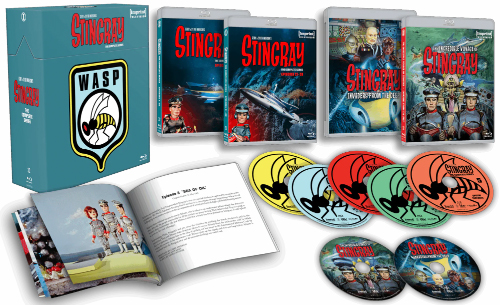
In addition to the 150-page hardcover book on the making of the series, the disc-based extra features are endless. They consist of the following:
- Audio Commentary on Plant of Doom by Graeme Bassett and Richard Farrell
- Audio Commentary on Stingray by Graeme Bassett and Richard Farrell
- Audio Commentary on Stingray by Gerry Anderson (2001)
- Audio Commentary on The Big Gun by Graeme Bassett and Richard Farrell
- Audio Commentary on An Echo of Danger by Graeme Bassett and Richard Farrell
- Audio Commentary on The Disappearing Ships by Graeme Bassett and Richard Farrell
- Audio Commentary on Titan Goes Pop by Jaz Wiseman and Al Samujh
- Audio Commentary on The Reunion Party by Jaz Wiseman and Al Samujh
- Audio Commentary on Stand By for Action by Jaz Wiseman and Al Samujh
- Audio Commentary on Stand By for Action by Gerry Anderson (2001)
- We Are About to Launch Stingray! (2022)
- Sylvia Anderson Interview
- The Reunion Party 40th Anniversary Episode Utilizing the Japanese Stingray Presentation Footage in HD
- Century 21 Tech Talk: Stingray (2019)
- Japanese Feature Presentation Footage
- Give-a-Show Projector Image Gallery
- Walton Home Movies
- Image Gallery
- Lincoln Toy Advert
- Des O’Connor Sketch
- Ad Bumpers
- French End Titles
Despite some minor shortcomings, like all of the Anderson’s Supermarionation shows, Stingray continues their constant technological production innovations and overflows with wild imagination. That’s an impressive achievement, as is the fact that the show still entertains children and adults more than 60 years after it was made. Imprint’s release, from the sturdy box itself to the video transfers and imaginative extras, make this a must-have for fans.
- Stuart Galbraith IV