
King Richard and the Crusaders (Blu-ray Review)
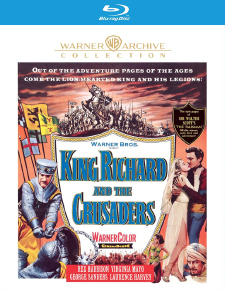
Director
David ButlerRelease Date(s)
1954 (April 28, 2026)Studio(s)
Warner Bros. Pictures (Warner Archive Collection)- Film/Program Grade: C
- Video Grade: A
- Audio Grade: A
- Extras Grade: B
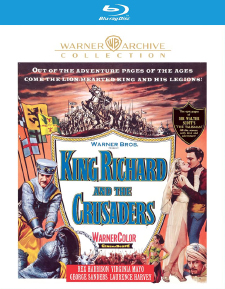

Review
Proving a rich source for adventure and intrigue, the Crusades served as the basis of a number of films in the 1950s and 1960s, among them The Mighty Crusaders, Saladin the Victorious and El Cid. More introspective than the typical Crusader film, Ingmar Bergman’s The Seventh Seal told of a disillusioned knight returned from the Holy Land during the Black Death. King Richard and the Crusaders, based on a novel by Sir Walter Scott, relies on the adventure genre and an all-star cast in a CinemaScope spectacle.
Richard the Lion Heart (George Sanders) is struck by a poisoned Saracen arrow surreptitiously shot by a Christian assassin, the result of contentious bickering as to who would lead the attack against Saladin. When Saladin learns of Richard’s life-threatening injury, he sends his personal healer to minister to the warrior king. The physician, actually Saladin (Rex Harrison) himself under an assumed name, works his cure using a magic talisman only after securing a promise that the two rulers will later resolve the nearly two centuries of struggle over the Holy Land in a joust between them.
Sir Kenneth (Laurence Harvey), a valiant Scotsman, tries to convince Richard that he will be loyal to the English king and willing to die under his command because he admires Richard’s deeds. Richard remains suspicious of Sir Kenneth and regards Sir Giles Amaury (Robert Douglas) and the Marquis of Montferrat (Michael Pate), as his closest allies. Eager for power and glory, Sir Giles plans to eliminate Richard and take command of the Crusaders.
Meanwhile, a romance between Richard’s cousin Lady Edith (Virginia Mayo) and Sir Kenneth becomes threatened by Saladin’s marriage proposal to Edith, a match that would bring peace and unify Christians and Moslems.
Director David Butler is saddled with a dumb script by John Twist with deadeningly idiotic dialogue in florid language that makes scenes unintentionally funny. The battle scenes are well staged and when they dominate, the film delivers some excitement, but in intimate scenes, the film flounders.
Sanders, who might have been better cast as the wily Sir Giles, lacks the screen presence to embody King Richard. He recites his dialogue as if he’s half asleep, with little or no body language to back up his regal pronouncements. Harrison, who in two years would play the role of Henry Higgins in My Fair Lady on Broadway, overacts with a face plastered with dark make-up to make him appear Arabic.
Virginia Mayo, never one of the screen’s best actresses, is awful as Lady Edith. Her fictional character does little for the plot other than to create a bit of tension as both Sir Kenneth and Saladin desire her affection. Her romantic scenes suffer the most and are awkwardly staged by director Butler. Of all the actors, Mayo is burdened with the silliest, most anachronistic dialogue. At one point, she strikes an annoyed pose and confronts her cousin Richard about his penchant for war with, “That’s all you ever think of, Dickie Plantagenet! You burner, you pillager!”
A young Laurence Harvey is nearly unrecognizable in a blonde wig. He, too, is undermined by screenwriter Twist’s dreadful dialogue and his chemistry with Mayo is non-existent. As the supposed hero of the film, his Sir Kenneth is off screen too much, and the villains, who are more colorful and interesting, take the spotlight.
This was Warner Bros. first CinemaScope production, and the battle scenes look especially grand on the wide screen. Action-wise, it delivers with elaborate horse stunts, exciting jousting matches, darting arrows, and dashing swordplay. Much of the action was staged by second-unit director Yakima Canutt, who adds considerable production value. It’s disappointing that the film is so out of balance. When the action stops, the film’s flaws are magnified.
King Richard and the Crusaders was shot by director of photography J. Peverell Marley on 35mm film with anamorphic lenses, processed by Warner Bros. Studio Laboratory, and presented in the aspect ratio of 2.55:1. Clarity on the Blu-ray is excellent. Details such as costumes on Saladin’s and Richard’s men, Virginia Mayo’s dresses, banners, items in Richard’s encampment, and desert expanses are well delineated. Complexions are well rendered but Rex Harrison’s thick, brown facial make-up makes his Saladin look clownish. Outdoor scenes are excitingly staged with lots of horse and foot soldier action.
The soundtrack is English 2.0 mono DTS-HD Master Audio. English SDH subtitles are an option. Dialogue is clear. Sound effects include horses’ hooves, swords clanking, a mace hitting a shield, arrows cutting through the air, jousters knocking their opponents off their horses, and men shouting in triumph. Max Steiner’s symphonic score is sweeping and glorious, giving the picture an epic feel, but it isn’t enough to obscure John Twist’s screenplay shortcomings.
Bonus features on the Blu-ray release from the Warner Archive Collection include the following:
- Satan’s Waitin’ (7:06)
- Baby Buggy Bunny (7:07)
- So You Want to Be a Banker (9:49)
- Original Theatrical Trailer (3:19)
Satan’s Waitin’ – In this 1954 Technicolor Merrie Melodies cartoon directed by Friz Freleng, the comedy takes a dark turn. As Sylvester chases Tweety along a high building ledge, he accidentally falls to his death. His spirit descends to Hell, a fiery underworld ruled by Satan, a menacing red bulldog. Satan looks at Sylvester’s record but can’t claim him because cats have nine lives. Instead, he orders Sylvester’s first spirit to wait while he tricks the cat back on Earth to take extreme risks. Sylvester returns to life and is killed off in several slapstick ways. Voice characterizations are provided by Mel Blanc.
Baby Buggy Bunny – Directed by Chuck Jones, this 1954 Merrie Melodies Technicolor cartoon focuses on a tiny, 35-year-old bank robber named Ant Hill Harry, aka “Babyface” Finster. After pulling off a bank heist using stilts, Finster loses his bag of stolen loot down Bugs Bunny’s rabbit hole. To retrieve the money, the ruthless thief dresses up as an abandoned orphan baby and leaves himself on Bugs’ doorstep. Mel Blanc provides voice characterizations.
So You Want to Be a Banker – George O’Hanlon stars as Joe Doakes. On graduating from Potash University, Joe gets a job at a bank run by his wealthy former classmate, Harrington Arrington Farrington (Alvy Moore). Joe spends years struggling through low-paying menial bank tasks while his classmate thrives. Joe eventually learns the inner workings of the system well enough to embezzle $1 million and takes over the bank.
Adapted from Sir Walter Scott’s The Talisman, King Richard and the Crusaders is unusual in its treatment of the Moslem Saladin. Generally in movies of the period, Moslems were depicted as the bad guys, the infidels, the villains. In this film, Saladin is well-spoken and progressive in his ideals. He has a keen sense of decency and a genuine yearning for peace. Whether accurate or not, this characterization gives Harrison a chance to play Saladin with more than one layer. Director David Butler fails to give the non-action sequences life. Often, characters spout dialogue from stationary positions. The more adventurous camera angles are employed in the battle scenes. Is the film entertaining? On a camp level, sure. But if static dialogue scenes with excessively florid language get on your nerves, King Richard and the Crusaders isn’t for you.
- Dennis Seuling