
To Live and Die in L.A. (4K UHD Review)
- Review Date: Jul 14, 2026
- Format: 4K Ultra HD
-


Director
William FriedkinRelease Date(s)
1985 (July 6, 2026)Studio(s)
United Artists/Metro-Goldwyn-Mayer (Arrow Video)- Film/Program Grade: A
- Video Grade: A-
- Audio Grade: A
- Extras Grade: A-

Review
[Editor’s Note: This is a Region-Free British 4K Ultra HD import.]
When William Friedkin unleashed The French Connection on unsuspecting audiences in 1971, he ended up revitalizing the entire police genre while setting the template for many of the cop movies that followed over the rest of the decade—and he kickstarted his own career in the process, too. Of course, nothing ever occurs in a vacuum, and intentionally or not, Friedkin was only walking in the footsteps of French director Yves Boisset, whose brutally amoral thriller The Cop (aka Un condé) had been released the previous year. Still, Friedkin did introduce new levels of cop movie grittiness to North American audiences, and he also raised the stakes for action scenes with a car chase that instantly became the stuff of legend. Yet by the early Eighties, both the genre and Friedkin’s career were in a bit of a rut, but he managed to inject new life into them one more time with To Live and Die in L.A. Once again, he pushed the boundaries of good taste, this time by taking the superficial gloss of Miami Vice and dragging it into a literal gutter. He also delivered another exceptional car chase that pushed the limits of control, perfectly mirroring the personality of his antihero Richard Chance (William Peterson).
The milieu of To Live and Die in L.A. is significantly different than that of The French Connection, and not just in terms of flipping the setting from the East Coast to the West Coast, either. Instead of policeman fighting drug traffickers, it’s Secret Service agents in pursuit of counterfeiters. Still, an unprincipled law enforcement officer by any other name still smells like a dirty cop, and To Live and Die in L.A. is very much a cop movie. In fact, despite the obvious Eighties trappings like the Wang Chung technopop score, MTV-style editing, and the neon/pastel color scheme, what lies underneath that deceptively glossy surface is a pure Seventies cop thriller that’s entirely consistent with the likes of The French Connection, The Seven-Ups, or The Taking of Pelham One Two Three. To Live and Die in L.A. may look like Miami Vice, but it feels like a modern urban retelling of Joseph Conrad’s Heart of Darkness. As Friedkin has noted, there’s more than just counterfeit currency at play in the film; everything is counterfeit, from the relationships between the characters to the warped sense of ethics that guides their behavior.
The Eighties was the decade of entertaining buddy cop movies like 48 Hours, Running Scared, and Lethal Weapon, but To Live and Die in L.A. provided an anodyne to that trend by essentially being the anti-buddy cop movie. It’s a cautionary tale about the seductiveness of corruption, showcasing the inevitable deleterious results of thinking that the ends justify any possible means. (Spoiler alert: they don’t.) Ironically enough, in this world of corrupt judges, shady lawyers, and amoral law enforcement officers, the only individual who demonstrates any kind of a code of honor is the murderous counterfeiter Rick Masters (Willem Dafoe). Masters is a tortured artist who burns any of his creations once he feels that they’re no longer of any value to him, which includes both his paintings and his counterfeit currency. Yet he makes a point of dealing equitably with his “business” associates, at least up to the moment at which he feels that he has been (or will be) double-crossed by them.
Richard Chance, on the other hand, lives his entire life by obsessively-compulsively pushing the limits in every aspect of his personal and professional circumstances. When he feels the need to exact revenge on Masters for killing one of his associates, he has no boundaries whatsoever regarding what he’ll do in order to achieve that goal. He mercilessly uses his informant and part-time girlfriend Ruth (Darlanne Fluegel) in order to get to Masters, threatening her with revoking her parole if she doesn’t help him. He also has no compunction whatsoever about dragging his new partner John Vukovich (John Pankow) down with him during their pursuit of Masters. Chance systematically pushes Vukovich to the edges of his own moral scruples and then beyond, eventually creating a doppelgänger in the process—as Ruth will discover during the film’s coda, much to her regret.
To Live and Die in L.A. is based on the 1984 novel by former Secret Service agent Gerald Petievich, who co-wrote the screenplay for the film along with Friedkin. They efficiently establish Chance’s unbridled nature from the moment that the opening credits finish by showing him base jumping off a bridge on a bet from his coworkers (the descender rig stunt was performed by the late great Dar Robinson, who also appears later in the film as an FBI agent). Chance continues that freefall unabated for the rest of the story—and just in case anyone might lose sight of the metaphor, Friedkin repeatedly flashes back to the jump during key moments. And if that’s still too subtle for some viewers, Chance also wears an incongruous set of cowboy boots for most of the picture, although he’s magically wearing sneakers whenever he has to chase anyone. Speaking of which, the chases in To Live and Die in L.A., both on foot and by vehicle, aren’t just remarkably well-staged action scenes; they’re an essential means of defining Chance’s character. The action in the film pushes the limits of control, just like Chance does.
None of that would work if Friedkin hadn’t found his ideal Richard Chance in William Peterson, since the entire film would collapse without Peterson’s Oscar-caliber performance. Not to put too fine a point on it, but Chance is a complete bastard and a genuinely vile human being, taking the concept of an antihero to its logical extreme and then some. Peterson is renowned for his intensity as an actor, but that kind of intensity goes hand in hand with a peculiar form of charisma. Gene Hackman managed to keep the morally questionable Popeye Doyle likeable thanks to his own raffish charm, but Peterson managed to make the thoroughly repellant Richard Chance seem oddly compelling no matter how deep that he dives into the heart of darkness. That’s a real achievement, by any measure.
Granted, the entirety of To Lie and Die in L.A. is an achievement on every possible level: the acting, stunt work, cinematography, editing, and even the music are all equally vital to the success of the film as a whole. Friedkin warned Wang Chung that he didn’t want a theme song with the title of the film in the lyrics, which was a mandate that they immediately broke with what they wrote for the opening sequence. Yet it couldn’t possibly have been more perfect to set the tone for everything that followed. Eighties audiences weren’t necessarily impressed, so To Live and Die in L.A. wasn’t as big of a hit as The French Connection had been, barely breaking even at the box office. (Needless to say, the Oscars wouldn’t touch it with a ten-foot pole, either.) Still, it made a huge impression on those of us who saw it back in 1985 (the ending alone left scars that are still felt to this very day), and it’s proven highly influential in the years since then. Just like The French Connection, it’s been often imitated, but rarely equaled—not even by Friedkin himself, unfortunately, but that’s a story for another day.
Cinematographer Robby Müller shot To Live and Die in L.A. on 35mm film using Arriflex BL3 cameras with Zeiss and Cooke spherical lenses, framed at 1.85:1 for its theatrical release. Arrow’s version uses a 4K master supplied by MGM and Park Circus, which appears to be identical to the one that was used on Kino Lorber’s UHD release. It’s based on a 4K scan of the original camera negative, digitally remastered and graded for High Dynamic Range in Dolby Vision and HDR10. The twist is that Arrow says that “additional picture restoration was completed by R3Store Studios,” but there’s no indication of the work that was done. It may have been basic cleanup—the Kino version still had some fleeting speckling and single-frame scratches visible, most of which seems less noticeable now (although I didn’t keep timestamps in order to verify that fact). Fine textures like skin, clothing, and various background details still display refinements compared to 1080p, and while the grain has been reduced, it’s still present and looking slightly better than it did on Kino’s disc, mostly due to encoding differences. A few examples: the grain on the dupe footage of the cityscape at 5:56 is less noisy and blocky (although it’s still petty ugly in this version). Other shots of the sky in the background, like at 9:00 and 59:05, have less of Kino’s trademarked swirling patterns—again, it’s still not perfect, but it’s noticeably better, especially in motion.
Aside from any extra cleanup and an improved encode, the grading displays the same strengths and weaknesses as Kino Lorber’s UHD. The contrast range is improved compared to Blu-ray, and there’s deeper color saturation. Highlights like the street lamps and flames burn just a bit hotter, and at the opposite end of the spectrum, shadow detail is better resolved—when Masters opens the warehouse door at 16:30, his black shirt and black leather jacket are both distinguishable from the shadowy black background. The rich red and green tones of the opening credits look more intense via HDR, but still in keeping with previous SDR versions. On the other hand, there’s some variance with intensity of the grading and the flesh tones. They generally look natural, but sometimes they display a stronger red/orange push than on previous versions. It’s noticeable in the walk-and-talk with Masters and Jeff Rice (Steve James) starting at 51:50, but it’s even stronger in the following sequence at the prison yard where Carl Cody (John Turturro) is attacked. To be fair, since both of those scenes are staged with the sun on the horizon, it does seem to be an intentional interpretation of sunrise/sunset lighting. It’s still noticeably different than on any of the previous Shout! Factory, Arrow, or MGM Blu-ray masters. It’s nothing as revisionary as Friedkin’s infamous retiming of The French Connection for its initial Blu-ray release, but it’s still worth mentioning.
Audio is offered in English 2.0 LPCM and 5.1 DTS-HD Master Audio, with optional English SDH subtitles. To Live and Die in L.A. was released theatrically in Dolby Stereo, while the 5.1 remix was produced for the 2003 DVD. It’s largely a straightforward discrete encoding of the original four channels (there’s no split surround activity), but some elements may have been rebalanced and re-EQed over the years. It tends to sound thin and brittle, with a harsh top end. Where things get interesting here is with Arrow’s 2.0 track. The 2.0 audio on Kino Lorber’s UHD has been accused of being a fold-down of their 5.1, which may or may not be true, but it was definitely inferior to this version. That’s because Arrow went back to the uncompressed PCM digital audio tracks on the 1992 Image Entertainment LaserDisc reissue of To Live and Die in L.A. (the original 1986 LD from Vestron Video had analogue audio only). That’s thanks to Spencer Draper, who has long championed the Image LD audio as being superior to all others. It appears to be an unretouched port of the original Dolby Stereo tracks, minus any alterations, re-EQ, compression, or any of the other tinkering that has occurred over the years. (Þorsteinn Gíslason handled audio remastering duties for this release.)
The results speak for themselves. If there’s one word to describe the improvements compared to all other digital disc versions, it would be “robust”—or, more to be more in the spirit of Friedkin’s deliberate transgressiveness, the audio finally has balls again. The dynamics are better, there’s more low-level information audible in the quietest scenes, and the loudest moments have real heft. Perhaps most importantly for fans of the film, Wang Chung’s music is also more robust, with the midrange restored, the harsh top end rolled off gently, and a smoother overall tonal balance. (Speaking as someone who has the intro for Wake Up, Stop Dreaming as the ringtone on his phone, I did a double take this time when the track first started to play in the film.) The dialogue is crystal clear, even if some of the ADR still stands out like a sore thumb (especially Robert Downey Sr.’s overdubs in his first scene). The surround activity is somewhat limited, but that’s in keeping with many Dolby Stereo mixes from that era. But it’s there, so don’t make the mistake of not turning on your decoder. (Friendly reminder: yes, Virginia, surround sound existed before 5.1.)
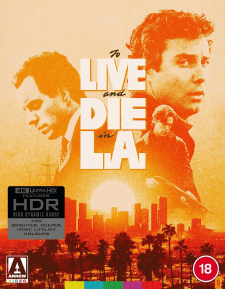
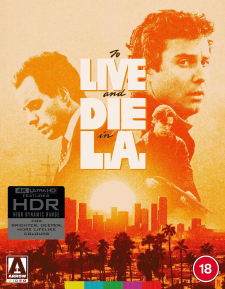
Arrow’s Limited Edition 4K Ultra HD release of To Live and Die in L.A. is UHD only—there’s no Blu-ray included in the package. The insert is reversible, featuring the familiar theatrical poster artwork on one side and new artwork by Eric Adrian Lee on the other. It also includes a slipcover with the new artwork; a 40-page booklet with essays by Anne Bilson and Ric Gentry; and a “counterfeit” $20 bill featuring a character portrait in place of Andrew Jackson and the L.A. skyline on the reverse (I got Rick Masters, but I’ve heard that there are others). The following extras are included:
- Commentary by William Friedkin
- Taking a Chance (HD – 20:42)
- Renaissance Woman in L.A. (HD – 14:56)
- Doctor for a Day (HD – 8:53)
- So in Phase: Scoring To Live and Die in L.A. (HD – 12:44)
- Wrong Way: The Stunts of To Live and Die in L.A. (HD – 35:39)
- Counterfeit World: The Making of To Live and Die in L.A. (Upscaled SD – 29:41)
- Alternate Ending:
- Alternate Ending (Upscaled SD – 6:00)
- Alternate Ending with Introduction (Upscaled SD – 8:20)
- Deleted Scene:
- Deleted Scene (Upscaled SD – 2:05)
- Deleted Scene with Introduction (Upscaled SD – 3:58)
- Trailer Gallery:
- Theatrical Trailers (HD & Upscaled SD – 3:33, 2 in all)
- Radio Spot (HD – 1:05)
The commentary track with William Friedkin was originally recorded for the 2003 MGM Blu-ray release of To Live and Die in L.A. He opens by saying that he’s not going to provide a scene-specific commentary as much as he’s going to give his impressions, thoughts, and feelings about what went into the making of the film. Anyone who’s familiar with Friedkin’s commentaries knows that he’s prone to falling into the trap of narrating what’s happening onscreen, so his approach here is actually a good thing. He gives a broad overview of the inspirations for the film, including his work with Petievich, as well as many practical stories about the production and working with the actors. Naturally, he also covers the car chase in some detail, as well as other technical information like the then-innovative use of a Louma crane for the shot of William Peterson standing at the edge of the bridge. It’s a fascinating commentary, especially since Friedkin stays focused throughout (for once).
The interviews were all recorded for the 2016 Shout! Factory Blu-ray, starting with the cast. Taking a Chance is with William Peterson, who describes his journey from playing Stanley Kowalski in a Canadian production of A Streetcar Named Desire to starring in To Live and Die in L.A., thanks in no small part to a kindly recommendation from his friend Gary Sinise. (Peterson returned the favor by recommending his own friend John Pankow for Vukovich.) He says that he learned more lessons working with Friedkin and Michael Mann on just his first two films than he would have if he had spent twenty years in Los Angeles. He offers plenty of stories about the way that the entire production pushed the limits just as much as his character did. Renaissance Woman in L.A. is with Debra Feuer, who also offers praise for Friedkin’s unconventional shooting style. People had told her to watch out for him, but he made her feel comfortable on set at all times despite the challenging nature of some of the material that she had to perform. Doctor for a Day is with Dwier Brown, who only had a single scene in To Live and Die in L.A. but he went on to play a bigger role in Friedkin’s The Guardian. (Friedkin completely forgot that they had worked together previously.)
There are also two interviews with different crew members. So in Phase is with Wang Chung’s Jack Hues and Nick Feldman. To Live and Die in L.A. was their first time working on a feature film, and they say that the experience inspired them to move on to the next phase of their career. They confirm that Friedkin had told them that he didn’t want a song with the words “to live and die in L.A.” in the lyrics, but he loved what they ended up doing with it. Wrong Way is with stunt coordinator Buddy Joe Hooker, who discusses the nature of his profession and the way that it’s changed in the modern CGI era. To Live and Die in L.A. was the first of seven films he did with Friedkin, and he describes the ways in which he brought the director’s visions to life. Hooker proudly notes that with all due respects to The French Connection and Bullitt, he believes that the car chase in To Live and Die in L.A. was the greatest one ever filmed up to that point in time. (He also provides a good explanation for why Friedkin wanted the traffic going the wrong way down the L.A. freeway system.)
The rest of the extras were originally produced for the 2003 DVD from MGM/UA. Counterfeit World is a making-of featurette that mixes interviews, film clips, and behind-the-scenes footage. Directed by Michael Arick and edited by none other than Cinesavant’s Glenn Erickson, it features interviews with Friedkin, Peterson, Pankow, Dafoe, and the late Darlanne Fluegel, as well as with producer Bud Smith, property master Barry Bedig, Buddy Joe Hooker, and Gerald Petievich. Friedkin reiterates that he saw the whole story as consisting of counterfeits: counterfeit currency, counterfeit emotions, counterfeit relationships, counterfeit motives, and counterfeit structures at the Secret Service. Speaking of which, there’s a fairly detailed look at the semi-illicit counterfeiting sequence from the film, a scene that caused no lack of issues for the production. There’s also a good examination of the action sequences such as the car chase and the airport foot chase. For anyone unfamiliar with the fascinating history of To Live and Die in L.A., this is probably the best place to start.
Finally, the Alternate Ending offers a very different coda that Friedkin shot only to placate the studio, even though he had no intention whatsoever of actually using it, while the Deleted Scene includes a brief moment between Vukovich and his soon to be ex-wife, who was completely eliminated from the final cut. In the optional introduction to the Alternate Ending, Friedkin, Peterson, Pankow, and Bud Smith all give their thoughts about why the scene wasn’t used, while Friedkin handles the Deleted Scene mostly solo.
No new extras, but that’s nearly everything that’s been included on previous releases of To Live and Die in L.A. The only noteworthy omission is the Still Gallery that was included on Shout! Factory’s Blu-ray and Arrow’s own 2016 Blu-ray, so it’s not clear why it wasn’t included here. In any event, that’s small potatoes. Hang onto your old discs if you must, but Arrow’s 4K version of To Live and Die in L.A. is the one to beat in terms of audio and video quality. The video improvements may be incremental at best, but the audio improvements? Night and day. Highly, highly recommended.
- Stephen Bjork
(You can follow Stephen on social media at these links: Twitter, Facebook, BlueSky, and Letterboxd).