
George Stevens: A Filmmaker's Journey (4K UHD Review)
Director
George Stevens Jr.Release Date(s)
1984 (May 12, 2026)Studio(s)
Creative Film Center/Warner Bros. (Warner Archive Collection)- Film/Program Grade: A-
- Video Grade: A
- Audio Grade: A
- Extras Grade: C+

Review
George Stevens Jr., writer, producer, and director on many TV series and documentaries including 1976’s America at the Movies (not to mention his massive contributions to the film community at large), helmed a documentary about his late father, legendary director George Stevens. This resulted in 1984’s George Stevens: A Filmmaker’s Journey, which Stevens Jr. also narrates. An archival piece that not only highlights many of the high profile films that Stevens made throughout his career, but it also explores his time as a World War II documentarian and how it affected his work in Hollywood upon his return. We’re treated to a number of clips from many of his classics films, as well as his personal home movie footage shot not just at home, but also on the set of varying productions. Though it doesn’t delve deeply into Stevens’ private life, it gives the full breadth of his work as an artist and as a human being.
A Filmmaker’s Journey traces Stevens’ earliest days with his father and brothers in the theatre business until its popularity died down. Stevens, fascinated by films early on, was gifted a Brownie camera a child, and his love of photography only grew from there. He became an assistant cameraman in his early 20s, making a name for himself when he introduced filmmakers to panchromatic film, which would be able to pick up more light, specifically Stan Laurel’s eyes which were bright blue. He would go on to become a director at Universal Pictures making short two-reel comedies before making the leap to features and moving to RKO Radio Pictures in the process. He also began a life-long friendship with a young Katharine Hepburn after directing her in 1935’s Alice Adams (later working with her again on 1937’s Quality Street and 1942’s Woman of the Year, the latter being a very noteworthy success in both of their careers).
He would go on to work at Metro-Goldwyn-Mayer, Columbia Pictures, Paramount Pictures, 20th Century Fox, United Artists, and Warner Bros. Pictures, making a number of successful and highly-regarded pictures. These include 1936’s Swing Time, 1938’s Vivacious Lady, 1939’s Gunga Din, 1942’s aforementioned Woman of the Year, 1948’s I Remember Mama, 1951’s A Place in the Sun, 1953’s Shane, 1956’s Giant, 1959’s The Diary of Anne Frank, and 1965’s The Greatest Story Ever Told. (The latter was a biblical epic and was not a success upon release despite the expansive all-star cast.) It’s an amazingly dense and diverse group of films, all with the eagle-eyed authority of Stevens whom actors purportedly loved working with.
Perhaps his most noble work as a filmmaker came when he and several other older directors, such as Frank Capra, joined the United States Army during World War II. There he became a documentarian in the truest sense of the term, assisting his fellow cameramen and sound operators in filming the Battle of Normandy, the liberation of Paris, and to his ever-lasting horror, the concentration camps in Dachau. Much of this footage was used in newsreels, and some of it is the only color footage ever captured during the war on European soil, which wasn’t seen in its original form for many years until A Filmmaker’s Journey.
Four years in the making, George Stevens: A Filmmaker’s Journey began premiering at various film festivals in late 1984 before having theatrical engagements in Los Angeles in April of the following year, then expanding. It wasn’t available on home video until 2004 when Warner Bros. finally released it on DVD. It also aired as a part of the PBS American Masters series in 2005, but it was cut down by nearly an hour. Today it continues to stand as a heartfelt tribute to a respected filmmaker, as well as one man’s exploration of his father’s legacy and his personal archive.
George Stevens: A Filmmaker’s Journey is made up of footage shot on varying 16mm and 35mm color and black-and-white film stocks with spherical and anamorphic lenses. The results were assembled and finished photochemically, and presented with varying aspect ratios of 1.66:1, 1.85:1, 2.35:1, and 2.76:1, with the primary interview and home movie footage framed at 1.37:1. Warner Archive’s Ultra HD upgrade of the film has been restored in native 4K under the supervision of director George Stevens Jr., interspersing upgraded ultra high definition footage of George Stevens’ body of work. The results have been graded for High Dynamic Range in HDR10 and Dolby Vision, and encoded to a triple-layered BD-100 disc. (Take note that the opening titles and many of the opticals have been re-created digitally.) Despite the mix of film stocks and aspect ratios, there’s a controlled evenness to this presentation that takes care to allow all of the footage to breathe properly together as an organic whole. There are variances in grain, but all of it is handled well by a masterful encode and carefully-attenuated bitrates. The interview footage is sharp and well-defined, while the home movie footage is clean with excellent clarity. The HDR grades handle each of the sources well, somewhat restrained at times but serving the needs of the film properly, whether it’s clear delineation of the black-and-white material, or the rich hues of the color footage, especially in The Greatest Story Ever Told. The image is stable and clean with no signs of macroblocking or other encoding errors. It’s a terrific UHD presentation.
Audio is included in English 2.0 mono DTS-HD Master Audio with optional subtitles in English SDH. As you might expect, it’s a calm and carefully-crafted soundtrack, giving the interview participants and George Stevens Jr.’s narration ample support. Carl Davis’ original score, as well as scores from other films, also have plenty of aural agency. It’s a clean and problem-free track.
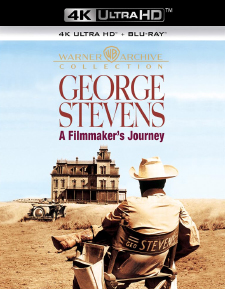
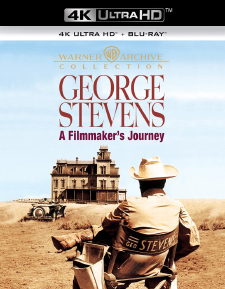
The Warner Archive Collection 2-Disc 4K Ultra HD release of George Stevens: A Filmmaker’s Journey sits in a black Amaray case alongside a 1080p Blu-ray containing the same restoration, with an insert and a slipcover featuring the film’s traditional home video artwork, a still photo of Stevens in his director’s chair juxtaposed against the Reata Ranch mansion in Giant. The following extras are included in HD on both discs:
- Christopher Nolan (20:19)
- Guillermo del Toro (24:14)
- Martin Scorsese (4:50)
Two of these stage-bound “George Stevens Lecture” talks were filmed at the David Geffen Theater at the Academy Museum of Motion Pictures, which are introduced by Bill Kramer, CEO of the Academy of Motion Picture Arts and Sciences, and George Stevens Jr. Christopher Nolan first introduces Shane on December 10, 2023, briefly discussing violence and how Stevens used it in his work, how Stevens’ viewpoint was altered after his war-time service, and the influence that Shane has had on himself, as well as other filmmakers. Next is Guillermo Del Toro speaking prior to a screening of The Greatest Story Ever Told on January 17, 2026. It’s a bit more scattershot than the previous talk, but he basically explores George Stevens’ work before his involvement in World War II, what came after, and the importance of his more spiritual side. Last is Martin Scorsese, who was recorded before the same event to introduce the film, speaking about the urgency of a post-war George Stevens to shine a light on evil in order to learn from it, and admiring the artistry on display in The Greatest Story Ever Told.
A documentary that has languished in standard definition for a couple of decades, even included as a mere extra with a Blu-ray release of Giant, George Stevens: A Filmmaker’s Journey has been resurrected in absolutely beautiful 4K quality. It’s one film documentary that’s not just a requirement for film fans, but it belongs on every cinephile’s shelf. Highly recommended.
- Tim Salmons
(You can follow Tim on social media at these links: Twitter, Facebook, BlueSky, and Letterboxd. And be sure to subscribe to his YouTube channel here.)