
Mortal Kombat Kollection (4K UHD Review)
Director
Paul W.S. Anderson/John R. LeonettiRelease Date(s)
1995/1997 (June 30, 2026)Studio(s)
Threshold Entertainment/New Line Cinema/Warner Bros. (Arrow Video)- Film/Program Grade: See Below
- Video Grade: See Below
- Audio Grade: See Below
- Extras Grade: A-
- Overall Grade: A-


Review
It’s difficult to imagine a world wherein an intellectual property like Mortal Kombat would not be automatically developed for other mediums, including live action films, but for those of us who were around in 1995, Mortal Kombat was the definition of a game changer. The year before saw the release of Double Dragon and Street Fighter, and the year before that Super Mario Bros., and all three were considered extremely poor representations of their source materials. Street Fighter had been a commercial success, but it was derided by critics and audiences alike, as was Double Dragon and Super Mario Bros.. In point of fact, Super Mario Bros. was the poster child for why video game adaptations didn’t work. However, fledgling director Paul W.S. Anderson and producer Lawrence Kasanoff were keen on making Mortal Kombat something that would work for a broader audience, as well as its hardcore fans. Needless to say, they succeeded, and prior to more prestige treatments on television of video game properties, Mortal Kombat was considered the best video game adaptation ever made. Not bad for a controversial, quarter-munching arcade game that was light on story but heavy on atmosphere, blood, and violence.
In Mortal Kombat, Earthrealm is under threat by Shang Tsung (Cary-Hiroyuki Tagawa) and the Outworld Emperor who have won nine straight victories in Mortal Kombat, and if they’re triumphant in the tenth tournament, they will conquer Earthrealm. Standing in their way is Lord Rayden (Christopher Lambert), god of thunder and lightning, who is aiding and guiding Earth’s defenders. Former Shaolin monk Liu Kang (Robin Shou) only wishes to exact revenge against Shang Tsung after killing his brother, movie star Johnny Cage (Linden Ashby) hopes to prove to everyone his martial arts prowess after being labeled a fake by the media, and Special Forces officer Sonya Blade (Bridgette Wilson) follows Kano (Trevor Goddard) into the tournament on Shang Tsung’s orders after killing her partner. If they’re to save the world, they need to set aside their personal struggles; and with the help of the rebellious Outworld princess Kitana (Talisa Soto), they’ll be battling the likes of Scorpion (Chris Casamassa), Sub-Zero (François Petit), Reptile (Keith Cooke Hirabayashi), and the overzied, four-armed Outworld prince Goro for the fate of the world.
In Mortal Kombat Annihilation, all has been saved, but not for long when Outworld Emperor Shao Kahn (Brian Thompson) and his undead queen Sindel (Musetta Vander) break the rules of Mortal Kombat and invade Earthrealm. Rayden (now played by James Remar) instructs Liu Kang, Kitana, and Sonya (now played by Sandra Hess) to seek out allies while he appeals to the Elder Gods to find out what has happened to allow this invasion. Along the way they meet a number of characters from both sides in their battle for Earthrealm, including Sonya’s fellow officer Jax (Lynn “Red” Williams), the enigmatic Jade (Irina Pantaeva), Nightwolf (Litefoot), Baraka (Dennis Keiffer), Mileena (Dana Hee), Scorpion (J.J. Perry), Sub-Zero (Keith Cooke Hirabayashi), Sheeva (Marjean Holden), Motaro (Deron McBee), Ermac (John Medlen), Cyrax (J.J. Perry), Rain (Tyrone Wiggins), Smoke (Ridley Tsui Po-Wah), Noob Saibot (J.J. Perry), and Shinnok (Reiner Schöne).
As a teenager growing up in the early 1990s, you can bet your bottom dollar that I was among the many fans of the Mortal Kombat games, both in the arcade and on home video game consoles. I grew out of them, especially when they went three dimensional and got über-violent to the point that they weren’t much fun anymore (at least for me), but the simplicity of the original games, particularly the first three, actually made its way into the first film. There’s nothing complicated about it, which is probably why different people from different generations were able to enjoy it. And while there are some questionable character motivations, particularly when it comes to Shang Tsung and his seeking out of Earthrealm fighters like Sonya Blade and Johnny Cage which would not work in his favor, there’s a solid enough story and charisma between the lead actors that it mostly works. Simple-minded or not, it doesn’t have any higher aspirations or pretensions about what it is, but it takes the material seriously enough that you can follow along with it and maybe even get caught up in it.
The same cannot be said about Mortal Kombat Annihilation. One of the worst sequels ever produced and a drastic nose dive in quality, Annihilation was an admittedly rushed production. So much so that the studio and the producers wouldn’t wait for members of the original cast to be available to shoot it, or bother to meet their financial requests. They just wanted another Mortal Kombat movie on the market as cheap and as fast as possible, likely perceiving it as a fad that was about to go out of style. It definitely shows in the quality, or lack there of. Anderson had meanwhile moved on to Event Horizon and Soldier, leaving his director of photography, John R. Leonetti, to helm the sequel. Frenetically paced with even less of a story than the first film, Annihilation is an all-out assault on the senses, as well as the good fortune garnered by the success and general acceptance of the original film.
One of the biggest problems with Annihilation is the multitude of characters. It’s true that as the games went on that they began stuffing them with more and more characters, but the movies didn’t necessarily need to follow suit. In addition, it suffers from a complete lack of Cary-Hiroyuki Tagawa as the main villain, who absolutely nailed being a charismatic evil sorcerer in the first film. His performance can be likened to Ian McDiarmid portraying the Emperor in the Star Wars films. Both characters enjoy being evil, and that makes them fun to watch. In Annihilation, we get a Shao Kahn that lacks the same kind of charisma, and he comes off more as Shredder from Teenage Mutant Ninja Turtles than Shao Kahn from Mortal Kombat. It also doesn’t help that they kill off one of the major characters from the original film in the first ten minutes, who has been completely re-cast with an actor who sort of resembles them. Things are’nt helped by the fact that Mortal Kombat Annihilation also has a chintzy quality to it, especially in the costumes and locations. It looks more like “Mortal Kombat On Tour” than a major motion picture, never mind the over-reliance on incredibly poor and rushed computer generated effects and opticals.
These films come from an era when summer movies could simply be fun, without heavy-handed political overtones, board room meddling, or the need to appeal to everyone of every background and in every age bracket. That’s not to say that Mortal Kombat is a masterpiece (though some may feel that way), but it’s an enjoyable romp that’s well made and reaches across to aisles in appeal without overtly trying to. The second film is a disappointing re-hash that has some very minor positive qualities, but could have been a better sequel had the powers that be not rushed it.
Cinematographer John R. Leonetti shot Mortal Kombat and cinematographer Matthew F. Leonetti shot Mortal Kombat Annihilation, both on 35mm film with Moviecam Compact and Arriflex cameras and spherical lenses. The results for both were finished photochemically and presented theatrically in the aspect ratio of 1.85:1. Arrow Video debuts both films on Ultra HD from 4K 16-Bit restorations from their original camera negatives. They’ve also been graded for High Dynamic Range in HDR10 and Dolby Vision, approved by their respective directors, and encoded to separate triple-layered BD-100 discs.
Due to the use of “cutting edge CGI,” as Paul W.S. Anderson describes it in his commentary, Mortal Kombat and Mortal Kombat Annihilation have always had a tendency to look inorganic, which isn’t true of these new UHD masters as they’re highly filmic. The CGI runs the gamut from poor to blending surprisingly well, usually when it’s used to enhance things, such as Goro’s mouth movements when he speaks. The sweeping beauty shots, as well as Reptile, have always stood out, and it’s far more apparent in the second film which uses an abundance of rushed, poorly-executed CGI, particularly during the finale. There’s an inherent softness and lack of detail there that simply cannot be improved upon without re-doing everything entirely from the ground up. However, in the case of these new Ultra HD presentations, Warner Bros. Motion Picture Imaging and Arrow Video have done the best possible job in making these films look as organic as possible. Bitrates tend to sit in the 80 to 100Mbps range with a fine layer of tightly-woven grain and enhanced detail during standard photography, thanks in no small part to quality HDR grading. Colors are richer without reaching levels of oversaturation. Lighting gels of blue, green, purple, and red tend to dominate with deep shadows, thick blacks, and more attractive flesh tones. Contrast has never been a major issue in previous incarnations, but it’s still healthier here. The images are stable and clean, but with a couple of minor hiccups during Annihilation. A shot of the Shaolin monks at 1:36 appears to have been taken from a very low resolution source, presumably because no other element for it could be found. (There are a couple of others, but thankfully, very few.) There’s also an odd moment at 3:33 when two of Sindel’s teeth are blurred in a close-up, presumably due to an encoding error. Otherwise, these new transfers are so good that you may find yourself appreciating the films a little more, warts and all... at least the first one.
Audio for both films is presented in English 5.1 and 2.0 DTS-HD Master Audio with optional subtitles in English SDH. These tracks have been remastered by Þorsteinn Gíslason, meaning that they’re the original mixes, but they’ve clearly been re-adjusted since the 5.1 tracks, especially for the first film, suffered from some balance issues in previous incarnations. The first film’s sound design is as much about texture and nuance as it is about action and music, meaning you get some nice soothing passages, replete with George S. Clinton’s terrific score, but also moments of being blasted all around with techno courtesy of The Immortals’ world-famous theme song. The second film, however, lacks the same level of nuance and is far more crowded with frequent explosive activity nearly at all times. There’s hardly room to breathe sonically, making it a strain on the eardrums. However, dialogue is king on both tracks, more so in the first film, with terrific low end and some effective steerage around the sound space. Dolby Atmos remixes would probably have knocked it out of the park, but as is, these mixes are solid options, much improved from previous releases.
MORTAL KOMBAT (FILM/VIDEO/AUDIO): B/A/A+
MORTAL KOMBAT ANNIHILATION (FILM/VIDEO/AUDIO): D/B+/A-
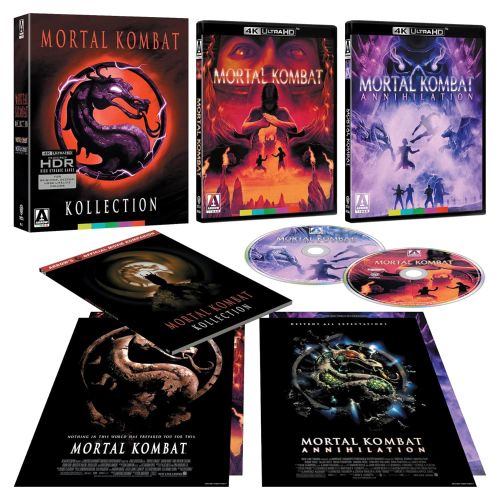
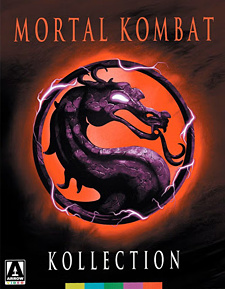
Arrow Video’s 2-Disc 4K Ultra HD Mortal Kombat Kollection features the two films in their own black Amaray cases with dual-sided inserts and posters, featuring new artwork by Matt Griffin on the front and the original theatrical poster artworks on the reverse. Alongside them is a 60-page booklet titled Arrow’s Official Movie Kompanion containing cast and crew information, the essays Mortal Kombat: Y’know for Kids – The Story of The Journey Begins by Simon Ward, Mortal Kombat 1995: A Martial Arts Masterpiece from a Gamer’s Perspective and Mortal Kombat Annihilation: An Underrated Scifi Sequel! by John Torrani, a behind the scenes gallery, presentations information, production credits, and special thanks. Everything is housed in a hardbox slipcase with a thin slipcover, each featuring new artwork, presumably also by Matt Griffin. The following extras are included on each disc:
DISC ONE (MORTAL KOMBAT)
- Audio Commentaries:
- Paul W.S. Anderson
- Dave Baxter
- Cage Match: Linden Ashby Steps Back Into the Ring (HD – 16:13)
- Leveling Up: John R. Leonetti on His Journey From DP to Director (HD – 16:16)
- Quarters to Millions: Taking Mortal Kombat From Arcade to Screen (HD – 18:16)
- The Heavyweight: Tom Woodruff Jr. on Bringing Goro to Life (HD – 15:43)
- Mortal Kombat: A Journey Behind the Scenes (Upscaled SD – 15:10)
- Behind the Scenes (SD – 12:46)
- On-Set Soundbites:
- Paul W.S. Anderson (Upscaled SD – :39)
- Linden Ashby (Upscaled SD – :28)
- Robin Shou (Upscaled SD – :16)
- Cary-Hiroyuki Tagawa (Upscaled SD – :47)
- Bridgette Wilson (Upscaled SD – :48)
- Christopher Lambert (Upscaled SD – :37)
- Theatrical Trailer (HD – 1:49)
- TV Spots (Upscaled SD – 6 in all – 3:50)
- Image Gallery (HD – 598 in all)
The first audio commentary features Paul W.S. Anderson in a very jovial mood, commenting upon the production while occasionally making some wisecracks along the way. Unfortunately, he stops commenting at certain times to silently watch the film, but these moments are thankfully brief. He discusses various aspects of the production, the test screening process, the eventual release, and his exposure to the games prior to being hired to make the film. Aside from falling into the trap of watching his own film from time to time, it’s still a fun and informative track. The second commentary option features Dave Baxter, comic book expert and host of the podcast Vintertainment. While he does cover some aspects of the film, he eagerly delves more into the history of the games and the early comic book adaptation, making comparisons to what was adapted for the films. It’s geared more towards fans of the franchise, but it’s still a nice track.
Cage Match features an interview with actor Linden Ashby who discusses his own history with video games, Johnny Cage being more of a reflection of himself, sometimes not feeling like you’re enough, improvising on the set, being prepared but not taking things too seriously, working with and becoming friends with Paul W.S. Anderson, learning the fight choreography, working with Robin Shou, appreciating the film’s success, and being a part of people’s personal lives unknowingly. Leveling Up speaks to cinematographer John R. Leonetti discusses his father and brother getting into the film business, working with his brother, shooting the first film, designing color schemes, working with Paul W.S. Anderson, dealing with Goro, becoming a director on the second film, bringing his knowledge of the first film to the second, and his reflections on the series today.
Quarters to Millions interviews producer Lawrence Kasanoff about his early exposure to the video games and having a vision for them in other types of media, bringing the project to New Line Cinema, making a movie out of the game’s story, scouring the world for great martial artists, doing test screenings and filming extra fight scenes, shooting in Thailand, nobody having faith in the first film, going bigger for the sequel and going too far, having school kids on the set, the second film’s special effects, the original being his favorite, and reflecting upon the experience. The Heavyweight talks to designer and suit performer Tom Woodruff Jr. about his beginnings as a creature designer, being brought in because of Stan Wilson, designing Goro and how it would work, being locked into the suit for hours, recording Goro’s lines ahead of time to use on the set, creating the character on the set, having different Goros for different shots, his favorite moment in the film, seeing the final product, and what happened to Goro after filming wrapped.
A Journey Behind the Scenes is a 1995 promotional featurette featuring interviews with Paul W.S. Anderson, Lawrence Kasanoff, Robin Shou, Cary-Hiroyuki Tagawa, Linden Ashby, Bridgette Wilson, Christopher Lambert, Talisa Soto, fight choreographer Pat Johnson, and associate producer and visual effects supervisor Alison Savitch. Behind the Scenes features B-roll of set construction, various scenes being shot, and fight choreography training. (There’s even some extra bits of deleted dialogue in a couple of spots.) Next is a set of On-Set Soundbites, which are interview snippets from the film’s Electronic Press Kit. Last is a theatrical trailer; six TV spots; and an Image Gallery containing a massive 598 images of behind-the-scenes photos, posters, and promotional materials.
DISC TWO (MORTAL KOMBAT ANNIHILATION)
- Audio Commentaries:
- John R. Leonetti and Gillian Wallace Horvat
- Dave Baxter
- The Queen of the Night: Musetta Vander Find the Duality in Sindel (HD – 18:29)
- Techno, Taiko, Orcho: Composer George S. Clinton Settles the Mortal Kombat Score (HD – 16:21)
- Man of a Thousand Deaths: J.J. Perry Makes Moves in Mortal Kombat (HD – 19:56)
- Behind the Scenes (Upscaled SD – 14:34)
- On-Set Soundbites:
- John R. Leonetti (Upscaled SD – :53)
- Lawrence Kasanoff (Upscaled SD – :59)
- Irina Pantaeva (Upscaled SD – :39)
- Lynn “Red” Williams (Upscaled SD – 1:17)
- Sandra Hess (Upscaled SD – 1:18)
- Talisa Soto (Upscaled SD – 1:02)
- Robin Shou (Upscaled SD – 1:14)
- Theatrical Trailer (HD – 1:30)
- TV Spots (Upscaled SD – 3 in all – 1:18)
- Image Gallery (HD – 663 in all)
The first audio commentary features director John R. Leonetti, moderated by filmmaker and physical media producer Gillian Wallace Horvat (who helped put together this release). Try as they might, this comes off more as a clunky Q&A session without any chemistry to get a really good conversation about the making of the film going. That said, Leonetti still tries and does provide some information about his memories of the production. It’s not a great track, but it’s good to have him on the record, regardless. Dave Baxter, comic book expert and host of the podcast Vintertainment, returns once more for another upbeat chat. Also once again, he doesn’t delve into the film’s production all that much, but instead spends more time talking about the video games, the characters’ backstories, and their respective portrayals.
The Queen of the Night interviews actress Musetta Vander about her career as a dancer before becoming an actress, learning new accents for different roles, auditioning and getting the role of Sindel after someone else dropped out, portraying a mother character, researching the role, getting along with the cast and crew, performing Sindel’s scream, her costume and wig, doing transcendental mediation with monks in Thailand, seeing the film for the first time, the type of characters she’s usually cast as, and her feelings about the film’s longevity. In Techno, Taiko, Orcho, composer George S. Clinton discusses his early days as a successful songwriter before getting into film scoring, getting involved with the Mortal Kombat scores, incorporating techno and taiko into an orchestra, bringing in Buckethead on guitar, playing the score for the filmmakers for the first time, becoming more aware of and utilizing world music, his various themes for the film, and feeling like a child when making movies. Man of a Thousand Deaths speaks to stunt performer J.J. Perry about his career in martial arts, coming to California and becoming a stuntman, not re-enlisting in the army to find a career in the movies, working all over the world, being brought in for re-shoots on the first film, accidentally breaking two ribs, shooting the sequel, doing stunts for multiple characters, working in the subsequent TV series, and his viewpoint on the experience of being a stuntman.
Behind the Scenes features B-roll of various scenes being shot and artists working on models. Next is a set of On-Set Soundbites, which are interview snippets from the film’s Electronic Press Kit. Last is the film’s theatrical trailer; three TV spots; and an Image Gallery containing a whopping 663 images of concept drawings, posters, home video artwork, promotional materials, set photos, behind-the-scenes photos, and various stills from the film.
With film’s that were as highly publicized as these were, some stuff inevitably falls through the cracks. For the first film, there’s a massive amount of marketing materials not included with this release. Among them is an early teaser trailer, additional TV spots, home video trailers, soundtrack promos, music videos, VHS screener material, the TNT making-of documentary Mortal Kombat: Behind the Dragon, and likely more archival material that I’m overlooking. For the second film, there’s an early teaser trailer, additional TV spots, home video trailers, VHS screener material, a soundtrack promo, and an additional short featurette included on at least one Region 2 DVD release. As far as previously-released material is concerned, the commentary from New Line Home Video’s LaserDisc release featuring producer Lawrence Kasanoff and visual effects supervisor Alison Savitch hasn’t been ported over, but since part of that track begins over the logos that open the disc, it may have been difficult to edit that out. There’s also a very poor quality workprint of the first film floating around, but aside from some unfinished effects, a temp score, and no final overdubs, it’s essentially the released version of the film edit-wise.
Revisiting the Mortal Kombat films has been an interesting experience. As someone who watched the original film repeatedly when it first hit video, it’s interesting to go back and see if it holds up, and it does. Sadly, Mortal Kombat Annihilation doesn’t get better with future viewings. It’s a major letdown that could have proven fruitful for a third film had the filmmakers and the studio behind it taken more care with it’s creation. But let’s face it, most people see these films as cheap and paper-thin entertainment, and they are to a degree; yet the original film is surprisingly solid, nostalgia aside, and Arrow Video’s 4K remasters are definitely the way to view them from here on in. Highly recommended.
- Tim Salmons
(You can follow Tim on social media at these links: Twitter, Facebook, BlueSky, and Letterboxd. And be sure to subscribe to his YouTube channel here.)