
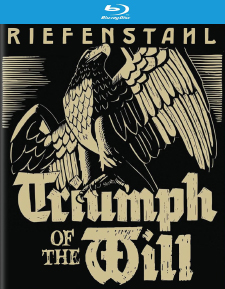
Triumph of the Will (Blu-ray Review)
Director
Leni RiefenstahlRelease Date(s)
1935 (July 21, 2026)Studio(s)
Leni Riefenstahl-Produktion/Reichspropagandaleitung der NSDAP (Kino Classics)- Film/Program Grade: N/A
- Video Grade: B
- Audio Grade: B-
- Extras Grade: B+
- Overall Grade: B+

Review
Triumph of the Will is a triumphant expression of film form that just so happens to express a grossly repugnant ideology—and contrary to some perspectives, those two elements aren’t mutually exclusive. They are inextricably intertwined, however, so it’s impossible to discuss Leni Riefenstahl’s masterpiece without addressing the Nazi weltanschauung that it promotes—and also her own thorny love affair with the Third Reich (and her likely unrequited love for its leader, Adolph Hitler). For all of the current online furor (and fruitless debates) over so-called “political correctness,” “cancel culture,” “wokeness,” “trigger warnings,” and other such disclaimers, the reality is that the challenge separating works of art from any problematic or outdated elements that they contain is often as old as the works of art themselves—and the challenge of separating the art from the artist is no different.
D.W. Griffith’s masterpiece The Birth of a Nation isn’t just racist through the lens of historical hindsight; it was controversial even when it was first released in 1915 (enough so that Griffith added a new title card for its rerelease championing free expression without censorship). And Gone with the Wind, generated plenty of controversy of its own in 1939, when contrary to some modern opinions, not everyone showed equal acceptance of the cringeworthy racial attitudes that it presents. Needless to say, Triumph of the Will provoked immediate negative reactions in 1935, at least outside of its native Germany, even inducing an immediate response from Frank Capra in his Why We Fight series (which, ironically, enough, is no less propagandistic). So, it’s not “wokeness” or “cancel culture” to decry the perspectives that Riefenstahl presented in Triumph of the Will; it’s just an acknowledgment of fact.
Riefenstahl’s later two-part documentary Olympia is easier to appreciate as a celebration of both film form and the human form, although its inherent overtones of Aryan idealism are impossible to ignore. On the other hand, Triumph of the Will openly glorifies Adolph Hitler and the Nazi party, and it enthusiastically (even lovingly) approves of every one of the repellent statements made by Hitler and all of his supporters. Yet it’s still a remarkable documentary regardless of the ideals that it glorifies. The challenge with analyzing Riefenstahl’s work is that the two sides of that coin can’t be separated; the triumphant filmmaking in Triumph of the Will can’t be divorced it from its undeniably awful context, but the ignoble nature of its subject matter can’t be used as an excuse to dismiss the film outright. Triumph of the Will is too important of a film, and it’s far too successful at what it does. Analyzing why it works so well is crucial for understanding the ways in which image and sound can be manipulated in order to shape public opinion. To understand how propaganda works, you must understand Triumph of the Will.
Riefenstahl was one of the most gifted editors in motion picture history, but she wasn’t content with just shaping events in the editing room. She also participated in staging everything in order to get the footage that she wanted, especially with many of the closeups. That was all with the blessings of Adolph Hitler, who gave her free reign to help design the entire rally so that it would work best for her cameras. The 1934 Nuremburg Nazi Party Congress was conceived as a propaganda event, and Riefenstahl was an active participant in planning everything, not just in successfully filming what happened. She wasn’t documenting the truth of what actually occurred as much as what she believed to be the essential truth that lay behind it. That’s easy to condemn when the film is promoting Nazi ideology, but it’s worth considering that other documentary filmmakers have followed in her footsteps by willingly staging or manipulating events in order to express their own views of the truth—often without engendering the same level of scrutiny that Riefenstahl has always received. That’s a double standard, and there’s a real debate to be had regarding the way that people are willing to excuse open manipulation as long as they approve of the ultimate message that’s being presented.
In the end, regardless of the standing that Triumph of the Will may or may not have as a work of art, it unquestionably serves as a cautionary story that’s sadly all too relevant in our current sociopolitical context. Triumph of the Will concludes with a series of speeches, and while many of them address nationalism and racial purity in somewhat oblique fashion, a few do so far more overtly. For example, Julius Streicher, the editor of Der Sturmer, opines that “a people that does not protect the purity of its race goes to seed." Streicher was hanged in 1946 during the Nuremburg trials, but the spirit of his paper lives on today in the form of neo-Nazi publication The Daily Stormer. Yet one of the most striking moments in Triumph of the Will occurs during the closing speech by Rudolph Hess, where he proudly and joyously makes the following declaration:
“The party is Hitler. But Hitler is Germany, as Germany is Hitler!”
Hess escaped a death sentence of his own at Nuremburg and didn’t die until he hanged himself four decades later in 1987, but his simplistic formula for nationalism didn’t die with him. Another four decades after his ignominious end, conflating party with personality, and personality with national identity, still poses as clear and present of a danger in the 21st century (and beyond) as it did in the middle of the 20th century. George Santayana wrote that “those who cannot remember the past are condemned to repeat it,” and Triumph of the Will should be mandatory viewing for anyone and everyone who still hasn’t grasped that fact. Those who cannot remember the lessons of Leni Riefenstahl are always condemned to repeat them.
Supervising cinematographer Sepp Allgeier (along with many, many others) shot Triumph of the Will on 35mm film using spherical lenses, framed at the 1.19:1 aspect ratio of early sound films (although like many such works, it was actually shot silent with post-synced audio). This version opens with a title card from the German Federal Archive (Das Bundesarchiv) noting that they have a legal obligation to preserve Germany’s audio-visual heritage and make it available for viewing—regardless of content. After carefully (and understandably) distancing themselves from the content in this particular case, they make a series of notes about their preservation of Triumph of the Will:
“The German Federal Archive (Das Bundesarchiv) has preserved several copies of the National Socialist propaganda film Triumph of the Will, made in 1934-35. These include an original 35mm nitrate print and a 35mm duplicate negative (on safety stock) created in 1986 by the laboratory of the Staatliches Filmarchiv der DDR. To create the most complete version possible, it was necessary to scan both copies and then digitally combine them. The nitrate print served as the basis for the 4K restoration. The safety negative was used to cover any splices and missing footage. The film’s running time, after restoration, is 112 minutes. The censorship card from the Berlin Film Testing Office, dated March 26, 1935, lists a length of 3,109 meters, which corresponds to 114 minutes.”
There’s no indication of what may account for the two-minute discrepancy in running time. (Note that the actual running time on the disc is nearly 115 minutes, but that’s including the series of new title cards at the beginning). The version on Synapse’s 2015 Blu-ray ran approximately 111 minutes, and no, I don’t know what the discrepancies are in that case, either. But Synapse’s HD master was a completely different scan and digital restoration done by Greg Kimble and Robert A. Harris. Since they felt that the film was in the public domain (a debatable point), they added repeated watermarks all throughout the film in order to identify any footage as coming from their restoration. Needless to say, those were distracting and proved quite controversial on their own. This German Federal Archive digital restoration contains no such marks.
The results of the new work are interesting, to say the least, especially when compared to the Synapse version. The damage hasn’t been cleaned up quite as meticulously here, so there are prominent scratches visible throughout the film where they were more muted on Synapse’s disc. There’s also more instability, some of which was due to vibrations on the original camera mounts, but others are due to deterioration in the elements. RAH’s restoration stabilized some of that while it’s still more unsteady here. Grain is much more prominent on the Synapse version, frequently quite chunky, while it’s clearly been reduced here (and Kino’s mediocre encode doesn’t help much in that regard). Density fluctuations are something of a wash between the two. But the flip side is that fine detail is significantly improved here regardless of any generational losses in the nitrate print and dupe negative that were used as sources. In fact, the difference in levels of detail is often quite dramatic. It’s like a veil has been lifted.
Where the veil has been dropped a bit is in terms of brightness, contrast, and black levels, and that’s an area which will no doubt be just as controversial as the old watermarks. The contrast is much improved in this version, and the blacks are truly deep, enough so that some of the shadow detail still visible on the Synapse version has been crushed out of existence. But here’s the thing: you can usually pull more detail out of film elements, even dupe elements, by turning up the brightness so far that the blacks turn gray. And the Synapse version was very, very bright throughout, offering more shadow detail at the expense of black levels. It’s ultimately going to come down to personal preference, with everyone having their own strongly held opinions, but I prefer the more dramatic contrast on this version regardless of any lost shadow detail. Your own mileage may vary. Ultimately, both versions have their pluses and minuses, but for me, the balance tips in favor of Kino Lorber. Short of the German Federal Archive restoration showing up on a different release with a better encode, this is my preferred version of the film for the time being.
Audio is offered in German 2.0 mono DTS-HD Master Audio, with removable English subtitles. Background noise and hiss are prominent throughout, although any major instances of pops or crackle have been reduced. The frequency range is understandably quite limited by the nature of the optical tracks used as a source, so don’t expect any real depth to Herbert Windt’s score, but that is what it is. There’s only one real downside here compared to the Synapse version: their subtitles included onscreen identifiers, some of which were superfluous, but others were quite useful—especially when identifying some of the participants at the rally. Regardless of whether or not you agree with me about the superiority of the visuals in Kino’s version, it’s worth hanging onto the Synapse disc for that reason alone (to say nothing of their own exclusive extras).
The Kino Lorber Blu-ray release of Triumph of the Will includes a rarity for the label: a 16-page booklet featuring an essay by Francine Prose. Part of the reason why may be due to Kino wanting to distance themselves from the content of the film as much as the German Federal Archive did, so let’s get this out of the way right now: that’s quite alright. For some reason, disclaimers have become controversial these days when they really shouldn’t be. If an organization or a company is releasing material containing content as reprehensible as Triumph of the Will, it’s perfectly acceptable for them to create a little distance from it. As long as you’re getting the uncut film (and you are in this case, at least as much as is humanly possible given that the negative is long gone), then a disclaimer or two isn’t going to hurt you. If you don’t like it, don’t read the booklet, and grab a beer during the first two minutes of the film while the new title cards are playing. There, crisis averted.
In any event, the following extras are included:
- Commentary by Anthony Slide
- Victory of Faith (HD – 63:58)
- Day of Freedom (HD – 29:18)
- Schichlegruber Doing the Lambeth Walk (HD – 2:27)
- Promo Reel (HD – 3:02)
The new commentary features historian and prolific writer Anthony Slide, author of (among many other things) Early Women Directors, and trigger alert: he offers his own disclaimer up front. Once that’s done, he provides a brief overview of Leni Riefenstahl’s career up to that point, affirming some well-known details while debunking others, with an emphasis on her production of Victory of Faith. He also addresses the arguments regarding whether Triumph of the Will is a documentary, a propaganda film, or both, adding his own view that most documentarians are propagandists to varying degrees. From there, Slide breaks down the film itself and gives background information regarding all of its participants (for good and for ill). He’s critical of a few sections in the film as being unexpectedly boring, but still notes its undeniable magnetic qualities—he believes that Riefenstahl was as good of a sound mixer as she was an editor. He closes by addressing the film’s complicated postwar legacy (and Riefenstahl’s equally complicated legacy as well).
Kino has also included Riefenstahl’s other two Nazi documentaries, Victory of Faith (1933) and Day of Freedom (1935, but made after Triumph of the Will). Both films were scanned from the best surviving elements, which consisted of dupe positives with dupe negative sound elements. They’re offered here with German 2.0 mono Dolby Digital audio. As the title cards from the German Federal Archives indicate, the first reel of Victory of Faith was in poorer condition than reels 2-4, so it’s filled with even more scratches and other artifacts than the rest of the film. It’s also 60 meters shorter than the length that was originally listed by the Berlin Movie Inspection Authority, but there’s no indication of what the differences may be. (Day of Freedom is only about 10 meters shorter.) Day of Freedom in general is in worse condition than Victory of Faith—it looks like the print might have been a couple more generations removed from the camera negative. But they’re both an invaluable archive of Riefenstahl’s remaining propaganda documentary efforts for the Third Reich.
Finally in addition to a Promo Reel consisting of trailer material from all of Kino’s Leni Riefentahl titles, there’s also a genuine historical curiosity: Schichlegruber Doing the Lambeth Walk, a 1942 propaganda short produced by Charles A. Ridley for the British Ministry of Information. It uses footage from Triumph of the Will re-edited to make it appear like the soldiers are doing the “Lambeth Walk” instead of goosestepping. The Lambeth Walk was a brief dance craze that was inspired by the song of the same title from the 1937 film Me and My Gal, which was based on Cockney strutting.
The only previous extra that’s missing here is Synapse’s commentary track with Dr. Anthony R. Santoro. But it’s worth noting that the version of Day of Freedom that Synapse included was considerably shorter than this one, running only 17:52 compared to Kino’s 29:18. But it’s still worth hanging onto the Synapse disc for that commentary and the explanatory titles. It’s even worth hanging onto for the different restoration, which does reveal more detail in the darkest sections. But I still recommend this German Federal Archive restoration regardless of any nitpicks about the grain reduction and Kino’s encoding. It still looks much better overall, and the extras package easily trumps Synapse’s. Triumph of the Will is always going to be a difficult film to recommend in any form, and while I’m not offering my own disclaimer here, I am declining to give a grade to the film itself. Suffice it to say that it’s still one of the greatest documentaries ever made, while simultaneously being one of the most reprehensible documentaries ever made. Life is complicated sometimes, so don’t look for easy answers where there aren’t any to be had.
-Stephen Bjork
(You can follow Stephen on social media at these links: Twitter, Facebook, BlueSky, and Letterboxd).