
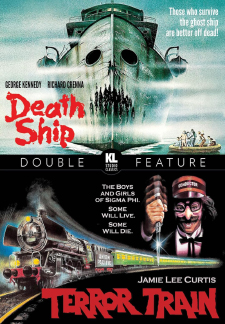
Death Ship/Terror Train: Double Feature (DVD Review)
Director
Alvin Rakoff/Roger SpottiswoodeRelease Date(s)
1980 (June 9, 2026)Studio(s)
Bloodstar Productions/Astral Films (Kino Lorber Studio Classics)- Film/Program Grade: See Below
- Video Grade: See Below
- Audio Grade: See Below
- Extras Grade: D-
- Overall Grade: C+

Review
[Editor’s Note: The review of Death Ship was originally written by Dennis Seuling and Tim Salmons, while Terror Train was written by Tim Salmons alone, both for their respective 4K Ultra HD and Blu-ray releases.]
In Death Ship, Captain Ashland (George Kennedy), a no-nonsense, by-the-rules cruise ship commander, will be relieved of command in mere days. The crew doesn’t much care for him, regarding him as cold-hearted and tyrannical. As the voyage comes to a close, their ocean liner is rammed by a derelict freighter. The handful of survivors—the captain, Trevor Marshall (Richard Crenna), his wife (Sally Ann Howes) their two kids, a widow (Kate Reid), lovers Nick and Lori (Nick Mancuso, Victoria Burgoyne), and band leader Jackie (Saul Rubinek)—climb aboard the rusting ship only to find that there’s no crew. It soon becomes clear that the ship is evil, intent on killing its passengers.
Director Alvin Rakoff does his best with a second-rate script and limited resources. The narrow corridors, abandoned decks, and tight spaces of the ship contribute to a sense of eeriness and quick cuts to ghostly images and sounds foreshadow doom. The bulk of the film relies on typical horror movie tropes—children left alone, increasingly weird expressions on the captain’s face, a romantic interlude amid danger, and questionable behavior that imperils the characters. Many of the gruesome horror bits are backloaded, so that the unnerving supernatural elements at play escalates. In the third act, the true horror emerges, but it might be too late. The slow pace kills the momentum, so that instead of increasing the tension, the film bogs down in too much unnecessary dialogue as characters try and figure out what we already know.
The acting overall is mediocre. Kennedy’s performance consists of looking annoyed to be captain of a cruise ship while also being possessed by some evil force when he’s aboard the creepy freighter. Kare Reid is wasted in a thankless role as the widow. Mancuso and Burgoyne are stereotypes of lovers who can’t keep their hands off each other even when their lives are in danger. Rubinek is an odd choice for the band leader. If the role was intended to provide comic relief, he fails miserably. Crenna and Howes are adequate as the heads of their small family, with Crenna posing as the nominal hero, taking charge when things get bad but turning out to be ineffectual in the face of forces he doesn’t understand. As the mother, Howes doesn’t seem especially concerned about letting her young kids run wild on an old ship that could prove dangerous even if otherworldly forces weren’t at play.
In Terror Train, a group of medical students during a New Year’s Eve party play a disturbing prank on the shy and awkward Kenny (Derek MacKinnon), traumatizing him and putting him in a mental hospital. Three years later, the same group of friends have a graduation party aboard a train, this time dressing up in costumes with a mysterious magician (David Copperfield) hired as the evening’s entertainment. Alana (Jamie Lee Curtis), Mo (Timothy Webber), Doc (Hart Bochner), Mitchy (Sandee Currie), Pet (Joy Boushel), and Jackson (Anthony Sherwood) all soon realize that there’s a killer loose on the train, which the conductor, Carne (Ben Johnson), attempts to keep quiet. Also among the cast are Vanity, Howard Busgang, and Greg Swanson.
Murder on the Orient Express this ain’t, nor does it attempt to be. Terror Train is your basic horror revenge plot that ultimately became the backbone of many slasher films that continue to this day, taking its plot seriously enough with a slight sarcastic edge that makes it mostly effective. It also helps that there’s some chemistry between the characters while the interpersonal relationships and issues therein give the story a more grounded feel. There are no tropes or archetypes because the rule book on slashers hadn’t really been written yet. For instance, Hart Bochner’s Doc is an odious character, and you have to wonder why these people put up with him. He’s constantly causing trouble for his close friend Mo, who at one point he somewhat admits to having a homosexual affection for, which sadly goes absolutely nowhere. The kills themselves aren’t necessarily creative, but the fact that there’s someone aboard the train constantly switching costumes at a costume party and offing the attendees somehow works.
Reminiscent of Prom Night, which was released a few months prior that same year and also featured Jamie Lee Curtis as its lead, Terror Train did decent business upon release, but it certainly wasn’t the Halloween-type powerhouse that 20th Century Fox was hoping for. The film is certainly dated when it comes to some of the clothes and music, but it’s held together with decent performances, a smooth pace, and terrific cinematography, courtesy of Stanley Kubrick regular John Alcott, the latter of whom was purportedly happy to have a more traditional film experience for a change. Sam Peckinpah editor-turned-director Roger Spottiswoode, for whom Terror Train was his first directing assignment, would go on to make a number of comedies and dramas including Turner & Hooch, And the Band Played On, and the 1997 James Bond entry Tomorrow Never Dies. Terror Train continues on as a slasher that’s a cut above many of its contemporaries. It’s not a particularly sophisticated horror film, but it offers some unique elements that make it stand out more than most.
Cinematographer Rene Verzier shot Death Ship on 35mm film with Panavision Panaflex cameras and spherical lenses. The results of were finished photochemically, and framed theatrically at the aspect ratio of 1.85:1. Cinematographer John Alcott shot Terror Train on 35mm film with Arriflex cameras and spherical lenses. The results were finished photochemically and framed theatrically at the aspect ratio of 1.85:1. Kino Lorber Studio Classics previously released each film on 4K Ultra HD and Blu-ray, here providing a Double Feature DVD release sourced from the same 4K scans of the original camera negative. It’s obviously a downgrade in quality, especially since both films share a disc, but the point is a lower budget alternative. With that in mind, all of the visuals and the quality of each presentation are fare with good color and decent detail. Nothing beats Dolby Vision-graded UHD restorations, but these are fine for what they are.
Audio is included for both films in English 2.0 mono Dolby Digital with optional English subtitles. Both presentations offer solid (albeit through a lossy container) audio with clear dialogue and good support for the various sound effects, music, and score elements. It’s worth noting that the Blu-ray and 4K Ultra HD presentations also offer 5.1 options.
DEATH SHIP (FILM/VIDEO/AUDIO): C/B-/B+
TERROR TRAIN (FILM/VIDEO/AUDIO): B-/B-/B-
None of the extras from the previous Blu-ray and DVD releases have been included, aside from a set of trailers for each film and other Kino Lorber releases:
- Death Ship (1:34)
- Terror Train (2:28)
- Airport (3:33)
- Dust Devil (1:36)
- Mimic (1:51)
This is purely a more affordable DVD release for those who simply want the films themselves, regardless of the format they’re presented on. As such, they should be pleased with this release.
- Dennis Seuling and Tim Salmons
(You can follow Tim on social media at these links: Twitter, Facebook, BlueSky, and Letterboxd. And be sure to subscribe to his YouTube channel here.)