
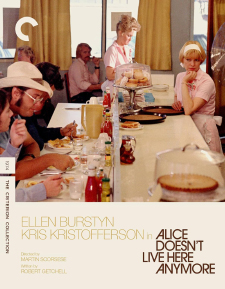
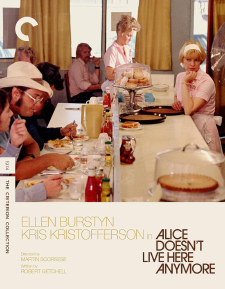
Alice Doesn’t Live Here Anymore (Blu-ray Review)
Director
Martin ScorseseRelease Date(s)
1974 (July 14, 2026)Studio(s)
Warner Bros. (The Criterion Collection – Spine #1318)- Film/Program Grade: A
- Video Grade: A
- Audio Grade: A
- Extras Grade: A

Review
Women’s pictures, a Hollywood staple from the 1930s to the 1960s, featured female protagonists in plots that had them struggle and ultimately triumph against adversity typically caused by the presence or absence of a man. Norma Shearer, Bette Davis, Barbara Stanwyck and Joan Crawford were among the major stars associated with this form. Made during the burgeoning 1970s feminist movement, Alice Doesn’t Live Here Anymore is an episodic tale about picking up the pieces of an unhappy life and navigating an uncertain future.
The film opens on an obvious Hollywood set complete with a fake sunset, looking like a scene out of The Wizard of Oz. A young girl strolls toward her house as she sings a tune. The mood is broken by harsh words coming from inside the house and the girl’s response suggesting an independent nature and a penchant to do things her way. The scene promptly shifts to 27 years later.
Alice Harris (Ellen Burstyn) is in an unhappy marriage with an abusive husband (Billy Green Bush) who treats his young son, Tommy (Alfred Cutter), horribly. An accident gives Alice the freedom to make a new beginning, but she’s 35, unskilled, and unqualified for most work. She recalls a happy time when, as a young woman, she was a singer in Monterey, California. So she packs Tommy and their belongings into a station wagon and heads west.
With her cash dwindling, Alice has to stop in Phoenix and get a job. Despondent at having no luck, she finally gets a gig singing pop standards to sparse barroom customers. There she meets Ben (Harvey Keitel), who’s handsome and complimentary. Hesitant at first, she succumbs to his charms, but soon regrets it and rushes from town.
Arriving in Tucson, she once again looks for a job and has to settle for one as a waitress. Her dream seems depressingly far away and her life is at a dead end until rancher David (Kris Kristofferson) takes an interest in her. Having been in two disastrous relationships Alice is wary, but she’s definitely attracted to him and he’s great with Tommy. Will David provide happiness for her? Or is he just another mistake?
Ellen Burstyn is outstanding as Alice. Banking on her success in The Exorcist the previous year, Warner Bros. was eager to work with her again. She was moved by the script. When she was asked who she’d like as director, Francis Ford Coppola recommended Martin Scorsese, who had just made Mean Streets. Burstyn was concerned that Mean Streets and Alice Doesn’t Live Here Anymore were very different kinds of films. She met with Scorsese and, impressed with his self-confidence and honesty, she knew he would be a good director.
Her instinct was sound, since she won the Best Actress Academy Award for her role as Alice. Burstyn gets to play a range of emotions including grief, despair, anger, embarrassment, fear, self-consciousness and humor. With no clear plan for the future, she nonetheless forges on, making Alice a kind of feminist heroine. But the film isn’t geared solely to women.
Kris Kristofferson is fine as David. His limited experience is evident but he gets by on his personality and smile, and his gentle manner. Meanwhile, Harvey Keitel’s character is a Jekyll & Hyde. When his heretofore mild-mannered character shows his other side, he’s terrifying and looks as if he’s easily capable of murder. His performance practically jumps off the screen. It was so intense in their explosive scene together that Ellen Burstyn couldn’t work for the rest of the day.
Diane Ladd plays Flo, a waitress Alice meets at her new job. Though Alice doesn’t like her at first, they become friends. With Flo’s upswept hair, longshoreman’s mouth, and regional accent, Ladd makes what could have been a caricature into a real person. In a scene between Flo and Alice, Flo serves as friend/therapist/advisor when Alice is at a difficult crossroads. The character of Flo became the centerpiece of the sitcom version of Alice, which ran for nine seasons on CBS (Polly Holiday played the role on TV).
Fellow waitress Vera (Valerie Curtin) is probably one of the world’s worst waitresses, but she’s committed. Oblivious to what’s going on around her, she moves through the crowded diner, delivering the wrong orders to the wrong tables with the predictability of a Swiss watch. Curtin, her head downcast and her face alternately registering bafflement and anxiety, maneuvers through the diner terrain in a nearly wordless, hilarious performance.
As Tommy, Alfred Lutter shares many scenes with Burstyn and he’s a natural performer. Cute, sharp-witted, often annoying, funny, sometimes mean, he epitomizes a typical 12-year-old who rolls with life’s punches. He’s also self-centered, demands answers his mother cannot give, and tells endless irritating jokes. Cynically wise beyond his years, Tommy has some of the script’s best lines. Lutter lands them perfectly, and he and Burstyn have a chemistry that reflects a mother/son bond. Jodie Foster has a small role as Audrey, a kid Tommy meets at guitar lessons, whose sweet face belies a larcenous aptitude.
The screenplay by Robert Getchell is first-rate, with universal appeal. All audiences can appreciate Alice’s emergence from oppressed, dependent housewife into a woman of drive, protectiveness of her young son, strong personality, and refusal to be beaten down by impediments. Director Martin Scorsese elicits excellent performances from the cast. We root for Alice because life hasn’t been generous to her and we cheer her when things look bright.
With plenty of light moments to balance the drama, Alice Doesn’t Live Here Anymore has an authenticity to its characters and situations, with a strong lead who juggles real-life responsibilities on the path to a dream.
Alice Doesn’t Live Here Anymore was shot by director of photography Kent L. Wakeford on 35mm film with Panavision cameras and lenses, processed by Technicolor, Hollywood, CA, and presented in the aspect ratio of 1.85:1. Supervised and approved by director Martin Scorsese, this new 4K restoration was created from the original 35mm camera negative. According to information in the enclosed booklet, a 35mm print from Scorsese’s personal collection was used as a color reference. Clarity and contrast are excellent with details sharp and well delineated such as individual strands of Ellen Burstyn’s hair, motel room furniture, objects on the family dinner table, dishes of food being served in the restaurant, luggage strapped to Alice’s station wagon, and Tommy’s cowboy outfit. Complexions are well rendered. A scene in which Alice and Flo sunbathe behind the restaurant is filmed in extreme close-up, showing off their soft skin. In a violent confrontation between Alice and Ben, glass is shattered and objects are strewn about as Ben rampages.
The soundtrack is English 1.0 LPCM. English subtitles are an available option. The original monaural soundtrack was remastered from the original 35mm magnetic track. According to information in the booklet, since the original film was recorded with a single-channel analog optical track, the audio is presented in its true-to-source format. Dialogue is clear and distinct. Sound effects include Alice’s station wagon on the open road, ambient noise in the restaurant, glass shattering, objects angrily swept off a table, guitar playing, and joyful noises from Tommy as his mother pins him playfully to the floor. Accompanying herself on piano, Burstyn sings Where or When, When Your Lover Has Gone, Gone with the Wind, and I’ve Got a Crush on You. Other tunes include I Will Always Love You (Dolly Parton), Cuddle Up a Little Closer (Betty Grable), I’m So Lonesome I Could Cry (Kris Kristofferson), and All the Way from Memphis (Mott the Hoople).
Bonus materials on the Blu-ray release from The Criterion Collection (which is also available in 4K Ultra HD) include the following:
- Audio Commentary with Ellen Burstyn, Kris Kristofferson, Diane Ladd, Jodie Foster, Alfred Lutter, and Martin Scorsese
- Ellen Burstyn Conversation (HD – 23:44)
- Marcia Lucas Interview (HD – 19:24)
- Making-Of Documentary (SD – 19:54)
- Trailer (SD – 2:30)
Audio Commentary – This 2003 commentary features actors Ellen Burstyn, Kris Kristofferson, Diane Ladd, Jodie Foster, Alfred Lutter, and director Martin Scorsese. Scorsese speaks about how he became involved in Alice Doesn’t Live Here Anymore. Burstyn was drawn to the project because of the portrayal of women. The feminine consciousness was in the script. Women were as important as men. When Scorsese and Burstyn met, they hit it off. The script left areas to open up. Scorsese was willing to do things outside the script to make the characters real. He encouraged improvisation. Jodie Foster regards this film as one of her favorites. When she arrived on the set with her hair cut short, the director was taken aback. He thought audiences would think she was a boy. This was Foster’s first film with Martin Scorsese. She would appear for him the following year in Taxi Driver. Alfred Lutter had a fairly short film career and was eventually accepted to Stanford University. He feels he’d been in some films that have held up well over time. There was tension on the set after the violent scene between Burstyn and Harvey Keitel. Diane Ladd speaks about seeing a waitress wearing a homemade crucifix and asked her to make one for her to wear in the film as Flo. Kris Kristofferson speaks about the difficulty he had playing the film’s final scene. Rather than keep to schedule and embarrass the actor, Scorsese told Kristofferson they’d film it the next day. The commentators make reference to Warner Bros., a major producer of women’s pictures during the Studio Era. It was a Hollywood tradition. All agree that making Alice Doesn’t Live Here Anymore was a comfortable shoot with everyone getting along and filming moving smoothly.
Ellen Burstyn Conversation – In this discussion with film critic Farran Smith Nehme, Ellen Burstyn speaks about her career and the staying power of Alice Doesn’t Live Here Anymore. She says it was the “blooming of the women’s movement.” She wanted to make a film about a single mother. The original script was lighter—more like a Doris Day movie. After changes were made, every scene was rehearsed the evening before it was shot. Burstyn refers to actress Valerie Curtin as “unusual but real.” Scorsese allowed the reality among women to get into the film. The portrayal of motherhood was authentic. Burstyn singles out Betty Grable as one of her inspirations and was deeply affected by The Red Shoes which showed the dedication an artist has to art. She worked extensively in TV and eventually worked in feature films. She studied with Lee Strasberg in New York to learn how to act and to be present in her portrayals. She defines method acting as training the senses to respond to imaginary situations. Burstyn has been able, through the years, to move smoothly between stage and film. She speaks about The King of Marvin Gardens, a film that was killed by a negative review in The New York Times. She cites Resurrection as a favorite film, though she doesn’t understand why it was marketed as a science fiction film. She was nominated for Best Actress for Resurrection but Universal put its energy into Coal Miner’s Daughter that year and abandoned Resurrection. She says she’s not demanding but will speak up when necessary. She gives an example of asking director Darren Aronofsky to shoot her close-up first for a scene in Requiem for a Dream even though it meant moving scenery and lights. Emotionally, she felt she couldn’t do the scene effectively more than once.
Marcia Lucas Interview – The late Marcia Lucas talks about her career and rise as a film editor working with many filmmakers in the 1970s. “Film talks to me a lot.” Her first job as editor was Alice Doesn’t Live Here Anymore. She fell in love with piecing together small segments of film to tell a story. She worked with Verna Fields, George Lucas, Martin Scorsese, and Brian De Palma. Back in the 70s, studios determined which personnel worked on which films. Young, up-and-coming directors wanted to use of their own people. Marcia Lucas talks about a long tracking shot in the film. To shorten it, alternate frames were removed. Lucas notes: “I’m challenged every time I get a new scene.” She clearly loved her job.
Making-Of Documentary – This documentary short was made in 2003. Ellen Burstyn and Kris Kristofferson discuss their experiences making Alice Doesn’t Live Here Anymore. Burstyn had just gone through a divorce. Kristofferson says that it was difficult striking out on his own. He didn’t have any acting experience and he was self-conscious about his acting. He’d had jobs as a laborer, he was in the army, and he was a musician. Scorsese bolstered Kristofferson’s confidence during filming. The director was great with inexperienced actors. Both Kristofferson and young Alfred Lutter were rookies. The film is significant because it centers on a woman who is primary in her own life, when most scripts were written from the male’s point of view. Burstyn’s agent found the script. Warner Bros. liked it and bought it.
Booklet – The enclosed accordion-style booklet contains the essay At Home in the World by Stephanie Zacharek, nine photos from the film, cast and crew list, and information about the film’s restoration.
While Ellen Burstyn and Alfred Lutter are the two main characters in Alice Doesn’t Live Here Anymore, other actors also shine. Harvey Keitel is terrifying as the explosive Ben and Kris Kristofferson gives a sweet, engaging performance as David, who becomes a love interest for Alice. Jodie Foster has a small but memorable role as tomboy Audrey, and Valerie Curtin turns in a quietly hilarious performance as waitress Vera. Diane Ladd nearly steals the picture as Flo, with her outspoken, sassy nature and a generous helping of common sense. Alice Doesn’t Live Here Anymore is satisfying not only because of its superior performances, but also because the characters ring true. They’re believable and relatable. Scorsese’s direction is focused, providing a brisk narrative flow. In addition to Burstyn’s win as Best Actress, the film received Academy Award nominations for Best Original Screenplay and Best Actress in a Supporting Role (Diane Ladd).
- Dennis Seuling