
West Side Story (German Import) (4K UHD Review)
- Review Date: Sep 23, 2026
- Format: 4K Ultra HD
-


Director
Robert Wise and Jerome RobbinsRelease Date(s)
1961 (August 20, 2026)Studio(s)
Mirisch Pictures/Seven Arts Productions/United Artists (Capelight Pictures)- Film/Program Grade: A+
- Video Grade: A-
- Audio Grade: A-
- Extras Grade: B+

Review
[Editor’s Note: This is a Region-Free German 4K Ultra HD import.]
In the long history of cinematic musicals, West Side Story remains one of the most perfect fusions of story and style, with form and content blending together to such a degree that it’s difficult to tell where one ends and the other begins. Yet while some films have been accused of being all style with no substance, and others have been criticized for having a flat presentation of otherwise interesting stories and characters, it’s arguable that the line between the two has been somewhat overemphasized. Jean-Luc Godard once told an interviewer for the CBC that “To me, there is not much difference between content and form. I mean, you can reach content through forms, and you can reach forms through content... form has a content like an envelope has a letter. Without the envelope, you can never send the letter.” In the right hands, form is content, and style is substance, but with West Side Story, form is so inextricably intertwined with content that any attempt at drawing a distinction between the two becomes meaningless.
In West Side Story, the content is a modern urban updating of the Shakespeare’s Romeo and Juliet, delivered via the form of Leonard Bernstein’s music, Stephen Sondheim’s lyrics, and Jerome Robbins’ choreography. West Side Story began life as a Broadway production in 1957, with the book written by Arthur Laurents. Their initial conception translated Shakespeare’s irreconcilable Montagues and Capulets into Jewish and Catholic families, but that ethnic and religious conflict eventually morphed into a subject that’s still all too familiar to contemporary audiences: immigration and racial conflict, envisioned in this case as gang warfare between the Puerto Rican Sharks and their xenophobic white antagonists, the Jets. That choice of subject matter drove the music and the choreography, with Robbins in particular using dance as a way to express not just the conflict between the two sides, but also the interior mental states of the characters. West Side Story was a major hit, running a total of 732 performances before the original production closed in 1959 and the show went on tour.
A Hollywood adaptation was perhaps inevitable, and two years later, the cinematic West Side Story would reach the screens—but not without a few conflicts of its own along the way. Ernest Lehman was brought in to translate Laurents’ book into a workable screenplay, with a team of music supervisors including Saul Chaplin, Johnny Green, Irwin Kostal, and Sid Ramin handling the unenviable task of reworking Bernstein’s score and songs. Yet fatefully, the decision was made to retain Robbins, not just as choreographer, but also as co-director alongside the veteran Robert Wise. The original intention was to have Robbins handle the musical numbers while Wise dealt with the dramatic material, but Robbins’ relentless perfectionism resulted in the film going significantly over schedule and over budget, which led to his removal from the project and Wise taking over in full. Yet Wise was able to retain most of Robbins’ assistants, who were intimately familiar with his intentions for the unfinished sections. Wise also brought Robbins back during the editorial phase to ensure that everything was cut the way that the choreographer had planned (Wise started his own career as an editor, and he always valued the process even as a director).
With all due deference to Wise, the simple fact of the matter is that West Side Story wouldn’t be such a perfect fusion of story and style without the influence of Robbins, both on set and off. It’s not just that Robbins was intimately familiar with the nature of the material, tailoring his choreography to the abilities of his performers in order to express the nature of the characters that they were playing. For his one (and only) turn as film director, Robbins brought all of that knowledge to bear in the way that he staged everything for the cameras—and just as importantly, in the way that he planned to cut all of it together. Editor Thomas Stanford would go on to win an Academy Award for West Side Story, and deservedly so, but there’s no denying that Robbins had an influence on the rhythms of the film, just as much as it was guided by the rhythms of Bernstein’s music. In fact, the confluence of those two rhythms is a large part of what makes West Side Story so special.
Many editors seem to operate on an unspoken rule against cutting on the beat of the music, but under the influence of Robbins (and Bernstein), Stanford reveled in it. Robbins completed just four full sequences in West Side Story before he was removed from the project: the Prologue, America, I Feel Pretty, and Cool. But he cast a long shadow over the rest of the musical numbers as well, especially the dance at the gym. Still, however impressive that his work may be throughout the rest of the film, it’s Cool that may be the ultimate expression of what he was trying to accomplish. Robbins’ choreography, the 70mm camerawork from cinematographer Daniel L. Fapp, Bernstein’s music, and Stanford’s editing are all in perfect sync with each other from start to finish, with the cuts (and even the camera movements) frequently landing right on the beat in order to give them greater emphasis. It’s arguably one of the single greatest musical numbers in the history of film.
Yet interestingly enough, Cool ended up showing how the film also strayed from Robbins’ preferences, much to its benefit. In the play, Cool takes place before the rumble, while the comical Gee, Officer Krupke occurs after it. Tonally, that never felt right, so the two songs were roughly swapped out for each other in the film. And while America in the play was a conflict between two different subgroups of the Puerto Rican girls, the film changes it to Anita and the girls vs. Bernardo and the boys, which makes the whole scene work much better—and regardless of how Robbins may have felt, the choreography benefits as well. After all, it’s the girls in the film who seem more comfortable with assimilating into the melting pot of New York City, while the boys want to fight for their independence. West Side Story is the rare example of an adaptation where nearly all of the changes are improvements over the original. (Some of Sondheim’s lyrics were altered as well in order to pass muster with the censors, but none of that is detrimental to the film.)
Still, while West Side Story may be the perfect fusion of form and content, it’s not necessarily a perfect film. Racially speaking, it’s a product of its time, with some of the Puerto Rican characters played by white (and even Japanese-American) actors in brownface. Even real Puerto Rican actors like Rita Moreno had to undergo the indignity of brownface makeup. Yet they’re all so perfect for their roles that it’s difficult to complain. Steven Spielberg rectified that issue in his 2021 remake, but however good that his more authentic cast may have been, they just can’t hold a candle to the problematic originals. Natalie Wood may have had her singing voice dubbed by Marni Nixon, but her incomparable radiance shines through as Maria (whether speaking or singing). And the Greek-American George Chakiris took home a deserved Oscar of his own as Bernardo. Right or wrong, there’s never been a better Maria and Bernardo.
The rest of the cast is excellent as well, even if future EGOT Moreno had to suffer further indignities by having her own voiced dubbed a couple of times by Nixon and Betty Wand—although the Oscar that she won for Best Supporting Actress was probably fair consolation for that. The irascible Russ Tamblyn is perfect as Riff (even though his singing voice on Jet Song was dubbed by Tucker Smith, who played his lieutenant Ice in the film). Richard Beymer (dubbed by Jimmy Bryant) is fine as Tony, and while he’s debatably one of the weakest members of the cast, that’s really only in comparison to the perfection of the others. Simon Oakland, Ned Glass, William Bramley, and John Astin all fill out their supporting roles capably, but it’s the dancers playing the gang members who really stand out: the Jets (Smith, Tony Mordente, David Winters, Eliot Feld, Susan Oakes, Gina Trikonis, Carole D’Andrea, et.al.) and the Sharks (Jose De Vega, Jay Norman, Gus Trikonis, Eddie Verso, Jaime Rogers, Yvonne Wilder, Suzie Kaye, Joanne Miya, et.al.). It’s their singular talents Robbins used to guide his choreography, leading to such a perfect fusion not just of form and content, but of form, content, and character as well.
That fusion struck a nerve when West Side Story was released in 1961, and it went on to become the highest-grossing film of the year. None of that escaped the attention of the Academy, with West Side Story being nominated for 11 Oscars in 1962 and winning 10 of them. That included a fusion of nearly all of the technical categories including Best Cinematography (Color), Art Direction (Color), Costume Design (Color), Editing, Music (Scoring of a Musical Picture), and Sound. Perhaps most importantly, it included Robert Wise and Jerome Robbins winning as Best Director. West Side Story exists thanks to a legion of talented artists, performers, and filmmakers, but there’s no denying the fact that the guiding vision for translating the work that Robbins, Bernstein, and Sondheim had done on stage belonged to Robbins—and that’s regardless of the fact that he ended up being his own worst enemy on the set. West Side Story wouldn’t have been such a perfect fusion without him.
Cinematographer Daniel L. Fapp shot West Side Story on 65mm film using Mitchell BFC 65mm cameras with spherical Panavision lenses in Super Panavision 70 format (although it’s still billed as Panavision 70 in the closing credits). 70mm prints were full-frame 2.20:1, while 35mm reductions were cropped to 2.35:1. This version, slightly reframed at 2.29:1, also crops off the top and bottom edges of the picture, though less so than on a 35mm print (I haven’t been able to find an explanation why). But it’s based on a new 8K scan of the original camera negative, with restoration work handled in-house at Amazon MGM studios, with the final results graded for High Dynamic Range in Dolby Vision and HDR10. Capelight actually announced their 4K release with the intentions of using a previous 4K restoration, but they delayed it to take advantage of the new 4K master, and despite a few minor quibbles, it was well worth the wait.
The image is crystal-clear and sharp as a tack, with the only minor blemishes being a few small remaining single-frame scratches that won’t be visible unless you happen to catch them accidentally while freeze-framing (there’s one across Bernardo’s face during the scene at Doc’s store after Lt. Schrank starts goading him). Like most 70mm productions from the era, optical effects like dissolves were either printed A/B roll or else they utilized Technicolor’s Auto Select printer (it appears to be the former in this case), so they’ve been recreated digitally here from the OCN and they look pristine. A handful of wipes (like at 10:52) and other optical effects were produced on an optical printer instead, and those do demonstrate the expected generational losses in quality that affect the entire leading and trailing shots (the weird haloing effect during the initial shots of the dance at the gym were due to a problematic filter). The grain looks smooth and even throughout, albeit a bit rougher during the opticals, but there don’t appear to be any major compression issues. The cropping to 2.29:1 does mean that there’s missing information at the top and bottom of the screen, but it doesn’t seem to be detrimental to the overall compositions.
West Side Story has always had an intentionally stylized color palette, contrasting the realism of the New York City settings with the heightened reality of stage (and film) musicals. Fapp told American Cinematographer in 1961 that “Wise encouraged me to get what he called ’out-of-this-world’ photography, to experiment with off-beat ways of using the camera to tell the story more effectively.” The colors here are definitely heightened via the new HDR grading, but they seem in keeping with photographs available online of a dye-transfer 35mm reduction print held at the Academy Film Archive (things like those glowing blues on the walls of Maria’s apartment have always had that intense look). The contrast range is vivid, with genuinely deep blacks, especially during the opening moments of Cool when Ice first turns on the headlights in the parking garage. Viewed via projection, it’s a gorgeously filmic image.
Still, that leads to the elephant in the room that’s causing some particularly vitriolic online hubbub: the shifting colors during the iconic overture sequence aren’t accurate to the original design. That’s an old issue, with various home video releases offering different iterations, each with their own inaccuracies. I’m not going to break down the differences between all of them here for the simple reason that after going down the rabbit hole of reading countless posts about it on three different forums, I stopped caring—there’s a “missing the forest for the trees” element to all of it. Yes, I do care about accuracy, and it’s a shame that the new 4K credits here don’t reproduce all of the color effects correctly (although there’s a 1080p alternate version included on the disc that seems to do better). But for a film based on a play that was inspired by Shakespeare, it’s worth remembering that the film’s the thing, not the opening credits. People have canceled their orders over the issue, but to me, it would be a shame to miss out on how great the body of the film looks regardless of any overture errors. You do you.
Audio is offered in English and German 5.1 DTS-HD Master Audio, plus German 2.0 mono LPCM, with optional English, English SDH, and German subtitles. West Side Story was released in 6-track mag stereo on 70mm prints, with a few 35mm prints offering 4-track mag, while the bulk of 35mm prints were optical mono. This 5.1 track is based on the original 6-track mag masters, which utilized five screen channels with mono surrounds (no boom track). That’s a big deal, because those were thought lost for decades, and even the 6-track mix that was used for 70mm prints on the film’s 20th anniversary were derived from the 4-track mix instead. (The same thing is true of the 7.1 track on the 2011 Blu-ray.) But the original 6-track composite masters and separate Music & Effects tracks were finally located, and they’re the source for this new 5.1 mix. (See this 2010 article on in70mm.com for a more detailed account of the work done to locate the original tracks.)
True to the spirit of that style of 6-channel mixing, the bulk of the sonic energy here is directed toward the front soundstage, with limited ambient activity in the surrounds. The only major change is that typical of modern mixes (and remixes) most of the directionalized dialogue has been moved to the center channel, although some of it does still move left or right with the characters. (Eliminating directionalized dialogue is still controversial in some circles, but it’s defensible since it would result in offscreen dialogue on most home theatre setups.) Regardless of any minor alterations like that (and others that some people are obsessing about online), this is a significant upgrade over the previous 7.1 and 5.1 tracks. It sounds cleaner, smoother, and more robust, with greater weight and heft to the music—and needless to say, the music is everything in West Side Story.
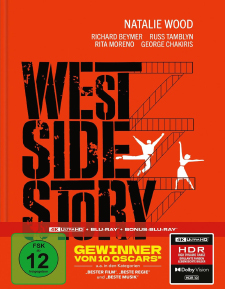
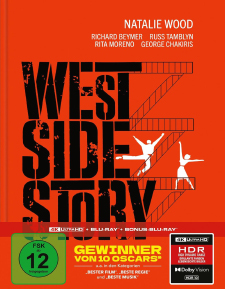
The Region-Free Capelight Pictures 4K Ultra HD Mediabook release of West Side Story is a 3-disc set that includes a Blu-ray with a 1080p copy of the film and a second Blu-ray with additional extras. It’s available in German and U.K. editions, both of which appear to include the identical discs with different languages on the labels and packaging (there’s an up-front language selection option at the head of all three discs). Either way, there’s an essay by Kathrin Horster, two art cards, and a J-card slipcover. The following archival extras are included (note that the extras on the first two discs are identical, but since the Song Specific Commentary and the Music Machine just skip directly to scenes in the film, they’re in 4K on the UHD and 1080p on the BD):
DISCS ONE & TWO: UHD & BD
- Song Specific Commentary by Stephen Sondheim (UHD or BD – 19:37)
- Music Machine (UHD or BD – 85:09, 20 in all)
- Alternative Overture (HD – 5:07)
- Original Theatrical Trailer (HD – 3:57)
- Original Issue Trailer (HD – 3:54)
- Reissue Trailer (HD – 3:58)
- Animated Trailer (HD – 2:03)
Sondheim’s Song Specific Commentary was originally recorded for the 2011 MGM Blu-ray, and it jumps to most of the key musical moments in the film: the opening ballet; Jet Song; Something’s Coming; the gym dance; Maria; America; Tonight; Gee, Officer Krupke; I Feel Pretty; One Hand, One Heart; Tonight (Quintet); Somewhere; Cool; and A Boy Like That/I Have a Love. He addresses the way that the music evolved in both the play and the film, and the way that he, Leonard Bernstein, and Jerome Robbins worked out their collective differences. Robbins was the one who wanted only the girls during America for the play, so Sondheim was happy to be able to restore it to his original intentions as Anita vs. Bernardo for the film, and he also preferred the fact that the film swapped out the positions of Cool and Gee, Officer Krupke. He does admit that he’s never been entirely happy with all of the lyrics, especially during I Feel Pretty, but he learned to be less “square” from Bernstein.
(Note that there appears to be an authoring issue on the UHD where it doesn't necessarily switch to the correct audio when you select the commentary from the Extras menu, but if that happens, you can still switch to it via the audio button on your remote.)
The Music Machine, on the other hand, jumps directly to all of the musical numbers in the film, offering a compressed version that’s basically a music-only musical. Considering that the film already has chapter stops, it’s pretty pointless, but it’s another feature from the 2011 Blu-ray that’s been replicated here if you want it.
The aforementioned Alternative Overture reproduces the original color design a bit more accurately than the 4K restoration does, but there are still some minor questionable spots like the dip to black before the final blue. Still, if the overture is a sticking point for you, then you can always watch this first instead of the 4K version.
DISC THREE: BD
- Pow! The Dances of West Side Story (HD – 19:12)
- A Place for Us: West Side Story’s Legacy (HD – 29:28)
- West Side Memories (Upscaled SD – 55:55)
- Storyboard to Film Comparison Montage (Upscaled SD – 4:50)
The first two featurettes were also produced for the 2011 MGM Blu-ray. Pow! The Dances of West Side Story focuses on just that: Jerome Robbins’ choreography and the way that the performers executed it, featuring interviews with participants in the film and the original Broadway production like assistant director Robert Relyea, Yvonne Wilder, Nobuko Miyamoto (Francisca), and Chita Rivera (Anita in the play). There’s also retrospective analysis from Jamie Bernstein (Leonard’s daughter); actor/ choreographer Debbie Allen; director/choreographer Adam Shankman; Mikhail Baryshnikov; director/choreographer Susan Stroman; author Deborah Jowitt; choreographer/producer Zach Woodlee; theater critic Sylviane Gold; author Amanda Vaill; and choreographer Joey McKneely.
A Place for Us: West Side Story’s Legacy features most of the same participants, this time joined by Stephen Sondheim, Jaime Rogers, conductor John Mauceri, orchestrator Sid Ramin, and writer/choreographer/performer Lin-Manuel Miranda, all of whom address the legacy of West Side Story as a whole. They also cover some practical information about the making of the film and the impact of its original release.
Speaking of which, West Side Memories is a much more comprehensive look back at the production of the film, originally produced for MGM’s 2003 DVD (it was edited by DVD Savant/CineSavant’s Glenn Erickson). It includes new and archival interviews with Jerome Robbins, Arthur Laurent, Stephen Sondheim, producer Hal Prince, producer Walter Mirisch, Robert Wise, Richard Beymer, Robert Relyea, Tony Mordente, Rita Moreno, Russ Tamblyn, Harvey Hohnecker (“Mouthpiece”),and author Greg Lawrence. Given the fact that it includes interviews with participants who are no longer with us, it’s an invaluable collection of their memories, and it also includes some priceless behind-the-scenes footage. It traces how the content of the story drove the form of the play and the film, both the score and the choreography, and how Robbins’ relentless perfectionism led to him being taken off the project. (Perhaps unsurprisingly, despite the fact that Cool remains one of the greatest dance numbers ever committed to film, Mordente says that Robbins was never satisfied with the choreography.) But the highlight for most fans will be the musical footage from the film synced to the original recordings of Natalie Wood and Russ Tamblyn’s real vocal performances.
Finally, there’s a somewhat perfunctory Storyboard to Film Comparison that was also from the 2003 DVD. Collectively, that’s all of the extras from the previous Blu-ray versions and most of them from the DVD, although the various Image Galleries from the latter haven’t been carried forward—and needless to say, the still-frame supplements and audio interview from the 1989 CAV Criterion Collection LaserDisc haven’t been seen anywhere else since then. (The Blu-ray did offer Pow! The Dances of West Side Story as picture-in-picture popups as well as a collection like here, but it’s still all the same content). The only other missing things are swag and packaging-oriented, like the full copy of the screenplay that was included in the 2003 DVD Collector’s Set. If you have any of those, you’ll definitely want to hang onto them. But unless the colors during the overture are a sticking point for you, then you’ll never want to watch West Side Story any other way again. It looks (and sounds) that good in 4K. A domestic release appears to be forthcoming, and maybe it will fix the overture colors, but I wouldn’t hold your breath on that one. If you can’t wait, then this import version is highly recommended—and in my case, I’m glad that I didn’t wait.
- Stephen Bjork
(You can follow Stephen on social media at these links: Twitter, Facebook, BlueSky, and Letterboxd).