
We Were Strangers (Blu-ray Review)
Director
John HustonRelease Date(s)
1949 (August 26, 2026)Studio(s)
Horizon Pictures/Columbia Pictures (Imprint Films/Via Vision Entertainment)- Film/Program Grade: B-
- Video Grade: B
- Audio Grade: A
- Extras Grade: F

Review
[Editor’s Note: This is a Region-Free Australian Blu-ray import.]
We Were Strangers is based on a historical event. As Cuba’s people suffered under the autocratic police-state rule of President Gerardo Machado, an underground movement spearheaded a revolution. Director John Huston offers a detailed drama about the revolutionaries’ ambitious plan. It required courage, precise coordination, and utmost secrecy.
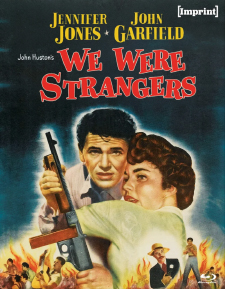
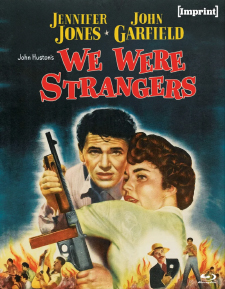
The film opens with the Thomas Jefferson quote, “Resistance to tyrants is obedience to God.” Young student revolutionary Manolo (Tito Renaldo) is gunned down on the steps of a university by the ruthless chief of police Armando Ariete (Pedro Armendariz) after a captured colleague gives him up under torture. His crime: distributing leaflets critical of the Machado government. Manolo’s sister, China Valdes (Jennifer Jones, witnesses the shooting and joins the Cuban underground to avenge her brother’s death. She allows her house to be used for secret meetings and strategy planning by Tony Fenner (John Garfield), an American sympathizer posing as a theatrical producer scouting talent in Cuba.
The small group hatch a plan to build a bomb and dig a tunnel from the basement of China’s house to the cemetery across the street. Then another team will assassinate Contreras, a key government official certain to be buried there. Machado and all of his top officials will turn up for the funeral. When everyone is assembled, the revolutionaries will detonate the bomb. The intended victims will be killed, but so will many innocent bystanders. This gives pause among some of the plotters, but reasoning that Machado’s continued rule would lead to far more people being killed, they all finally agree to the plan.
The group is led by the head of the underground (Ramon Navarro). Other members are politically motivated humanitarian Toto (Jose Perez), bike mechanic Miguel (Wally Cassell), wealthy grad student Ramon (David Bond), and dock worker Guillermo (Gilbert Roland). The men take turns digging the tunnel, the work is grueling, discovery a constant fear. Meanwhile police chief Ariete has seen China and Tony together and suspects them. China knows she’s being followed and has to watch her every move. At one point, Ariete comes to her house while her co-conspirators are hiding, creating enormous tension.
The screenplay by Peter Viertel and John Huston, based on an episode in the novel Rough Sketch by Robert Sylvester, resembles a caper film. It chronicles the secret planning and execution of an elaborate, illegal plan. The prize, however, isn’t riches but the deaths of government officials who have stripped citizens of rights and tortured and executed adversaries. Sympathy is with the revolutionaries.
Casting is troublesome. Jennifer Jones is a poor fit for China. Jones attempts an accent, which comes and goes throughout the film, and she lacks the fire that would inspire the chances she takes in the name of vengeance. Once the plan gets underway, she’s more an observer than a participant since the action shifts to Fenner and the digging of the tunnel. In a scene that strongly suggests Ariete is about to rape her, the look on her face is theatrical fear, not genuine terror. An actor like Katy Jurado would have been ideal as China.
Garfield’s character, Fenner, is a bit of an enigma. We learn late in the film why, as an American, he takes such risks. Though Garfield, along with Jones, is top billed, he disappears for long periods, making him more an ensemble player than star. Garfield projects confidence in the plan, despite its complexity. He motivates the others to continue even as they become exhausted from the manual labor. He handles himself well under pressure. Cool and collected when Ariete stops by their table making thinly veiled threats, Garfield’s character doesn’t panic, his manner having a calming effect on nervous China. Garfield gets the chance to do some action work toward the end of the film that shows his character’s heroism when things get tough.
Pedro Armendariz has a wonderful scene in which his Ariete shows his gluttony and his lust. As he stuffs himself with crab’s legs and guzzles rum, he ogles China, who’s repelled by his vulgarity. Armendariz likely knew this was his big scene and he doesn’t hold back making Ariete as vile and gross as possible. Armendariz’s portrayal of Ariete’s disgusting behavior and intolerance for opposition establishes him as representative of the entire regime.
Gilbert Roland stands out as guitar-strumming Guillermo, who casually provides off-the-cuff lyrics about the group’s grand plan and offers sensible thoughts about revolution and what might occur after Machado is gone. The other actors fail to stand out as clearly because the script doesn’t give their roles as much attention.
Director John Huston manages to keep the narrative moving despite having few exteriors to open up the action. The story is strong and we become involved in the plot, even though it sounds far-fetched and fraught with obstacles. It’s the sincerity and extremely detailed and coordinated planning that make it seem attainable.
Because Huston was aware of the controversial nature of the subject matter, he formed an independent company along with Sam Spiegel to avoid interference from studio executives. Huston and Garfield shared a progressive, anti-fascist viewpoint and both pushed back against Washington’s anti-communist investigations. Huston was able to get permission to film in Cuba because the country’s ruling party at the time allied itself with the 1933 Cuban revolution. The main actors were filmed in Los Angeles. Body doubles were used in scenes shot in Havana. Rear screen projection is used quite noticeably when main characters are shown in Cuba.
We Were Strangers was shot by director of photography Russell Metty on black & white 35mm film with spherical lenses and presented in the aspect ratio of 1.37:1. The Blu-ray has an aspect ratio of 1.33:1. Metty’s high-contrast images give the film a documentary look and he uses many film noir elements, especially dramatic shadows to suggest secrecy and danger. Scenes in the tunnel are especially atmospheric, with details of the dirt and rocks highlighted. Late-night meetings emphasize the caution with which the revolutionaries must operate. Rear projection attempts to give the illusion that Jones and Garfield were actually in Cuba. To trained eyes the blend is pretty obvious, but the meshing of live action with a filmed background was an often-used technique at the time, not unique to We Were Strangers.
The soundtrack is English 2.0 mono LPCM. English SDH subtitles are an available option. Dialogue is clear. Most of the actors playing Cubans attempt an accent, but often the accents aren’t consistent. This is particularly noticeable with Jennifer Jones because her character is prominent. Her accent comes and goes from scene to scene. Sound effects that dominate a large section of the film include digging, dirt being hauled out, chopping with pick axes, and dynamite explosions. The panting of the men doing the laborious work is prominent. George Antheil’s score isn’t as overwhelming as those of the 1940s. Director Huston uses it to enhance suspense in key scenes but avoids an ongoing musical track. Often, the only audio component is the sounds of digging in the tunnel.
There are no bonus features on the Region-Free Blu-ray release from Imprint Films.
We Were Strangers, directed by John Huston between his successful Key Largo and The Asphalt Jungle, was his first box office failure. The plot is suspenseful, the visual style impressive, and the performances—with the exception of Jennifer Jones’ underwhelming portrayal—effective. Pedro Armendariz stands out as the Javert-like police officer hounding China and Fenner. The finale differs in style jarringly from the rest of the picture. By altering the ending of the novel, the script abruptly changes gears to become a shoot-em-up action picture. Critics and the public alike turned their backs on it. Today, it stands as an example of how cinema can combine a dramatic plot with an anti-fascist message.
- Dennis Seuling