
Interview with the Vampire: The Vampire Chronicles (4K UHD Review)
Director
Neil JordanRelease Date(s)
1994 (September 22, 2026)Studio(s)
Geffen Pictures (Warner Bros. Entertainment)- Film/Program Grade: A
- Video Grade: A+
- Audio Grade: A+
- Extras Grade: B+

Review
Anne Rice’s 1976 novel Interview with the Vampire had been kicking around as a potential Hollywood project for a number of years before it finally reached screens in November of 1994. It had gone through different permutations and creatives before finally landing in the hands of director Neil Jordan, who had previously directed 1984’s The Company of Wolves and had recent success with 1992’s The Crying Game. Jordan was given permission to write his own version of the script uncredited, and controversially hired Tom Cruise and Brad Pitt as the two leads. The film nonetheless hit theaters and was a commercial success, and along with Bram Stoker’s Dracula from two years prior, redefined the vampire genre for a generation.
In modern day San Francisco, reporter Daniel Molloy (Christian Slater), self-proclaimed collector of stories, interviews Louis de Pointe du Lac (Brad Pitt), who reveals himself to be a 200-year-old vampire. Although Molloy is initially dubious, he still records Louis’ story, revealing that he was turned into a vampire in 1791 by Lestat de Lioncourt (Tom Cruise), later turning a young girl named Claudia (Kirsten Dunst) into one as well. The three of them live throughout the centuries and changing of times together, though Louis is never able to get past his own personal guilt of being a killer. Along his path, he meets a Parisian troupe of vampires led by Armand (Antonio Banderas) while searching for answers to where his kind originated, and Daniel continues to listen. Also in the cast are Stephen Rea, Thandiwe Newton, and Domiziana Giordano.
It’s fair to say that before Interview with the Vampire, no filmmaker had ever attempted to make a period drama horror film. Vampires had been explored in differing and interesting ways throughout the 1980s by directors like Tony Scott (The Hunger) and Kathryn Bigelow (Near Dark), but none really dealt with the idea of a vampire being miserable with his own existence, and that he regretted doing what he had to do to survive. Brad Pitt was purportedly also unhappy with this aspect of his character as well, and with six weeks of night shoots and being hung upside down for 30 minutes a day in order to apply the make-up for the veins in his face, he wasn’t exactly thrilled with the film once it was completed. Meanwhile, author Anne Rice decried the casting of Tom Cruise as Lestat, as did fans of the book, though she changed her tune once she saw the final film. In other words, adapting Interview with the Vampire was no simple task.
Thankfully, under the producorial hand of David Geffen at Geffen Pictures, Neil Jordan was able to shoot the film that he wanted to make. Things got a little more complicated in the editing room, especially when David Geffen started showing the unfinished film to test audiences to see how it was playing against Neil Jordan’s wishes. At its final length of two hours and three minutes, Interview with the Vampire maintained its epic scope while mostly ironing out its pace, though many have criticized that the latter half of film has a tendency to drag once Louis and Claudia reach Paris and Lestat is effectively out of the movie. Others were disappointed in Lestat not having a clearer backstory, though it wound up working in the character’s favor as it made him that much more mysterious.
Today, Interview with the Vampire walks a fine line of being a period piece, a horror film, a personal drama, a dialogue between two characters, and as intended by Neil Jordan, a gay relationship fable. Lestat and Louie never engage in sensual or loving acts with each other and their primary targets are women, but it becomes clear once Claudia comes into their lives that they’re essentially a gay-coded couple raising a daughter. These are the sorts of layers, along with the sexual magnetism of the male leads, that have kept Interview with the Vampire in the spotlight since its release, regardless of any alterations from the original text. Further Vampire Chronicles novels and stories have been adapted since, but the 1994 film still reigns supreme.
Cinematographer Philippe Rousselot shot Interview with the Vampire: The Vampire Chronicles on 35mm film (Eastman EXR 500T 5296) using the Super-35 process with Panavision Panaflex Platinum cameras and Primo lenses. The results were finished photochemically and framed theatrically at the aspect ratio of 1.85:1. Warner Bros. Entertainment debuts the film on Ultra HD with a new 4K restoration of the original camera negative, supervised by director Neil Jordan, graded for High Dynamic Range in HDR10 and Dolby Vision, and encoded to a triple-layered BD-100 disc. To say that this film has been a challenge to present on home video is an understatement, since it was primarily shot at night with challenging light levels. Warner Bros. UHD presentation captures the film’s look with perfection. It’s an exquisite image with well-resolved grain and superb compression. The HDR ably improves the contrast with deeper blacks and widens the gamut for the warmer colors and pallid flesh tones of our leads, as well as the variety of tones on their victims. The low level Barry Lyndon-esque candlelight scenes early on are sumptuous, with super deep blacks and strong levels of saturation. The image is stable and incredibly clean from one end to the other, making for an impressive picture. It’s the finest the film has ever looked on home video.
The main audio options are English Dolby Atmos (Dolby TrueHD 7.1 compatible) and 5.1 DTS-HD Master Audio, with optional subtitles in English SDH. The 5.1 track, which has followed the film around since the 2014 Blu-ray, is impressive in its own right. The new Atmos track merely expands upon it, widening out its potential, with particular regard for the added height that it provides. Dialogue is obviously the main pull, but Elliott Goldenthal’s spectacular score is given even more room to breathe. Sound effects range from the subtle to the bombastic, with careful steering and placement. Both tracks are outstanding, though some may prefer the simplicity of the original track. Additional audio options include French (Parisian), German, Italian, and Spanish (Castilian) 5.1 Dolby Digital; French (Canadian), Spanish (Latin), and Czech 2.0 Dolby Digital; and Polish 5.1 Dolby Digital Descriptive Audio. Additional subtitle options include French, German SDH, Italian SDH, Spanish (Castilian), Dutch, Chinese, Korean, Spanish (Latin), Czech, Danish, Finnish, Norwegian, Polish, and Swedish.
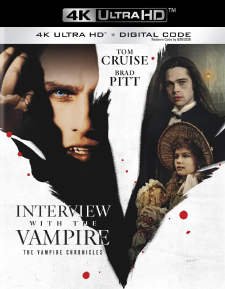
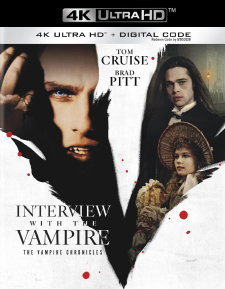
The Warner Bros. Entertainment 4K Ultra HD release of Interview with the Vampire: The Vampire Chronicles sits in a black Amaray case alongside a Digital Code on a paper insert within the package, along with an inner sleeve and a slipcover featuring a version of the original theatrical poster artwork. A Limited Edition Steelbook option is also available. The following extras are included on the disc:
- Audio Commentary by Neil Jordan
- Introduction by Neil Jordan, Anne Rice, and Antonio Banderas (Upscaled SD – 1:02)
- Eternal Night and Deadly Light (HD – 8:00)
- Interview with the Vampire: Creating the World (HD – 10:40)
- In the Shadow of the Vampire: The Making of Interview with the Vampire (Upscaled SD – 29:40)
- Lestat, Louis and the Vampire Phenomenon (HD – 24:06)
- Deleted Scenes (HD – 8 in all – 8:01)
The commentary with director Neil Jordan, recorded in 2000 for the DVD release, is a rapid-fire track as the filmmaker is more than game to talk about various aspects of the film. There are some brief dropouts, but mostly things stay on track. Also included is a brief introduction by Neil Jordan, Anne Rice, and Antonio Banderas, also from 2000.
Eternal Night and Deadly Light in a new featurette that speaks to Neil Jordan and editor Mick Audsley, celebrating cinematographer Philippe Rousselot’s work and the film’s absence of light. Creating the World is also a new featurette that once again features Jordan, now joined by production designer Dante Ferretti via Skype/Zoom, discussing the design of and building of the world of the book for the film. In the Shadow of the Vampire is a retrospective making of from 2000 by J.M. Kenny, featuring interviews with Anne Rice, Neil Jordan, Tom Cruise, Brad Pitt, Antonio Banderas, Stephen Rea, Kirsten Dunst, creature effects creator Stan Winston, visual effects director of photography and supervisor Rob Legato, and professor Laurence Rickles. Lestat, Louis and the Vampire Phenomenon from 2014 examines the myth of the vampire in different cultures with various authors and experts, while also taking a look at the film and the original novel. Last is a set of newly-unearthed Deleted Scenes, one of which memorably features Louis attacking a priest after visiting confessional. The rest are all mostly scene extensions. According to Neil Jordan, some of the deleted footage couldn’t be found, including a brief moment of Lestat re-appearing in Paris during Louis’ and Claudia’s visit, of which only some stills survive. Missing from previous releases is the film’s trailer and a set of production notes.
Revisiting Interview with the Vampire once in a while is rewarding as it continues to hold up as a terrific piece of filmmaking, as well as one of the best horror films of the 1990s. Warner Bros. 4K release is a knockout and belongs on your shelf if you’re a fan. Highly recommended.
- Tim Salmons
(You can follow Tim on social media at these links: Twitter, Facebook, BlueSky, and Letterboxd. And be sure to subscribe to his YouTube channel here.)