
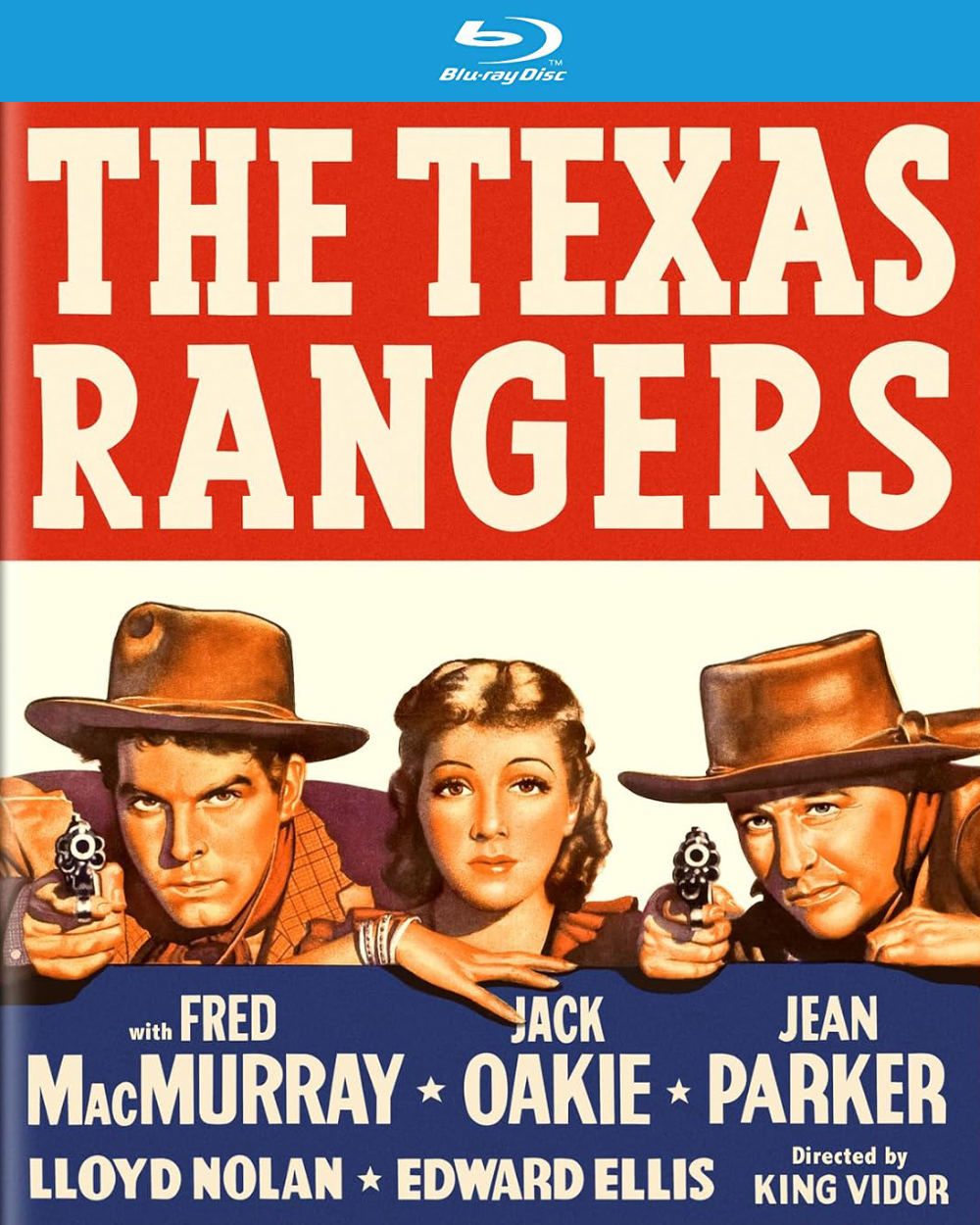
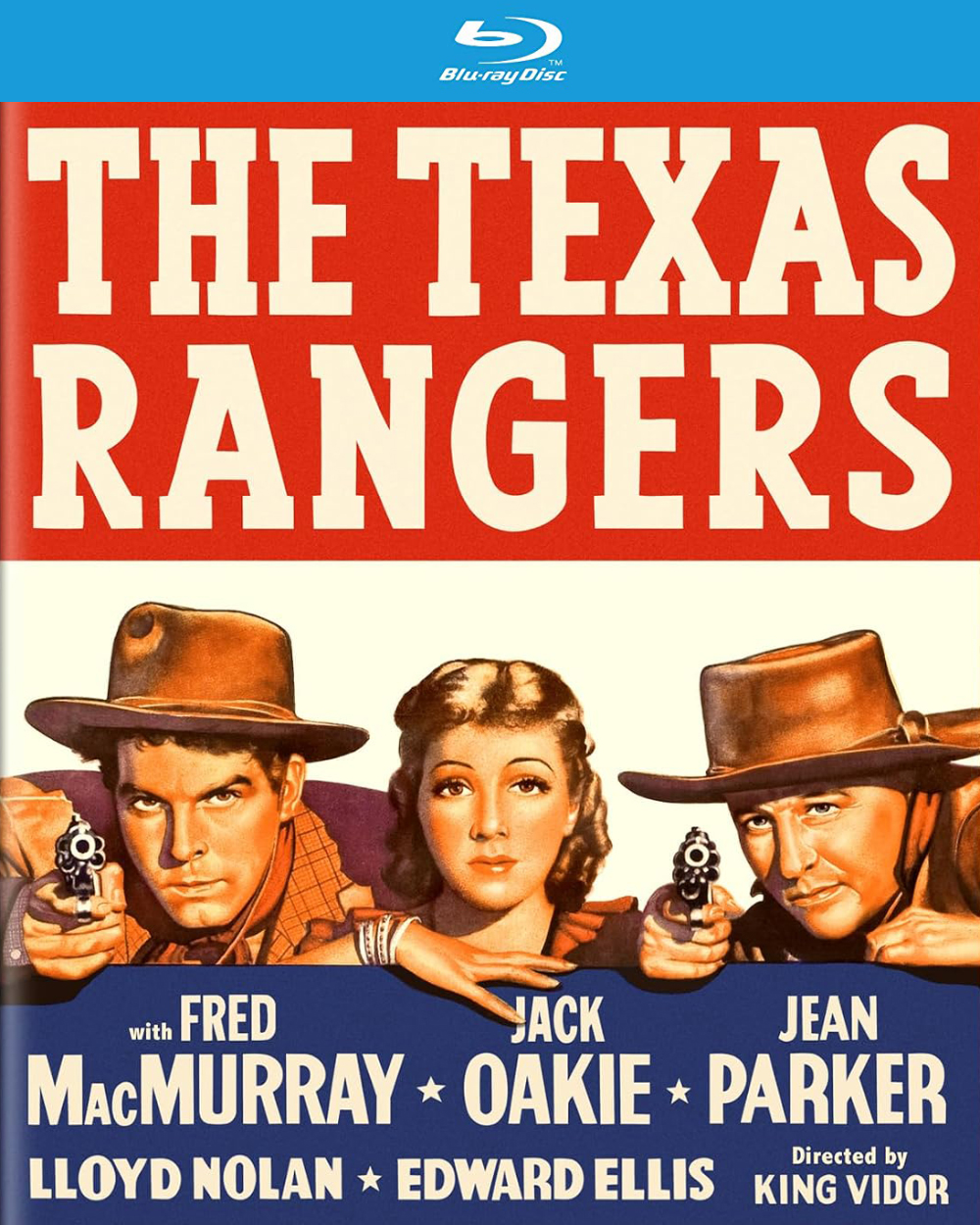
Texas Rangers, The (1936) (Blu-ray Review)
Director
King VidorRelease Date(s)
1936 (June 23, 2026)Studio(s)
Paramount Pictures (Kino Lorber Studio Classics)- Film/Program Grade: B+
- Video Grade: A-
- Audio Grade: A
- Extras Grade: B

Review
There’s an amusing, apparently true story that when director John Ford borrowed John Wayne from Republic Pictures to star in Ford’s Stagecoach (1939), Republic’s executives were bemused. “Why is Ford bothering to make a picture like that?” they asked. “Doesn’t he know that Republic makes the best Westerns?”
Of course, Stagecoach became one of the great, seminal Westerns of all-time, but in one sense Republic’s executives weren’t entirely off the mark. During the 1930s, at least until 1939, the major studios had largely given up producing “A”-level Westerns, while smaller companies, some of which essentially banded together to form Republic, cranked out scads of “B” Westerns. So bifurcated had the genre become that polls of the Top Box Office stars relegated B-Western movie stars to its own, separate-but-unequal category. However, these lower-class B-Westerns proved popular; Gene Autry, for instance, wasn’t just the top Western star of 1940, he ranked #4 overall, ahead of such Hollywood heavyweights as James Cagney, Bing Crosby, and Judy Garland.
At the time The Texas Rangers (1936) was made, when a major Hollywood studio, Paramount in this case, attempted a big, splashy Western, the results often resembled a gussied-up “B.” The Texas Rangers is corny and sentimental in the bad sense, populated by characters and plotting similar when not identical to B-Western tropes. At 99 minutes, The Texas Rangers is also nearly twice the length of the typical B-Western, but even with bigger stars and better production values, it still isn’t as entertaining as the best B-Westerns of its period.
Producer-director King Vidor made The Texas Rangers to cash in on interest in Texas’s centennial (though, curiously, it was shot on location in New Mexico), and also to celebrate the Rangers themselves. Supposedly the film was inspired by incidents in Water Prescott Webb’s 1935 book The Texas Rangers, a Century of Frontier Defense, but the movie is about as authentic as Drip-Along Daffy. One sequence has the film’s heroes effortlessly picking off Indians with pistols at 300 yards.
Carefree outlaws Jim Hawkins (Fred MacMurray), Sam “Polka Dot” McGee (Lloyd Nolan), and “Wahoo” Jones (Jack Oakie) have a good thing going with stagecoach driver Wahoo feeding Jim and Sam route and cargo information, which they then rob—until crack-shot Texas Rangers threatens their livelihood. When lawmen surround their camp, Sam disappears while Jim and Wahoo, soon broke, frivolously join the Texas Rangers themselves, neither taking their job or the Ranger’s oath very seriously. When they find Sam rustling cattle, Jim and Sam scheme to work both ends against the middle, but after battling hostile Indians that leave a young boy, David (Benny Bartlett), an orphan, Wahoo begins having seconds thoughts. He tries to get Jim interested in pretty Amanda Bailey (Jean Parker), hoping Jim will give up his plans with the increasingly violent Sam, but Jim seems determined to take the Rangers for a ride.
The Texas Rangers isn’t bad for what it is. The production values are obviously much higher than a typical B-Western; MacMurray, Nolan, and Oakie are all good; some of the action scenes are well-staged, and the climax is reasonably exciting. But where later Westerns like The Searchers, High Noon, Rio Bravo, etc. seem to age like fine wine, The Texas Rangers plays hopelessly old-fashioned and corny. It awkwardly shifts in tone from high comedy to tragedy, and lacks the carefully modulated nuances (yes) of the best B-Westerns, particularly the Paramount-released (but independently-produced) Hopalong Cassidy films, that series just beginning to hit its stride in the mid-1930s.
In those films, the carefully-defined triumvirate of unassailable Hoppy, impetuous male ingenue Johnny Nelson, and uneducated but devoted sidekick Windy Halliday not only influenced other B-Western series, but stretched into television and other media, including even the Kirk-Spock-McCoy relationships on Star Trek. In The Texas Rangers, there’s a bromance between Jim and Sam, with Jim’s devotion to Sam—and his utter disinterest in Amanda—quite unintentionally but amusingly inching toward the outer edges of queer cinema.
Jack Oakie delivers the film’s best performance, straddling Windy Halliday-like foolishness with a kind of growing wizened perceptiveness that Jim is all but blind to. He’s also very good in his scenes with child actor Benny Bartlett (later a spear carrier in the Bowery Boys series), both very naturalistic. No wonder Oakie soon became one of Hollywood’s top character stars.
Nolan makes a particularly ruthless heavy; he was good in such parts, but better as a character star himself, and more appealing on the side of law and order. MacMurray, much better and more versatile than he’s remembered for, is fine also but more memorable in later Westerns, even unambitious ones.
The film’s attempt to cash in on the growing popularity of B-Westerns is reflected in the casting. George “Gabby” Hayes, Windy Halliday himself, plays a very Windy-like judge; Charles Middleton (Ming the Merciless in the Flash Gordon serials), also in several early Hoppy films, appears as a defense attorney here, while Frank Shannon (Dr. Zarkov in Flash Gordon), also in many B-Westerns (and later a writer for the TV series Tales of the Texas Rangers), plays a Rangers officer. Alas, Middleton and Shannon have no scenes together.
Kino’s Blu-ray, licensed from Universal, is derived from a 4K restoration done by Universal and The Film Foundation sourcing a 35mm nitrate fine grain provided by the UCLA Film & Television Archives. Many of Universal’s Paramount holdings from this period, in black-and-white, 1.37:1 standard format, tend to be both soft and overly grainy, but this is a fine video transfer with a lot of detail. The DTS-HD Master Audio (2.0 mono) is also better than average, and supported by optional English subtitles. The disc itself is Region “A” encoded.
Somewhat oddly, there are two audio commentaries, the first by mystery writer Max Allan Collins and film historian Heath Holland, while the second one is hosted by genre historian Toby Roan. I’m not sure many viewers will want to sit through The Texas Rangers three times, but maybe there are. A trailer is also included.
Far from a great Western but not bad for what it is, or for the period in which it was made, nevertheless The Texas Rangers is more dated and less interesting than other Westerns that came later, and in some ways inferior to the lowlier B-Westerns that it in some respects emulates.
- Stuart Galbraith IV