
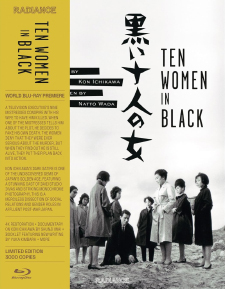
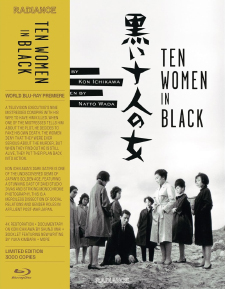
Ten Women in Black (Blu-ray Review)
Director
Kon IchikawaRelease Date(s)
1961 (September 1, 2026)Studio(s)
Daiei Motion Picture Co. Ltd. (Radiance Films)- Film/Program Grade: A-
- Video Grade: A-
- Audio Grade: A-
- Extras Grade: B

Review
Director Kon Ichikawa (1915-2008) was something like a Japanese John Huston—he made films in every conceivable genre (including animation), sometimes for the money or just to keep busy. In the west he is probably best-known for two deadly serious war dramas, The Burmese Harp (which, like several hits, Ichikawa later remade) and Fires on the Plain, and for Tokyo Olympiad, by far the best-ever document of the Olympic Games. In Japan, however, these days he may be best remembered his 1970s mystery films beginning with The Inugami Family (1976; he remade that, too), blockbusters released at a low point in Japan’s film industry. But his filmography includes such oddities as Topo Gigio and the Missile War, starring the famous Italian puppet, co-director of the Disneyesque The Adventures of Milo and Otis, and a live-action adaptation of Hinotori, from Osamu Tezuka’s manga.
Nevertheless, if there’s one genre Ichikawa tackled most, it would have to be ironic and/or black comedies, exemplified in Ten Women in Black (Kuroi junin no onna, 1961), previously known under its original international title, Ten Dark Women. As usual for Ichikawa, the screenplay was written by his wife, Natto Wada (1920-1983) and, by 1961 standards especially, it’s a startlingly funny, unique effort.
Television executive Matsuyoshi Kaze (Eiji Funakoshi, definitely not Fujiko Yamamoto, as reported elsewhere) of VTV, is an incorrigible womanizer, with dozens of obsessive mistresses, despite being married to Futaba (Fujiko Yamamoto, definitely not Eiji Funakoshi, as reported elsewhere). She’s aware of his habitual unfaithfulness, spending her days and nights operating a successful traditional Japanese restaurant. The film has an odd structure, with nine of Kaze’s mistresses confronting Futaba, before most of the story leading up to that point is told in flashback.
These nine of perhaps dozens of other mistresses, primarily TV actress Ichiko Ishinoshita (the late Keiko Kishi), the most cunning of the group, the fragile Miwako Mikishi (Mariko Miyagi), and Sayoko Goto (Kyoko Kishida), mostly aware of their many rivals for Kaze’s affections, grow weary of his casual refusal to commit to any one of them, and decide to partner with Futaba in a plot to murder him, not so much out of anger or revenge as an acknowledgment that his unvarying philandering will continue indefinitely; they can’t help but love him anyway, despite his guile and lack of any remorse, and the only way to resolve everything is to eliminate him, lest other women fall prey to his charms while generating more jealously among the women.
They make no secret of their plans, and an incredulous Kaze, upon learning their scheme, becomes hopelessly paranoid that he may be murdered at any minute, which among other things effects his TV executive work. Pleading with his wife, they decide to fake his murder in front of all the mistresses, with Kaze going into hiding for a few months until... well, that’s not really clear.
Did I mention Ten Women in Black prominently features a ghost in its narrative?
Ten Women in Black made the influential Kinema Jumpo’s “Best Ten” list and must have really left 1961 audiences gobsmacked. Stars Fujiko Yamamoto, Keiko Kishi, Mariko Miyagi and others were famous playing idealized, usually traditional (and submissive) Japanese women, often women helpless in a man’s world, so to have them so casually if assertively take control of their love lives by plotting the murder of their self-centered lover was, for the time, quite shocking. All of these actresses give delightful performances, but particularly standing out is Mariko Miyagi, playing the most naïve and vulnerable of the ten. A prominent actress and singer from the mid-1950s, she largely gave up those professions after establishing Nemunoki Gakuen, a school for disabled children, Miyagi even directing several acclaimed documentary films about the school but only rarely appearing in commercial films after that. Her performance in Ten Women in Black is exceptionally truthful and captivating, hinting at the loss cinephiles suffered when she mostly retired from acting.
Eiji Funakoshi is also terrific as a casual, amoral philanderer mortified to learn that his wife and mistresses intend to murder him. A handsome leading man at Daiei, Funakoshi’s collaborations with Ichikawa brought him acclaim in such films as Fires on the Plain and Being Two Isn’t Easy, and he came to be regarded as the “Japanese Marcello Mastroianni.” (Funakoshi really did play Mastroianni-type parts during this period, and vice versa.) After Daiei’s collapse in 1971, the actor retreated to much less prestigious television work, and when I interviewed him 1996 I got the sense that he had been unjustly forgotten or, at least, was egregiously undervalued.
The movie also does an exceptional job capturing, like a time capsule, the frantic heyday of early Japanese commercial television. Future writer-director Juzo Itami has a funny scene as an overworked, nervous TV announcer with a skin condition brought on by stress, while the Spike Jones-like Hajime Hana & The Crazy Cats (including future star Hitoshi Ueki), then a phenomenon on Japanese variety shows (and soon after as movie stars), make a brief but amusing cameo as themselves.
Photographed in black-and-white Daieiscope by longtime Ichikawa collaborator Setsuo Kobayashi, the movie lives up to its name, with most of the story taking place at night, in darkened (and, typical of Tokyo, often cramped) rooms, in shadows. To a large degree, Ten Women in Black is about the emptiness in the lives of many Japanese, men and women, especially those rebuilding postwar Japan by devoting themselves to their work. Even for the many film and television personalities I interviewed peaking during this period, their memories are something of a blur: famous actors might appear in 10 movies within a single year, their days filled further booked onto dozens of TV shots on dramas and variety shows, and for recordings of multiple record albums, etc. To eke out some kind of life outside these unimaginably busy schedules yet with sometimes empty rewards—even big stars earned peanuts compared to their Hollywood counterparts—such whirlwind affairs as dramatized in Ichikawa’s film, heavy in their own drama, is not unimaginable. Ichikawa himself supplemented his movie career with TV work, so it was a world he knew well.
Radiance Films’s Region A/B Blu-ray of Ten Women in Black is derived from a 4K restoration completed by Kadokawa, inheritors of the Daiei film library. Presented in its original black-and-white, 2.35:1 Daieiscope format, the heavy use of blacks throughout is splendidly rendered, inky and with good contrast and grain throughout. More likely a peculiarity of DP Kobayashi’s use of lenses rather than a transfer glitch, a couple of times the left-side of the image appeared overly squeezed, which is especially noticeable around the 28:30 mark. My guess is Kobayashi had to really open the Daieiscope lens extra-wide to encompass Ichikawa’s staging. The LPCM mono (Japanese only) is strong, supported by good, optional English subtitles.
Biggest among the extras is The Kon Ichikawa Story (2006), directed by Shunji Iwai (Love Letter, Swallowtail Butterfly), running 79 minutes. It’s a very strange, for me frustrating experience: most of its running time consists not of film clips, nor interviews with Ichikawa (and a cigarette butt, ever-dangling from his lower lip) or colleagues, nor archival interviews with Wada, but rather just plain text in Japanese, often with nothing on the soundtrack but silence. There are a few scattered film clips, but for about three quarters of the movie, I felt like I was reading a book.
Also included is a new, 21-minute appreciation of the film by Pizzicato Five’s Yasuharu Konishi, an original and 1997 re-release trailer, and a 28-page booklet featuring a good essay by Yuka Kimbara putting the film and the careers of Ichikawa and Wada into context.
So influential was Wada’s screenplay (and Ichikawa’s direction) that Ten Women in Black was remade at least twice for Japanese television, the most recent running 10 episodes over nearly 10 hours, and it’s been adapted (also multiple times) for the Japanese stage. For western viewers, this is another virtually long-lost classic of Japanese cinema finally available, thanks to Radiance Films, and a most welcome release.
- Stuart Galbraith IV