
Soylent Green (4K UHD Review)
Director
Richard FleischerRelease Date(s)
1973 (July 28, 2026)Studio(s)
Metro-Goldwyn-Mayer (Arrow Video)- Film/Program Grade: A-
- Video Grade: A+
- Audio Grade: A
- Extras Grade: A

Review
There’s no getting around the fact that you know the twist to Soylent Green revealed in the final minutes of the film. It’s a twist that’s infected popular culture for decades, having been parodied and referenced many times over in all forms of media. But, there’s a chance that someone reading this may not know what the twist is at all, perhaps someone younger. If that’s the case, I won’t reveal it here. Instead, let’s focus on the strengths of Soylent Green as a whole. It’s premium science fiction of the highest order, one of several that Charlton Heston took part in.
Soylent Green takes place in the distant year of 2022, far beyond the year of 1973 when the film was originally released. In the story, the world is nearly collapsed due to overpopulation and global warming, leaving only the most upper elite members of society with direct access to food, water, housing, and everyday vices. The rest of society has to live in near complete poverty, totally dependent on processed food bars called Soylent Green and Soylent Yellow, which are handed out once a week, but without enough supply to meet demand. In the midst of this dystopian society, New York City police detective Robert Thorn (Charlton Heston) is investigating the murder of the wealthy William R. Simonson (Joseph Cotten), questioning his obedient mistress Shirl (Leigh Taylor Young) and his bodyguard Tab Fielding (Chuck Connors). Thorn is also close friends and lives with police researcher Solomon Roth (Edward G. Robinson), and while investigating Simonson’s murder, the two of them uncover a sinister plot by the Soylent Corporation that will shake society to its very core. Also in the cast are Brock Peters, Paula Kelly, Stephen Young, Mike Henry, Roy Jenson, and Leonard Stone.
Given that we’re experiencing a world that lives somewhere at the intersection between Michael Crichton, George Orwell, and Rod Serling, Soylent Green’s dystopian future, one that aesthetically came about due to the end of the world as we knew it during the 1970s, is a fascinating and not too far-fetched one. In the era I’m currently writing from where meat and produce is becoming more and more untrustworthy due to government cutbacks and shortcuts, you can see a world where only the most affluent have access not just to quality food, but common necessities. Charlton Heston’s Thorn is not just a good cop, but he’s also a desperate human being, taking a pillow case and filling it with everything from food to booze as he takes a look at the crime scene of someone wealthy. Only Edward G. Robinson’s Roth can remember a time from before when having access to these things was a cinch for everyday people.
Soylent Green sells you on its dystopian premise and, perhaps a little broadly in certain respects, makes its points while also serving as a police procedural. We learn more about this world through Thorn’s eyes, and it’s obvious from his tired and dour demeanor that he’s had to go through a lot to get to where he is. His fondness for Roth and his growing affection for Shirl, and likewise her growing affection for him, help to give the characters some depth. At the end of the day, no matter how we’re conditioned, we’re still human and we need each other to get us through this thing called life, to borrow a phrase from dearly departed musical royalty. Thankfully, Thorn’s exploration of this singular crime at the beginning of the film and the rabbit hole that it leads him down is intriguing enough to keep us engaged, and that’s what’s important.
Based upon Harry Harrison’s novel Make Room! Make Room!, which was also a short story prior to being expanded, much has been changed from the source material. The central idea of overpopulation and the upper minority hoarding everything for themselves are the only ideas carried over for the film adaptation by Walter Seltzer and Russell Thacher. The rest, including all of the characters, the main storyline, and the aforementioned twist, were all inventions for the motion picture. Harrison wasn’t consulted nor was he allowed access to the screenplay, and needless to say, he wasn’t totally thrilled about the final result. The film also has an eerie quality in that it was Edward G. Robinson’s final performance before his death two months before it was finished. And knowing his fate in the film, it gives it a haunted quality that even Heston himself couldn’t ignore.
Even knowing the twist going in, Soylent Green is a solid and satisfying piece of sci-fi, one that feels closer to reality than ever. Performances are strong across the board, with wonderful cinematography by Richard H. Kline, and a strong sense of verisimilitude in the realization of this world. It’s certainly dated because of the decade that it was made in, but most future-based science fiction always is. What you take away from it is a reflection of current society, and how much it resembles the real world more than we would care to admit, and this certainly does.
Cinematographer Richard H. Kline shot Soylent Green on 35mm film using Panavision R-200° cameras and anamorphic lenses. The results were finished photochemically and framed theatrically at the aspect ratio of 2.39:1. Arrow Video’s Ultra HD debut of the film is sourced from a new 4K restoration from the original camera negative, which has been graded for High Dynamic Range in HDR10 and Dolby Vision, QC’d by Pixelogic, and authored by The Engine House Media Services to a triple-layered BD-100 disc. It’s a highly organic picture, thoroughly accurate to how the film looked at the time, replete with thick grain and occasional opticals. The 2011 Blu-ray was no slouch, but this UHD upgrade excels. The film has never looked better, with sharper and more precise levels of detail in the frame, and bitrates sitting between 80 and 100Mbps. There are no issues with compression, nor are there any elements-related blemishes, outside of the aforementioned softer opticals. Aside from a fresh 4K 16-Bit scan by Warner Bros. Motion Picture Imaging (the 4K restoration itself was carried out by Silver Salt Restoration), the true draw of this release is the HDR grading. It provides a more accurate and richer palette, including the sickly green overcast in the city and the various tans and browns of the various urban environments. The use of primaries is mostly reserved for those in power, with Joseph Cotton’s blue suit and Charles’ red jacket really popping off the screen with a newfound lushness. Blacks are considerably deeper as well with improved contrast, which is most apparent during nighttime scenes. The image is stable and clean throughout, and it’s doubtful that a better picture for the film could be achieved. It’s outstanding.
Audio is included in English mono LPCM with optional subtitles in English SDH. It’s a clean and satisfying track that does much with little, giving some surprising dynamism to single channel audio. The score is offered plenty of punch, as are sound effects. Look no further than Thorn making his way up the stairs to his apartment and quietly stepping over the people who sleep there, with the sounds of his steps having gentle but effective impact. Dialogue is king here, and the track is clean overall with no age-related issues or other anomalies. A multi-channel, perhaps even object-based mix might be too much, but it could certainly open up the more ambient and subdued passages of the film’s soundtrack. Just a thought.
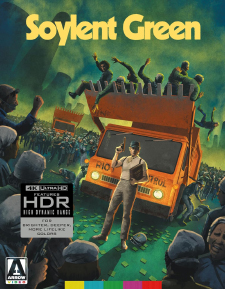
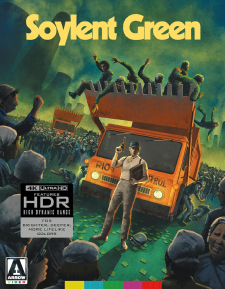
The Arrow Video 4K Ultra HD release of Soylent Green sits in a black Amaray case alongside a double-sided insert featuring new artwork by Nathanael Marsh on the front (as well as the slipcover) and the film’s main theatrical poster artwork on the reverse. Also included is a 32-page insert booklet containing cast and crew information; the essays “Remember, Tuesday is Soylent Green Day” by Frank Collins and Death Rites and Culinary Ethnography: Capitalism and Cannibalism in Soylent Green by Alexandra Heller-Nicholas; presentation information; production credits; and special thanks. The following extras are included on the disc:
- Audio Commentaries:
- Richard Fleischer and Leigh Taylor-Young
- Michael Brooke and Johnny Mains
- A Look at the World of Soylent Green (Upscaled SD – 10:03)
- MGM’s Tribute to Edward G. Robinson’s 101st Film (Upscaled SD – 4:51)
- Charlton Heston at the BFI (UHD w/HDR – 71:50)
- Richard Fleischer at the BFI (SD – 76:25)
- Theatrical Trailer (Upscaled SD – 3:29)
- Image Galleries:
- Posters & Artwork (HD – 11 in all)
- Black & White Promo Stills (HD – 235 in all)
- Color Promo Stills (HD – 164 in all)
The first audio commentary, recorded in 2003 for the DVD release, features director Richard Fleischer and actress Leigh Taylor-Young. Each are recorded are separately and the track can be a little choppy, but it provides valuable insight into the making of the film directly from the source. Newly-recorded for this release is the second commentary with writer and film historian Michael Brooke and author Johnny Mains, which is very much an exploratory track examining the world of the film versus reality, while also going over not just the film’s cast and its director, but also the set design and thematics at play. Both tracks make for excellent listening and education.
A Look at the World of Soylent Green is a vintage studio featurette (which was also included on MGM/UA’s Deluxe Letterboxed Edition LaserDisc) that examines previous science fiction films in comparison to Soylent Green, showcases clips from the film, and presents behind-the-scenes footage, as well as Edward G. Robinson and company celebrating his 101st film. MGM’s Tribute to Edward G. Robinson’s 101st Film features more extensive footage of the latter. Next are a pair of stage-bound interviews, courtesy of the British Film Institute. One features Charlton Heston from 1985, and the other features Richard Fleischer from 1994 after a screening of his film Compulsion. Both interviews were conducted at the National Film Theatre, which is now the BFI Southbank cinema. The former is audio-only and acts as an extra audio commentary track, nearly running the entire length of the picture, while the latter is video-sourced footage of the director, both answering questions for their host. Last is the film’s trailer and three Image Galleries containing a total of 410 images of posters, lobby cards, newspaper clippings, and black-and-white and color promotional stills. The only item missing from previous releases is the text essay Charlton Heston: Science Fiction Legend, which was included on the 2003 DVD.
Arrow Video’s UHD release of Soylent Green is leaps and bounds beyond any previous release, and definitely one that science fiction fans, as well as film fans in general, will want to add to their library. Highly recommended.
- Tim Salmons
(You can follow Tim on social media at these links: Twitter, Facebook, BlueSky, and Letterboxd. And be sure to subscribe to his YouTube channel here.)