
Popeye (4K UHD Review)
- Review Date: Aug 31, 2026
- Format: 4K Ultra HD
-


Director
Robert AltmanRelease Date(s)
1980 (August 18, 2026)Studio(s)
Paramount Pictures/Walt Disney Productions (Paramount Pictures Home Entertainment)- Film/Program Grade: B
- Video Grade: A-
- Audio Grade: B+
- Extras Grade: C

Review
“Hey, what’s this—one of Bluto’s tricks? I’m in the wrong movie!”
So says the animated Max Fleischer version of Popeye that appears before the opening credits of Robert Altman’s 1980 film Popeye, and some viewers (and far too many critics) soon would be asking themselves the same question. Yet Altman had built an entire career out of defying expectations, so they shouldn’t have been so bewildered. What may have been legitimately surprising at the time was the presence of Robin Williams in such a confoundingly idiosyncratic film, but history would end up proving that expectation wrong, too. For all of the safe and predictable mainstream efforts that Robin Williams would go on to make during his career, he usually balanced them with riskier and far more interesting projects. For every Patch Adams, Mrs. Doubtfire, or Jumanji, there was a World’s Greatest Dad, One Hour Photo, or What Dreams May Come. So in hindsight, it makes perfect sense that Williams would choose Popeye as his feature film debut in a leading role. Essentially, he was trying to work both sides of the room at the same time, making big budget mainstream entertainment that just happened to be a bit farther off the beaten track than usual. Yet nothing about Popeye turned out as Williams might have expected, either.
The fact that Paramount ever greenlit this version of Popeye in the first place is bewildering enough, but producer Robert Evans still had a great deal of clout with the studio, and he must have called in a few big-time markers for the project. Yet stubbornly going his own way, he hired Carnal Knowledge screenwriter Jules Feiffer to write a script based not so much on the well-known Fleischer cartoons, but rather on E.C. Segar’s less familiar Thimble Theatre comic strips that had originally introduced the character. After multiple directors passed on the script, he offered it to Robert Altman, and that’s when the curious saga of Popeye really began. It was always intended to be a musical, but Altman turned around and hired the equally idiosyncratic Harry Nilsson to write the songs for the film. To say that this offbeat Altman/Feiffer/Nilssen formula wasn’t exactly a guarantee of box office success would be a gross understatement, and to top it off, Robin Williams was completely untested as a lead actor. To its credit, Paramount still decided to roll the dice on the project anyway, although they shared the risk with Disney in a relatively rare co-production deal for the era. Still, they did ultimately pull the plug on the production once the price tag hit $20 million (giving Altman no opportunity to fix the issues with the mechanical octopus used for the finale).
Evans’ selection of Robert Altman as director resulted in Altman deciding to make a full-blown Robert Altman film rather than a simple Popeye adaptation, Fleischer, Segar, Feiffer, or otherwise. One of Altman’s greatest gifts during the Seventies had been his uncanny knack for creating living, breathing worlds, whether in his perverse vision of Korea in M*A*S*H, the Pacific Northwest of McCabe & Mrs. Miller, the satirical country music scene of Nashville, or even his sunbaked neo-noir rendition of Los Angeles for The Long Goodbye. They’re the kinds of worlds that feel as if they continue to exist beyond the edges of the frame, even when the cameras aren’t rolling—and given Altman’s working methodology at the time, that’s not far from the truth. For Popeye, he essentially made a more whimsical version of McCabe & Mrs. Miller, replacing Warren Beatty and Julie Christie with Robin Williams and Shelly Duvall, switching his fully-functioning town of Presbyterian Church, WA into the no less vibrant seaside community of Sweethaven, and swapping out the Leonard Cohen songs for Harry Nilssen tunes instead.
It’s not much of a stretch to make that comparison, either, because Altman took the exact same approach to crafting Sweethaven that he had used on McCabe & Mrs. Miller. He hired production designer Wolf Kroeger to build an astonishing seaside set in Malta, and then he filled it with background characters in constant motion to make it feel as if the whole village was alive even when the camera wasn’t pointed at them. (Remarkably enough, Kroeger’s set remains standing to this very day, and it’s become a popular tourist attraction over the years.) Altman filmed everything in his typical fashion for the era with the camera at a distance shooting with long lenses, and that helped give the impression that his cinematographer Giuseppe Rotunno was following the action as it occurred rather than leading it. The actors and extras didn’t always know if the camera was going to be on them at any given moment, either. As a result, however intricate the choreography of the background action may be, it always feels spontaneous rather than preplanned.
Many of those background actors and extras were circus performers and acrobats in order to facilitate the most extreme choreography, but Altman being Altman, he also peppered Popeye with members of his own stock company. Altman regulars or not, they couldn’t possibly have been more appropriate for the world of Popeye. Shelly Duvall simply was born to play Olive Oyl, and it’s difficult to imagine a better Wimpy than Paul Dooley. The rest of the actors are equally well cast, with Paul L. Smith being an inspired choice for Bluto, and Ray Walston arguably stealing scenes from Robin Williams as Poopdeck Pappy—although Altman’s grandson Wesley Ivan Hurt ended up stealing scenes from both of them as the incurably adorable Swee’Pea. Everyone else fills out their roles capably, including the likes of Donald Moffat, Roberta Maxwell, MacIntyre Dixon, Donavan Scott, Richard Libertini, Allan F. Nichols, Linda Hunt, Peter Bray, and more (watch for cameos by Dennis Franz, Klaus Voorman, and Van Dyke Parks, too). Yet Robin Williams was still the linchpin for the entire production, because without a credible Popeye, all of Altman’s spectacular worldbuilding would have been for naught.
Granted, some people still thought it was all for naught in 1980, especially the critics who panned the film. Yet interestingly enough, while Popeye has sometimes been described as being a flop, it was actually nothing of the sort. While it definitely wasn’t an international blockbuster, it ended up grossing about three times its budget worldwide, which dragged the film kicking and screaming into profitability, critics (and nervous studio executives) be damned. Yes, much of that critical reception was generally somewhat harsh at the time, but enough of the public went to see the film anyway. Paramount (and Disney) were doubtless hoping for more, but they should have been thanking their lucky stars such an unorthodox piece of popular entertainment found any kind of an audience at all. Yet while Popeye does have its ardent fans, it’s never really built up the kind of cult movie reputation that it deserves (the perception of it having been a flop probably doesn’t help). And to be fair, it is a rather unorthodox film. But if you let the late great Robert Altman take you by the hand and guide you on his one-of-a-kind journey through the wonders of Sweethaven, Popeye will work its magic on you as well.
Cinematographer Guiseppe Rotunno shot Popeye on 35mm film using anamorphic Technovision lenses, framed at 2.39:1 for its theatrical release. This version is based on a new 4K scan of the original camera negative, with Pro-Tek in Burbank handling the physical negative while MTI Film in Hollywood performed the actual scanning, digital remastering, and grading (both Dolby Vision and HDR10 are included). Since Rotunno and Altman are no longer with us, a high-quality archival reference print produced at Technicolor in London was used as primary color reference. The previous HD master was based on a scan of an interpositive instead, and compared to the archival print, it made some changes to the original color timing, most notably during the opening animated sequence, which was supposed to be sepia-toned but it was changed to pure black-and-white instead. It’s been restored to the correct sepia here.
4K scan of the OCN or not, given Altman’s predilection for shooting with long lenses, Popeye was never going to be the sharpest of 4K presentations, but it does look like every possible bit of detail has been wrung from the negative. The opening titles and a handful of other opticals throughout the film still look softer, but everything else is as sharp as it can be. (The iris in onto a zoomed-in closeup of Swee’Pea still looks particularly rough and grainy, but that’s how it’s always looked.) The grain does appear to have been massaged a bit here, but it’s still present, and any grain reduction tools that may have been used haven’t done any real damage to the underlying image. The contrast range is improved and the black levels are deep, but the HDR grade is quite restrained overall, never pushing the highlights beyond properly filmic levels. As far as the colors go, they all look excellent, and in lieu of any reference material of my own, I have no reason to question the quality of the new grade. It’s a lovely 4K upgrade for Popeye.
Audio is offered in English 5.1 Dolby TrueHD and 2.0 stereo Dolby Digital, with optional English, English SDH, and French subtitles. Popeye was released theatrically in Paramount’s short-lived Vistasonic Sound—in five theatres, anyway, and only for the premiere showings. (Wide release prints appear to have been optical mono instead.) Vistasonic offered the same four L/C/R/S channels as Dolby Stereo, but as four discrete optical tracks rather than the two matrix-encoded channels that Dolby used. There were enough issues with the system (or at least reported issues, anyway) that Paramount gave up on using it for Popeye, although they did give it another try on some 35mm prints for Dragonslayer the following year before giving up on the format entirely.
This version is a new 5.1 mix based on the original mag master audio tapes that attempts to recreate the effect of Vistasonic Sound (it’s not the same 5.1 mix as the previous Blu-ray). Unfortunately, it’s mastered at a seriously low volume level, so you will have to turn up the volume drastically in order to compensate (so be careful if you try switching back and forth between 5.1 and 2.0). It does have the precision that discrete formats could offer, with sound effects clearly placed across the front soundstage, and some limited surround activity like thunder, flies buzzing around the room, and other ambient effects. Harry Nilssen’s music is much clearer and more prominent in this version than in any previous home video mixes, with noticeably increased clarity. Superficially, that may appear to be at the expense of some of the mumbled dialogue, which is harder to make out here even with the volume turned up.
However, it’s worth pointing out that one of the complaints about the original Vistasonic Sound presentations during Popeye’s premiere is that the dialogue wasn’t clear, especially the mumbled stuff. And it’s also worth pointing out that overlapping and sometimes incomprehensible dialogue had been something of a Robert Altman trademark during the Seventies. Altman never intended all of the background dialogue in his films to be understood, but rather part of the film’s texture. While I wasn’t at the premiere in 1980 (and wouldn’t trust my own memories even if I had been), this new 5.1 mix does seem to be in the spirit of how Altman worked back then. The 2.0 Dolby Digital track here is more balanced overall, at least in the conventional sense, so that’s an option if you can’t vibe with the 5.1. But my recommendation is to give the 5.1 a shot, turn up the volume, and let yourself get immersed in Altman’s idiosyncratic vision for Sweethaven.
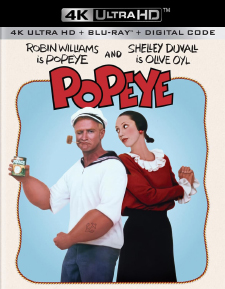
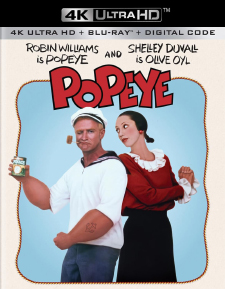
The Paramount 4K Ultra HD release of Popeye is a two-disc set that includes an unremastered Blu-ray with a 1080p copy of the film, a Digital Code on a paper insert tucked inside, and a slipcover that duplicates the theatrical poster artwork on the insert. The following archival extras are included on the Blu-ray only, all of them in HD:
- Return to Sweethaven: A Look Back with Robin and the Altmans (13:29)
- The Popeye Company Players (9:34)
- Popeye’s Premiere (2:40)
- The Sailor Man Medleys:
- Sweethaven (2:49)
- Blow Me Down (3:32)
- Everything Is Food (3:27)
- He’s Large (3:57)
- I’m Mean (1:33)
- Sailin’ (2:55)
- I Yam What I Yam (2:43)
- He Needs Me (2:57)
- Swee’Pea’s Lullaby (2:35)
- It’s Not Easy Being Me (1:55)
- Kids (4:39)
- I’m Popeye the Sailor Man (2:19)
- Theatrical Trailer (1:53)
Return to Sweethaven is a retrospective overview of the making of the film, featuring interviews with Robin Williams, Robert Altman, and prop master Stephen Altman. They offer a few brief thoughts about the Malta location, sets, makeup, cinematography, music, and the film’s legacy. Robert Altman makes the point that structurally, the film is more akin to the comic strip, but it gradually gets more cartoonish as it goes along. The same interviewees return for The Popeye Company Players, which focuses specifically on the cast and how they ended up personifying the characters. Altman explains that his grandson Wesley Ivan Hurt had been born with a temporary case of Bell’s palsy, which is why Swee’Pea has such a charmingly perfect cockeyed smile.
There are also a couple of pieces of miscellany. Popeye’s Premiere is a montage of photographs from the film’s premiere in 1980, including plenty of red carpet snaps and shots of the various props and set pieces that were used for promotional purposes. Finally, The Sailor Man Medleys is a compilation of all the musical numbers in the film that can be played either individually or as a group.
No new extras, and the archival extras that are here are pretty slim, but let’s face it: Popeye is not the kind of film that’s likely to get a lavish special edition from the studio that’s always had a complicated relationship with it. Yet Paramount has given it some newfound love in the form of the 4K Ultra HD treatment, and personally, I’ll take it. Like pretty much any other Robert Altman film, Popeye will simply never be to everyone’s tastes, but if you’re as open to its offbeat charms as I am, then you’ll be happy with this 4K upgrade. Recommended for similarly open-minded viewers.
-Stephen Bjork
(You can follow Stephen on social media at these links: Twitter, Facebook, BlueSky, and Letterboxd).