
Mortal Kombat II (4K UHD Review)
Director
Simon McQuoidRelease Date(s)
2026 (July 28, 2026)Studio(s)
New Line Cinema/Domain Entertainment/Atomic Monster/Broken Road Productions/Fireside Films/Warner Bros. Pictures (Warner Bros. Home Entertainment)- Film/Program Grade: B-
- Video Grade: A
- Audio Grade: A+
- Extras Grade: D+

Review
2021’s Mortal Kombat certainly wasn’t a smash hit, but it was successful enough on streaming platforms that a sequel was all but inevitable. Mortal Kombat II was released in the spring of 2026 to mixed reviews but a decent audience reaction, while also continuing its predecessor’s trend on streaming. Director Simon McQuoid and his producing team returned, as well as most of the main cast, and the film did about as well financially theatrically.
The tenth Mortal Kombat tournament between Earthrealm and Outworld is approaching, and Lord Raiden (Tadanobu Asano) has sent Sonya (Jessica McNamee) and Jax (Mehcad Brooks) out to recruit former martial artist and washed-up movie star Johnny Cage (Karl Urban), who’s more than reluctant to get involved. Meanwhile, Shao Kahn (Martyn Ford) is rallying his fighters, including Shang Tsung (Chin Han), Queen Sindel (Ana Thu Nguyen), Jade (Tati Gabrielle), and Kitana (Adeline Rudolph), while resurrecting Kano (Josh Lawson) and Kung Lao (Max Huang), both of whom are brought back from the dead by the sorcerer Quan Chi (Damon Herriman). Kitana, once a princess who saw her father die at the hands of Shao Kahn when she was young, is secretly aiding Earthrealm, though her close friend and fellow fighter Jade is onto her. Earthrealm kombatants Liu Kang (Ludi Lin) and Cole Young (Lewis Tan) are among the first to fight, even as Lord Raiden is nearly assassinated by Shang Tsung, and it’s up to the defenders of Earthrealm to stop Shao Kahn and his forces, and save Raiden; even turning to the Tartakan clan’s Baraka (CJ Bloomfield) and the long dead Hanzo Hasashi aka Scorpion (Hiroyuki Sanada) for help against the resurrected Bi-Han, aka Noob Saibot, formerly Sub-Zero (Joe Taslim).
While the previous Mortal Kombat was all about setting up the characters and establishing the world, II is all about the Kombat, though introducing us to new characters. Kitana, Jade, and Johnny Cage have taken over as the film’s leads, giving us some emotional anchor. Kitana wants revenge against Shao Kahn, Jade is torn about being loyal to Shao Kahn and helping Kitana, and Johnny Cage needs to prove himself. None of it’s complicated, but the filmmakers give you enough to keep you invested. The tournament itself feels like a series of vignettes rather escalations, even pushing the kombat to the side more than once to seek out other characters. Granted it would be difficult to make a Mortal Kombat movie that is almost entirely about the kombat without any stakes or character growth, but it’s definitely clunky here.
The most intriguing aspect is that the film kills major characters off, including one from the previous film that’s been almost completely sidelined in the sequel. That should give it some weight, but the other characters are too busy worrying about other things for those moments to really land. Things aren’t helped by the fact that there’s a Netherealm that characters can be resurrected from, including some from the previous film. So the question is if you can just continuously bring fighters back from the dead, why not amp up the fight scenes with more over-the-top violence like the games? There’s simply not enough kombat, when it really should be front and center most of the time. Some characters have even been nerfed from their video game counterparts, particularly Baraka, who turns out to be more of a Johnny Cage fanboy than a frightening monster who wants to bite your head off, quite literally.
Visually, Mortal Kombat II has more going for it than its predecessor, especially during the kombat scenes which go full tilt for the looks and color schemes of moments from the games. This includes the green, acid-pool fight between Shao Kahn and Cole, as well as the blue portal backdrop of the Liu Kang and Kung Lao showdown. Unfortunately, green screen backgrounds are frequent and noticeable, and the digital cinematography can’t help but look flat, despite the filmmakers aiming for some depth in the image but never fully succeeding.
Still, even with its flaws, Mortal Kombat II is enjoyable on its own terms, even if doesn’t entirely gel. Then again, one might argue that hoping for a stronger story and more compelling characters in a property like this may be asking for too much. There’s certainly examples of other video game franchises turned into movies and TV shows that deliver in this capacity, but Karl Urban’s turn as Johnny Cage, the film’s main highlight, makes Mortal Kombat II at least surface level entertaining, but entertaining nonetheless.
Cinematographer Stephen F. Windon captured Mortal Kombat II digitally in the ARRIRAW codec (4.5K and 4.6K) using a combination of Arri Alexa 35 and Arri Alexa LF cameras with anamorphic Atlas Orion and Panavision Primo lenses. The results were finished as a 4K Digital Intermediate and framed theatrically at the aspect ratio of 2.39:1, though some scenes in the IMAX version of the film were framed at 1.90:1. Warner Bros. Entertainment debuts the film on Ultra HD straight from the 4K DI, which has been graded for High Dynamic Range in HDR10 and Dolby Vision, and encoded to a triple-layered BD-100 disc. (Take note that there are no shifting aspect ratios for the IMAX scenes.) Whatever faults there are in the visuals, the UHD encode presents them in the (nearly) best possible way with sharp levels of fine detail and a bitrate that sits frequently in the 80 to 110Mbps range, dipping only for moments that are less detail-oriented. Scenes from Johnny Cage’s films are offered the most visual texture, but outside of those, the image has a clean digital look. The HDR grades aid the film’s color palette which offers a nice array of hues, whether it’s in the costumes, sets, or lighting schemes. Reds, blues, greens, and purples are potent without appearing oversaturated. Blacks are deep, but contrast could have been dialed slightly higher for better distinction, which could possibly have smoothed out some of the heavier and more obvious green-screen oriented moments. The image is stable and clean overall, and outside of any minor nitpicks, the film looks great in native 4K.
The main audio option is English Dolby Atmos and it’s a knockout of a soundtrack. Very active all around the sound field, it offers lots of texture and pushes the various elements all around the listener. The height channels get plenty of use, as do the surround channels. Dialogue is clear, while the score and music selection rattle the windows thanks to very much impactful LFE. Little else need be said as it’s a demo-worthy track.
Other audio options include Czech, English, French (Canadian), French (Parisian), German, Italian, Japanese, Spanish (Castilian), and Spanish (Latin) 5.1 Dolby Digital. In addition, there are English (US) and English (UK) Audio Descriptive 5.1 Dolby Digital and German Audio Descriptive 2.0 Dolby Digital tracks, as well. Subtitle options include Czech, Danish, Dutch, English SDH, Finnish, French, German SDH, Italian SDH, Japanese, Mandarin (Traditional), Norwegian, Polish, Spanish (Castilian), Spanish (Latin), and Swedish.
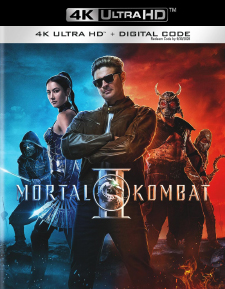
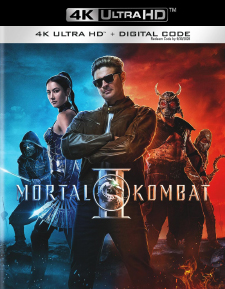
The Warner Bros. Entertainment 4K Ultra HD release of Mortal Kombat II sits in a standard black Amaray case with a Digital Code on a paper insert, with an insert and a slipcover featuring a fairly generic teal and orange color scheme (the film’s poster would have been a better choice). The following extras are included, all in HD:
- Mortal Kombat II: Evolving the Saga (6:34)
- Building the Realms of Mortal Kombat (5:51)
- Mortal Kombat II: Choose Your Fighter (5:53)
- Klose Quarters Kombat (6:35)
- A Boon to Gamers Everywhere (3:11)
These featurettes are definitely EPK type material on the fluffy side, but they do manage to briefly cover the worlds of the film, the cast, the production design, and the fight choreography. They feature interviews with almost the entire main cast, including Karl Urban, Adeline Rudolph, Jessica McNamee, Josh Lawson, Ludi Lin, Mehcad Brooks, Tati Gabrielle, Lewis Tan, Max Huang, Chin Han, Damon Herriman, Joe Taslim, Hiroyuki Sanada, Ana Thu Nguyen, CJ Bloomfield, and Martyn Ford. Also interviewed is director Simon McQuoid; producers James Wan and Todd Garner; executive producer Michael Clear; video game co-creator and executive producer Ed Boon; production designer Yohei Taneda; set decorator Emma Rudkin; makeup and hair designer Nikki Gooley; costume designer Cappi Ireland; and second unit director and stunt coordinator Kyle Gardiner. There’s also some behind-the-scenes footage, including glimpses of some deleted dialogue, but all of it is over before it really begins.
Mortal Kombat II opens up the MK universe a little further, though based upon the ending and the success of the film, albeit mild, it’s doubtful that this is the last we’ll see of these characters. The Warner Bros. UHD is a solid release that’s light on extras, but serves up a quality presentation. For fans, this is very much recommended.
- Tim Salmons
(You can follow Tim on social media at these links: Twitter, Facebook, BlueSky, and Letterboxd. And be sure to subscribe to his YouTube channel here.)