
Montana (Blu-ray Review)
Director
Ray Enright, Raoul WalshRelease Date(s)
1950 (August 18, 2026)Studio(s)
Warner Bros. Pictures (Warner Archive Collection)- Film/Program Grade: B
- Video Grade: A-
- Audio Grade: A
- Extras Grade: B+

Review
Montana, a period Western drama, is based on historical fact. During the late 19th and early 20th centuries, a series of violent conflicts raged in the American West over the control of open, public lands. These “range wars” pitted cattle barons, who needed vast stretches of grassland for their beasts, against homesteaders, sheep ranchers, and small-scale farmers who threatened the open range.
Morgan Lane (Errol Flynn) is a sheepman from Australia who returns to the same Montana Territory where his father raised sheep years earlier until he was driven off. After one of his herders is killed, Morgan announces in town that he’s partnered with traveling salesman Poppa Schultz (S.Z. Sakall) and, under false pretenses, leases land from wealthy cattle rancher Maria Singleton (Alexis Smith). Opposition arises when it’s discovered that Morgan plans to graze sheep on the rented land. Rancher Rodney Ackroyd (Douglas Kennedy), a philanderer engaged to Maria, threatens to run Morgan off the land. The cattlemen claim that no cattle can live where sheep grazed because sheep pull up the roots along with grass, leaving barren land and inadequate food for cattle.
In the meantime, Morgan develops a romantic interest in Maria and the feeling is mutual until she learns about his intended use of the leased land. She determines to get the land back whatever the cost. Morgan, however, is stubborn. He approaches big-time cattle rancher George Forsyth (Lester Matthews) and explains how sheep and cattle can coexist and how more profits can be made from the sale of wool and mutton. This intended plan leads to resentment and deadly violence.
Flynn plays a variation of his swashbuckling hero as Morgan. In dangerous territory, he’s courageous but not foolhardy. He adopts the guise of genial salesman to insinuate himself as a non-threatening outsider and wins over influential Maria with his charm and good looks. He also proves himself more than capable with a gun and even makes a high-stakes bet that he can stay on a difficult, unbroken horse for a full minute. Flynn’s Morgan exudes an air of confidence as he attempts to win over tough adversaries by appealing to their pocketbooks. He makes a case that sheepherding can be an enriching enterprise.
Alexis Smith, who appeared in four films with Errol Flynn, has good chemistry with him. When we first see her, she’s galloping through town with her ranchers, her long red hair blowing in the wind. With a veritable splash of Technicolor against the dull browns and earth tones of the riders, their horses, and the dirt street, her Maria makes quite an impression. Smith delivers a spirited performance. Her walk and manner convey the self-assurance of a respected cattle baroness. No helpless damsel in distress, she’s atypical for the time, perfectly able to handle herself in a difficult, physical world of men. Having been cast in lackluster, lifeless roles or as elegant, strait-laced socialites, Smith looks as if she’s enjoying the challenge of playing a strong, outspoken woman.
Rodney Ackroyd (Douglas Kennedy) is the film’s nominal villain. Motivated by real economic concerns, he prefers to scare the sheepherders off through intimidation. If that fails, however, he will resort to murder. Rodney and Maria seem to be headed for marriage when Morgan enters the scene, but we find out that Rodney isn’t exactly exclusive in his affection for Maria. Kennedy is right out of the villain textbook—surly, sneering, violent, a jealous bully who discovers he’s up against a man who won’t easily back down. Compared to Morgan, Kennedy’s Ackroyd is a petulant, little man resistant to change.
Director Ray Enright and cinematographer Karl Freund (and uncredited co-director Raoul Walsh) have created some spectacular shots of cattle and sheep herds being driven across the prairie, the Rocky Mountains in the background. Though set in Montana, the film was shot entirely at the Warner ranch in Calabasas, California and in Arizona. Non-singers Flynn and Smith perform the romantic duet Reckon I’m in Love with no help from ghost singers.
Montana was completed in 1948 but Warner Bros. shelved it for nearly two years because the studio lacked confidence in its commercial appeal. At various points, Gary Cooper and Ronald Reagan had been announced for the lead. The film wound up earning over $3.6 million against its $1.5 million budget. Future Western star Jock Mahoney was Flynn’s stunt double. In one scene, he looks directly into the camera. Flynn didn’t want to make the film, but he had to fulfill his contractual obligation and he needed the money. Montana was the final screen pairing of Flynn and Smith.
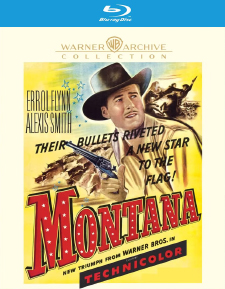
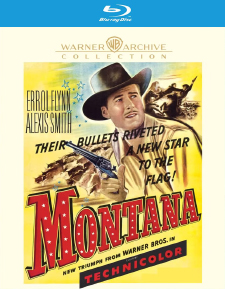
Montana was shot by director of photography Karl Freund on 35mm film with spherical lenses, processed by Technicolor, Hollywood, and presented in the aspect ratio of 1.37:1. The Warner Archive Collection Blu-ray features a new 2026 HD master taken from 4K scan of the original nitrate technicolor camera negatives. Clarity is exceptional, with sharp detail in Alexis Smith’s flowing red hair, Errol Flynn’s outfits, Douglas Kennedy’s whiskers, goods in Poppa Schultz’s wagon, the sprawling Singleton ranch, and decor in the Singleton home. In the scene of Morgan attempting to ride a bucking bronco, close-ups of Flynn on a mechanical horse in front of a projected image give the illusion that he, not a stuntman, is riding. In long shots, a stuntman does the riding. Rear projection is used when Morgan and Maria sit and look out at the wide range and picturesque scenery. These scenes lack the same clarity as the footage shot live.
The soundtrack is English 2.0 mono DTS-HD Master Audio. English SDH subtitles are available. Dialogue is clear and distinct. S.Z. Sakall speaks with his trademark Hungarian accent. Sound effects include gun shots, cattle being driven across the range, a stampede, bleating sheep, horses’ hooves, Poppa Schultz’s wagon rumbling along dusty roads, bodies being pummeled in a fight, ambient noise in a bar, and crowd rumblings at a meeting of the cattlemen. Songs heard complete or in part include Cielito Lindo, Old Dan Tucker, Buffalo Girls, and Reckon I’m In Love (sung by Alexis Smith and Errol Flynn). The original score by David Buttolph offers fairly traditional orchestrations and lacks a memorable theme such as those from The Magnificent Seven and The Good, The Bad and the Ugly.
Bonus materials on the Blu-ray release from the Warner Archive Collection include the following:
- Oklahoma Outlaws (19:52)
- Wagon Wheels West (17:28)
- Gun to Gun (17:37)
- So You Want a Raise (10:50)
- It’s Hummer Time (7:05)
- Theatrical Trailer (2:25)
Oklahoma Outlaws – The city of Tulsa is founded after the 1893 Oklahoma land rush. Judge John Kincaid becomes mayor and his son, Ned (Robert Shayne), is sheriff. Saloon owner Rip McCord (Warner Anderson), who has a criminal past, plots against them to gain control of the city. This 1943 two-reel short was the first of Warner Bros. Santa Fe Trail series. These shorts were used as training grounds for up-and-coming actors to test their abilities.
Wagon Wheels West – This 1943 short is the second installment of the Warner Bros. Santa Fe Trail series. A young boy’s father is murdered by a ruthless gang. Years later, the boy grows up to become U.S. Marshal Frankie Wilson (Robert Shayne) and returns to the frontier town to lay a trap for the mastermind, Phineas Hook (Charles Middleton, Ming the Merciless in the Flash Gordon serials). Nina Foch (An American In Paris) co-stars.
Gun to Gun – This 1944 short is set in 1850s Los Angeles. Rancher Don Diego (Pedro de Cordoba) is unjustly fined by a corrupt tax commissioner. He dispatches his ward, Steve Randall (Robert Shayne), to deliver 1,000 cattle as payment. Steve uncovers the official’s corruption, initiating a violent confrontation where he must bring the outlaws to justice. Lupita Tovar co-stars.
So You Want a Raise – Pressured by his wife (Phyllis Coates), Joe McDoakes (George O’Hanlon) asks for a raise and is informed by his boss (Willard Waterman) that the employee he selects to run the office while he’s on vacation will get a raise. Joe works hard and is selected. When he hears his boss rehearsing for a gangster role in a play (which Joe mistakes for a real criminal plot involving thugs) Joe is terrified that he’s being set up to take the fall for a crime. Panicked, he calls the police. His blunder gets Joe de-selected from the job and the raise. This 1950 black & white short was directed by Richard L. Bare.
It’s Hummer Time – Directed by Robert McKimson, this 1950 Technicolor Looney Tunes cartoon follows a persistent cat determined to capture an elusive hummingbird. In his pursuit, the cat repeatedly and clumsily stumbles onto the property of a large, sleepy bulldog. Every time the cat interrupts the bulldog’s slumber or accidentally causes him pain, the bulldog inflicts cruel and elaborate punishments on the helpless cat. Comedy takes a dark turn as the cat begins to anticipate and dread the painful tortures he knows are coming.
Montana draws upon actual history. Errol Flynn plays a courageous outsider whose stubbornness and ability to reason with people induces cattle ranchers to put aside long-held biases. Getting to that point involves a good deal of action, gunplay, fist fighting, and stampedes. Alexis Smith breaks from type casting as strong, independent Maria Singleton. Director Ray Enright incorporates familiar Western tropes of gunplay and vengeance but never elevates the film beyond a routine programmer. Montana pales compared to Flynn’s other Westerns, San Antonio and Dodge City.
- Dennis Seuling