
Masters of the Universe (4K UHD Review)
Director
Gary GoddardRelease Date(s)
1987 (September 14, 2026)Studio(s)
The Cannon Group, Inc./Metro-Goldwyn-Mayer/Warner Bros. (Toy Robot Video/Arrow Video)- Film/Program Grade: B+
- Video Grade: A-
- Audio Grade: A-
- Extras Grade: A-

Review
Few toy lines were ever as popular as Masters of the Universe, subsequently becoming a hit cartoon show and running for two seasons in syndication from 1983 to 1984 when the toys were at their peak financially. As its popularity dwindled, Mattel was seeking other avenues to keep their highly successfully franchise viable, and a film adaptation was the next logical step. Working with The Cannon Group and first time director Gary Goddard, 1987’s Masters of the Universe was not the massive success they had hoped for, to say the least. Up until the last decade or two, time has been very unkind to the film in its aftermarket life, many deeming it to be one of the worst films ever made. To those people I say, you probably need to see more movies.
In a distant galaxy, the planet of Eternia is at war with the forces of evil from Snake Mountain, led by Skeletor (Frank Langella) and aided by Evil-Lyn (Meg Foster). They eventually conquer and invade Castle Grayskull, the center of all power in the universe, guarded by the mystical Sorceress (Christina Pickles). The forces of good, led by the powerful He-Man (Dolph Lundgren) and joined by Man-At-Arms (Jon Cypher) and Teela (Chelsea Field), attempt to confront Skeletor and his army with the help of Gwildor (Billy Barty), an inventor responsible for the creation of the Cosmic Key, which Skeletor has in his possession. Wielding a prototype, Gwildor whisks He-Man and his friends away from Skeletor’s clutches, opening a doorway to another world, which turns out to be Earth. There they meet Julie (Courtney Cox) and Kevin (Robert Duncan McNeill), two teenagers who become entangled in their plight when Skeletor and his troops track them down, intent on capturing He-Man and forcing him to be his slave before the Great Eye opens and grants him all the powers of the universe. Also in the cast are James Tolkan, Anthony De Longis, Robert Towers, Tony Carroll, Pons Maar, Barry Livingston, Gwynne Gilford, and Walter Scott.
Among the reasons for the hatred towards this film, besides not being a strict adaptation of the cartoon show (which it never claimed to be anyway), was that it was made at a time when sword and sorcery, fantasy, and action movies were a dime a dozen, making it seem like just another Deathstalker, Beastmaster, or Conan film. Director Gary Goddard also took some inspiration (some would even say a bit more than just inspiration) from Jack Kirby’s Fourth World metaseries of comic books from the early 1970s, as well as the original toy line’s stories prior to the creation of the cartoon series. In other words, he was doing something different with it.
Right off the bat, there are obvious Masters characters missing in action, including Orko, who was replaced by Gwildor when the filmmakers couldn’t find a satisfactory way to bring the character to the screen; as well as Cringer aka Battlecat, King Randor, Queen Marlena, and various other characters on both sides of good and evil. He-Man is also never seen in his Prince Adam guise, rendering his “I have the power!” moments in the film a tad moot since it serves no story purpose, per se. What it boils down to is this: the filmmakers basically took as many elements as they could from the Masters franchise and tried to make them work under the auspices of Mattel, who had a very heavy hand in what could and could not be done with them.
On top it all, funding for the film was fluctuating between hemorrhaging and disappearing, leaving Goddard in a difficult position to try and finish principal photography with little support from his producers and no money to do it. During one key moment in the story’s climax, he was told to shut down production before He-Man and Skeletor’s final battle could be shot. Paying for the day out of his own pocket, he and a skeleton crew, as well as Dolph Lundgren and Anthony De Longis doubling for Skeletor, shot the sequence as best as they could, though the quality left something to be desired in the eyes of audiences. There are also conflicting stories that Goddard wasn’t doing that great a job as he was often unprepared. Nevertheless, the film was eventually finished and put together by legendary editor Anne V. Coates, dying in theaters soon thereafter.
Masters of the Universe also became somewhat of a casualty as Cannon was slowly going bankrupt at the time and about to shut its doors forever. Along with other expensive projects like Superman IV: The Quest for Peace, they became victims of a studio that was trying desperately to hang on to every last dollar it had, starving its “children” in order to do so. As such, Masters is often unfairly maligned for many of the qualities that other, more successful and more popular films are forgiven for. Chief among them are the visual effects and production design, neither of which are really a problem. The opticals can be wonky, but the same can be said of other fantasy and science fiction films of that era. Therefore, the effects and the look of the film are on par with other similar films of the era, even showing off some genuine creativity in the worldbuilding.
However, you can certainly poke holes in some of the story elements and lapses in logic, not to mention setting most of the film on Earth and not on Eternia, which was nothing more than a money-saving tactic by Cannon. Its biggest strength is Frank Langella’s portrayal of Skeletor, which towers over every other performance and is definitely your price of admission. Bill Conti’s score also does much of the heavy lifting, which is quite good and very memorable, especially the main theme that opens the film (with a credit sequence reminiscent of other space-oriented films).
Besides Frank Langella’s Skeletor, Jon Cypher’s Man-At-Arms is also a bright point, having some fun and even sensitive moments, including a scene in which he sorrowfully announces that he may not have a sorceress to go home to, which feels genuine and you totally buy it. Chelsea Field does a fine job as Teela, and both Courtney Cox and Robert Duncan McNeill have some authenticity. Most viewers disparage Dolph Lundgren’s performance as He-Man. Even his own director had him completely re-dub his own lines, citing that he couldn’t be understood. The reasons for this have not always been sound, especially since there are interviews from the era with Dolph Lundgren, not to mention other performances, wherein he speaks clear English. What that was about, we’ll never know, but one thing’s for sure: he gave the role his all.
As you can do doubt tell by my commentary thus far, I’m definitely a fan of 1987’s Masters of the Universe and I believe it’s a much more enjoyable movie than many give it credit for. Appreciation of it has grown over time, with more and more people proclaiming it to be one of their favorite childhood movies, and that’s certainly the case with me. The flaws are there, some more obvious than others, but if you can take the time to actually watch the film without feeling the need to riff on it, Masters of the Universe is a pleasant fantasy adventure with an unfortunately bad rap, and that needs to change.
Newly-included in this release from Toy Robot Video is a never-before-seen preview version of the film, referenced by the late Gary Goddard in his commentary on the theatrical version. It’s about four minutes and eighteen seconds longer and puts back in mostly minor trims along the way, but there are some substantial additions. One involves an extended moment when He-Man arrives on Earth and Man-At-Arms cites an old knee injury before they discover Gwildor stuck in the mud. Another is Skeletor having a conversation with the Sorceress about the loneliness of evil, which sets up his line “have faith Sorceress, you won’t be lonely long” at the end of the scene, as well as his question about loneliness to He-Man during the climax. The largest addition is an extended version of the goodbye scene at the end of the film wherein Julie has a more substantial interaction with Teela and Man-At-Arms gives a longer speech. There’s also a slightly altered opening credit sequence, signifying which cut you’re watching. Most of the other trims are small, some obviously for pacing, but I’m sure there will be fans who will prefer this longer cut.
Cinematographer Hanania Baer shot Masters of the Universe on 35mm film (65mm film for visual effects) with Panavision Panaflex cameras and lenses. The results were finished photochemically and framed theatrically at the aspect ratio of 1.85:1. Toy Robot Video, a subsidiary of Arrow Video, debuts two versions of the film on Ultra HD: the original theatrical version, and a newly-discovered preview version. No information has been given about the restorations, but presumably they’re taken from 4K scans of the original camera negative and interpositive elements for opticals and new footage. Both versions have been graded for High Dynamic Range in HDR10 and Dolby Vision, and encoded by Duplitech to two triple-layered BD-100 discs. There are no clear discrepancies between the two versions visually since the newly-discovered footage blends well with the rest of the material. It’s a very sharp and precise presentation with maxed out bitrates and solid levels of medium grain, obviously shifting during opticals, of which there are many. The palette offers a relaxed set of hues that aren’t necessarily bold, but the HDR grades get the most out of them, with some strong blues and reds, as well as deep blacks and excellent contrast. The image is crisp, stable, and clean aside from the opticals, which have an inherent softness. The film has never looked better.
Audio is included for both versions in English 2.0 and 5.1 DTS-HD Master Audio with optional subtitles in English SDH. The film was released in Dolby Stereo and the 2.0 track included here appears to be the same matrixed audio, with the 5.1 option obviously opening it up a little more in the surrounds. Dialogue is clear and distinct with some decent low end response, and ample support for the various sound effects. Most especially, Bill Conti’s excellent score is given plenty of heft. A Dolby Atmos option with a deeper bass response could give it some additional muscle, but these are still great tracks and represent the original theatrical experience well.
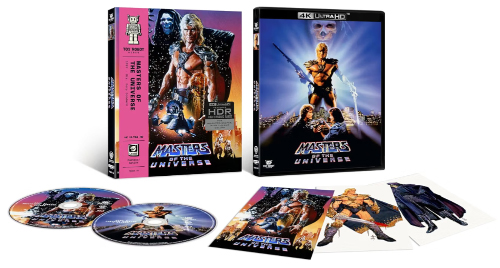
Toy Robot Video’s 2-Disc 4K Ultra HD release of Masters of the Universe sits in a black Amaray case with two double-sided artcards featuring alternate theatrical poster and home video artworks for the film on one side and early sketch designs of He-Man and Skeletor on the other. The double-sided insert features the same artwork options, and everything is housed in a slipcover with the main theatrical artwork on the front, sealed with an obi strip. The following extras are included on each disc:
DISC ONE (THEATRICAL VERSION)
- Audio Commentary with Gary Goddard
- Behind the Legend of Masters of the Universe (Upscaled SD – 4:23)
- Theatrical Trailer (HD – 1:48)
- Teaser Trailer (HD – 1:18)
- Stills Gallery (HD – 136 in all – 11:29)
- Production Design Gallery (HD – 23 in all – 2:04)
DISC TWO (PREVIEW VERSION)
- Audio Commentary with William Stout
- Becoming Kevin with Robert Duncan McNeill (HD – 16:00)
- They Call Me Blade with Anthony De Longis (HD – 14:06)
- Designing the Universe with William Stout (HD – 16:56)
Gary Goddard’s audio commentary for the theatrical version was recorded in 2001 for the film’s DVD release. It’s not a great track since the volume of the film’s audio phases in and out between his comments, but he still manages to provide some valuable insight into the making of the film. Behind the Legend is a time-stamped archival featurette featuring interviews with Gary Goddard and Dolph Lundgren, made while the film was still in production. Next are the teaser and theatrical trailers, followed by a Stills Gallery and a Production Design Gallery containing a total of 159 images of publicity stills, behind-the-scenes photos, production stills, posters, and design sketches.
Production designer William Stout provides a new audio commentary for the preview version of the film. The volume of the film’s audio also phases in and out between comments, and things tend to get repetitive since much of the same ground is covered elsewhere, but he’s still game to bring his knowledge and his memories of the production to the table.
Becoming Kevin features a new interview with actor Robert Duncan McNeill who discusses his early career leading up to Masters of the Universe, appearing in a soap opera while simultaneously making the film. He gives his impressions of what was going on behind-the-scenes, highlighting that he became close friends with Courtney Cox, Eric Stoltz nearly being cast instead of him, working with the Cosmic Key props, and being proud of the movie in retrospect. They Call Me Blade is a new interview with actor and stuntman Anthony De Longis who talks about his long career in theater and show business, being brought on to the project and having the freedom to create his character, sword training Dolph Lundgren, doubling for Frank Langella, the difficulties fighting in the God Skeletor costume, doing the whipping scene, getting feedback from fans, and the importance of being prepared on film sets. Designing the Universe is a new interview with William Stout who talks about switching from medical school to art school, working in advertising before becoming a conceptual designer, initially hired to make storyboards for Masters of the Universe before replacing the production designer, dealing with the budget constraints, various ideas for designs, problems he had with Mattel and Frank Langella, building the sets, seeing the film in the theaters, and being proud of the work that he did for the film.
Not carried over from Umbrella Entertainment’s Blu-ray release in Australia is a set of extended Electric Boogaloo interviews with Dolph Lundgren, Gary Goddard, producer Ed Pressman, co-writer Stephen Tolkin, William Stout, and special effects supervisor Richard Edlund; a Masters of the Universe 2: Tales of the Sequel That Never Was featurette; and a Cannon Films promo reel, included as an Easter egg. There’s also interview content exclusive to the Power of Grayskull: The Definitive History of He-Man and the Masters of the Universe documentary, which we reviewed on Blu-ray in 2025.
A proper home video release of Masters of the Universe has long been overdue in the U.S., and Toy Robot Video’s 4K Ultra HD release certainly fixes that problem, particularly with the preview version of the film. If you’re a fan, this is most definitely worth picking up. Highly recommended.
- Tim Salmons
(You can follow Tim on social media at these links: Twitter, Facebook, BlueSky, and Letterboxd. And be sure to subscribe to his YouTube channel here.)