
La Tête contre les murs (Blu-ray Review)
Director
Georges FranjuRelease Date(s)
1959 (June 23, 2026)Studio(s)
La Société des films Sirius/ATICA/Eipénor Films (Radiance Films)- Film/Program Grade: B
- Video Grade: A
- Audio Grade: A
- Extras Grade: A

Review
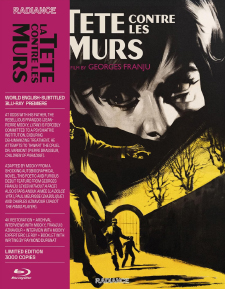
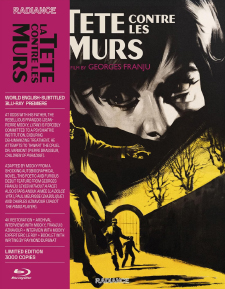
La Tête contre les murs (“Head Against the Wall,” 1959) was the first feature film of French director Georges Franju, best remembered today for Eyes without a Face (1960), the poetic horror-thriller, part of that same watershed year that included Alfred Hitchcock’s Psycho, Michael Powell’s Peeping Tom, Mario Bava’s Black Sunday, and others. Though Franju directed a series of sometimes shockingly graphic documentary shorts prior to this, his later feature career was spotty and still largely unseen outside of France. His only other well-known work outside of France is, in my opinion, the best of the three, Judex (1963), a funny, visually-rich remake-tribute to a French serial from the silent era.
La Tête contre les murs was adapted by the star of the film, Jean-Pierre Mocky, from a story by Herve Bazin. Mocky plays François, the unemployed son of Maître Gérane, an influential lawyer, who as the film opens meets beautiful Stéphanie (Anouk Aimée) and they hang out with rich friends, François unsuccessfully trying to borrow money from several of them. Later, he breaks into his estranged father’s (Jean Galland) home to steal money and, strangely, to burn some important legal documents. (Why François does this is never adequately explained.) The father uses his influence to have François committed to an isolated long-term psychiatric facility in the country, lorded over by senior psychiatrist Dr. Varmont (Pierre Brasseur). He believes even patients with minor mental illnesses should be locked away from society, effectively making the hospital a prison, with little hope of ever being released.
A more progressive psychiatrist, Dr. Emery (Paul Meurisse, of Les Diaboliques), tries to help François and the other patients, but lacks the authority to affect change. Stéphanie comes to visit and François befriends a few other patients, particularly Heurtevent (Charles Aznavour), a gentle soul suffering from epilepsy, and François plots several escape attempts, which only serve to make Dr. Varmont more determined to keep him locked up.
The film has many obvious fine qualities, from its fine cast that also includes Eyes without a Face’s Édith Scob, instantly recognizable singing in one scene, to Eugen Schüfftan’s (The Hustler) cinematography, and Maurice Jarre’s moody musical score.
Nevertheless, the film is singularly muddled in expressing its themes and even its narrative at times is more than a little murky, lacking the audaciousness of Samuel Fuller’s Shock Corridor (1963) and the verisimilitude of One Flew Over the Cuckoo’s Nest (1975), movies operating from a similar premise. A text prologue discusses the inadequacies of France’s psychiatric institutions, but the one presented here seems rather phony, with nearly all of the patients acting like mild, resigned inmates, few presenting obvious mental problems. Maybe that was Mocky and Franju’s intention, that the vast majority have no business being there in the first place, and that Varmont is, through bureaucratical disinterest, able to run the hospital like a private fiefdom, sanctimoniously holding men indefinitely with little medical science to back up his diagnoses. But it doesn’t ring true; the original novel is set in 1934, placing it closer to the era when psychiatric facilities were more like medieval dungeons, but it still seems “off” somehow.
François, while clearly troubled what with an unloving, even cruel father and lost after his mother died in drowning accident – he blames his father for her death—shows no signs of needing confinement in a mental hospital, and it’s clear his father just wants to get rid of him, but François’s actions don’t make a whole lot of sense, either. He first attempt to escape, by mingling with departing visitors, seems foolish; he’s instantly caught, still within the grounds of the hospital.
Pierre Brasseur’s performance as Dr. Varmont is the film’s biggest asset, the actor displaying a low-key arrogance, authoritative yet cruel, like François trading one bad parental figure for another. Clearly, it’s a warm-up to his very similar character in Eyes without a Face, one so self-involved and single-minded of purpose that he’s lost every shred of humanity.
Radiance Films’ Blu-ray can’t be faulted. Presented on a Region-Free disc, the video transfer is derived from a 4K restoration, the 1.37:1 standard frame, black-and-white image crystal-sharp with excellent blacks, contrast, and zero signs of damage. The LPCM mono is likewise very good, the French audio supported by optional English subtitles.
Excellent supplements abound. They consist of archival interviews with actor-screenwriter Mocky, director Franju, and actor Aznavour; an interview with Mocky’s assistant and friend Eric Le Roy; and booklet featuring a 1967 essay by Raymond Durgnat, along with cast and crew information and details about the video transfer.
Mocky’s later work is so different from Franju’s the collaborators may have been at cross purposes on La Tête contre les murs. The film, for all the talent involved, is not without interest, but it never quite comes together, either, but Radiance’s presentation is excellent and the film is certainly worth a look.
- Stuart Galbraith IV