
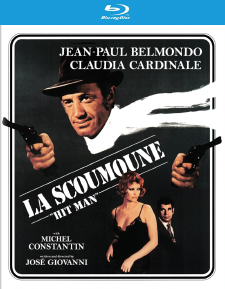
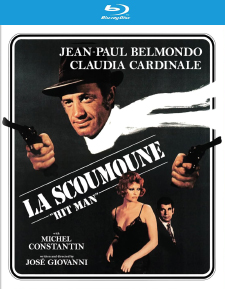
La Scoumoune (Blu-ray Review)
Director
José GiovanniRelease Date(s)
1972 (July 14, 2026)Studio(s)
Lira Films/Praesidens (Kino Lorber Studio Classics)- Film/Program Grade: C+
- Video Grade: A-
- Audio Grade: A
- Extras Grade: B-

Review
Previously here on The Bits we reviewed a French crime-thriller starring Jean-Paul Belmondo, A Man Named Rocca (Un nommé La Rocca, 1961), based on the 1958 novel L’Ecommunié by José Giovanni, whose books were also the basis of such classics of French cinema as Le Trou (directed by Jacques Backer), Classe tous risques (by Claude Sautet), Le Deuxième souffle (Jean-Pierre Melville) and others. That film was directed by Jean Becker in black-and-white. It wasn’t bad though a little confusing for those, like me, that hadn’t read Giovanni’s original novel. It had many fine individual set pieces, but its narrative tended to lurch forward with not much in the way of transitional or expository material explaining how Belmondo’s character got from place-to-place, his relationships with various characters, or his falling and rising position within the criminal underworld.
Neither Belmondo nor Giovanni were entirely satisfied with that film, and in the early ’70s, Belmondo decided to remake it, he reprising his character, with Giovanni directing and again writing the screenplay. One might reasonably assume La Scoumoune (aka The Hit Man; literally, “The Bad Luck Charm,” 1972) would be closer to the novel, and perhaps more explicit in its sex and violence. However, in almost every way La Scoumoune is the lesser film.
Ex-gangster Roberto Borgo (Belmondo, no longer a man named Rocca) learns that his friend Xavier Saratov (Michel Constantin, who played a different character in A Man Named Rocca), is on trial for a murder he did not commit. Roberto travels to Marseilles where (not shown) he seduces the mistress of gangster Villanova (Aldo Bufi Landi), whom Roberto and Xavier’s sister, Georgia (Claudia Cardinale, speaking French), suspect is behind the framing of Xavier.
However, the mistress is gunned down by Villanova’s men in the street, leaving Roberto to confront Villanova, Roberto shooting him in the head and Roberto taking over the gangster’s gambling club and brothel for no clear purpose. Instead, as with A Man Named Rocca, the story pivots as he becomes involved in an unrelated crime after a gang of African-American gangsters (played by English-speaking non-actors) threaten Georgia over protection money for her brothel, this landing Roberto in the same prison as Xavier, where the former plans to... do what, exactly?
Compared to A Man Named Rocca, this version changes some of the character names, but more significantly moves the setting from the present day (i.e., early 1960s) of the original movie, to a ten-year stretch lasting from the mid-1930s to the mid-1940s, effectively making La Scoumoune a period film. It doesn’t help: the extravagant costume design is very inauthentic, as if early ’70s fashion tastes were applied to 1930s clothing. Likewise, the hairstyles and makeup on the women is much too contemporary. The end results are similar to 1960s Hollywood movies set in the 1920s and ’30s; they never looked right, either.
The biggest surprise, though, is that while Giovanni makes a few changes here and there—the film ends very differently from A Man Named Rocca—mostly it consists of recreations of that earlier film’s best scenes, often not done half as well. One of the original film’s highlights was the gang of American thugs (led, in that film by Michel Constantin), big bruisers, several of whom were black. These guys meant business and, through their violence and threats of violence, were far more intimidating than the usual such characters in gangster films, French or otherwise. Here, however, the entirely African-American gang, though greater in number, make little impression. The shootout with Roberto is more protracted but also more ordinary, and undermining it all is that they look less like 1930s black gangsters than extras from a 1970s American blaxploitation film, with the synthesizer underscoring of this scene adding to its anachronistic qualities. Other scenes are near-recreations, like Moe-Larry-Shemp remakes of Moe-Larry-Curly Three Stooges shorts.
Further, instead of clearing up all that transitional confusion in the original film, La Scoumoune merely adds to it. Even having recently seen the first film version, I was hopelessly confused by Giovanni’s additions, like an opening scene with Roberto arriving at a stately château where he meets Georgia. Where is she? Who is the older man she’s with? Is it supposed to some kind of rural brothel? I have no idea. One suspects those who haven’t read the novel or seen the 1961 film first will be hopelessly confused for much of the picture.
Belmondo waltzes through the film with pretty much the same superficial ambivalence he showed in the earlier picture, making one wonder we he wanted to remake it. Claudia Cardinale is wasted; her character is no longer pivotal to the narrative in the way it was in the first film, and here she is little more than attractive scenery. Michel Constantin is okay, but he made a bigger impression in the original film. A very young Gérard Depardieu, bearded, turns up briefly near the end in what was only his fourth movie role.
Kino’s Blu-ray of La Scoumoune, licensed from StudioCanal, is derived from a 4K restoration from the original 35mm camera negative. It looks good in this 1.66:1 widescreen transfer, sharp and with accurate color. The DTS-HD Master Audio (2.0 mono) track is fine, and the optional English subtitles are good. The disc itself is Region “A” encoded.
Extras are limited to a trailer and a new audio commentary track by critic and author Simon Abrams.
A disappointing remake considering the talent involved. Not quite terrible but hardly worth 106 minutes of one’s time.
- Stuart Galbraith IV