
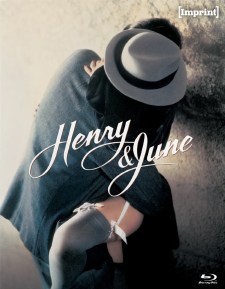
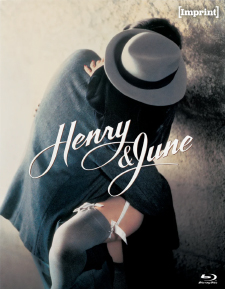
Henry & June (Blu-ray Review)
Director
Philip KaufmanRelease Date(s)
1990 (June 24, 2026)Studio(s)
Walrus & Associates/Universal Pictures (Imprint Films/Via Vision Entertainment)- Film/Program Grade: C
- Video Grade: B+
- Audio Grade: A-
- Extras Grade: B-

Review
[Editor’s Note: This is a Region-Free Australian Blu-ray import.]
Anais Nin’s unexpurgated diary Henry and June, published in 1986, detailed the Cuban-French writer’s sexual awakening and erotic obsession with June Miller and her husband, writer Henry Miller. The screen adaptation, released four years later, takes place as Henry is writing his groundbreaking Tropic of Cancer. The film, Henry & June, was the first film to receive an NC-17 rating.
In the early 1930s, Anais Nin (Maria de Medeiros) is living a comfortable but unfulfilled life in the suburbs of Paris with her devoted husband, stodgy American banker Hugo (Richard E. Grant). Seeking artistic and personal liberation, she begins socializing in bohemian circles and recording her innermost thoughts and desires in personal diaries.
Her life changes dramatically when she meets Henry Miller (Fred Ward), an impoverished American writer struggling to complete his manuscript for Tropic of Cancer. Anais is intrigued by Henry’s unfiltered approach to life and literature. Her fascination deepens on meeting Henry’s mysterious, bisexual wife, June (Uma Thurman).
Anais becomes enchanted with June and they embark on a passionate romantic affair. When June has to return to the United States temporarily, she gives Anais her blessing to sleep with Henry while she’s away. Anais then enters a highly charged physical relationship with Henry while also helping to finance the publication of his book.
Portuguese actress Maria de Medeiros is third billed but she’s the centerpiece of Henry & June. With her large eyes, curious expression, elegant bearing and soft manner of speaking, she suggests upper middle-class affluence at odds with her desire for more than material wealth and a dutiful but unexciting husband. Way ahead of her time, she doesn’t accept her role as the complacent wife of a prosperous banker. She wants more. She strives for this through writing, sketching, and dance classes, but they’re not enough. When she becomes involved with June and Henry, her sexuality blooms and so does her life.
Despite all the explosive developments in Anais’ life, Madeiros’ expression seldom varies. The screen shows two people at the height of intimacy, but Madeiros’ face reflects only a modicum of pleasure. When Anais is alone with her husband, her body language suggests barely a flicker of discontent. The actress does look the part, since there’s a striking resemblance between her and the diarist.
Ward is brash and volatile as Henry, driven to finish his novel despite real-world concerns of paying for food and rent. He depends on June and later Anais to support his literary efforts. With a Brooklyn street-smart attitude and an accent that mangles Brooklynese, Ward’s Henry carouses, complains, blows up in anger, and treats both June and Anais poorly. With his novel unfinished, he wears the role of struggling artist like a badge. The unconvincing balding toupee Ward was provided is distracting.
Thurman, who disappears for a good part of the film, has her best scenes in the film’s final third when she speaks with raw emotion and a New York accent that’s believable. June’s bisexuality is treated as simply a part of her nature. She’s in love with Henry, yet not opposed to his being with another woman (Anais) if it will help him focus on his book. Complex, sensual, and sympathetic, Thurman’s June is the most interesting character of the three. It’s a shame she doesn’t have greater screen time.
Director Philip Kaufman (The Right Stuff, The Incredible Lightness of Being) has crafted an unjustifiably long picture that’s hardly the “hot sex” movie it was thought to be more than three decades ago. The sex scenes are treated rudimentarily and shot similarly to those in films that have received far less notoriety. So much of the film is on the same note that it’s difficult to stay involved. Kaufman, whether intentionally or not, gives the film a sense of claustrophobia with limited outdoor scenes. Most of the scenes in Paris take place indoors, with the city hardly exploited visually. For a picture with sex as its focus, it’s not especially erotic. Sex scenes are frequent but take on a sameness. The viewer has to believe these individuals are totally engrossed in each other, yet the careful staging is what registers.
Henry & June is a long, dull slog into a world of sexual intoxication that never adequately lets us feel the passion of the three main characters for one another. The director apparently wanted to have it two ways—a controversial film about sexual awakening and obsession that’s also unsquirmable and palatable for an audience. Fades are used often for scene transitions, slowing still further a sluggish pace. Sorely in need of editing, it seems an artifact of an earlier time when American films were trying to put aside traditional taboos. Had it been made by a French director, it likely would have come off as more honest and more erotic.
Henry & June was shot by director of photography Philippe Rousselot on 35mm film with spherical lenses, processed by DeLuxe Laboratory, Hollywood and Laboratoires Eclair, Paris, France and presented in the aspect ratio of 1.85:1. The sex scenes are shot like most Hollywood R-rated films today with photography and bodies strategically placed. A softer focus is used for these scenes to give them a nearly dreamlike quality. Parisian streets of the 1930s have an authentic look and feel, nicely capturing the time period. Costumes, especially Anais’ cloche hat, reflect the fashion of the period.
The soundtrack is English 2.0 LPCM. English subtitles are an available option. Dialogue is clear and easy to understand. Maria de Madeiros speaks with a French accent. Fred Ward and Uma Thurman adopt New York regional (Brooklynese) accents, but Thurman’s is more convincing. To reflect the era, the score features a combination of period-appropriate 1920s and 1930s French chansons, jazz standards, and classical pieces. Among them are Parlez-Moi D’Amour, St. James Infirmary, I Found a Million Dollar Baby, Sous Les Tots de Paris, and selections by Claude Debussy, Francis Poulenc, and Erik Satie.
Bonus materials on the Region-Free Blu-ray release from Imprint Films include the following:
- Becoming Anais: Interview with Maria de Medeiros (47:31)
- Theatrical Trailer (2:17)
- U.S. TV Spot(:29)
Becoming Anais: Interview with Maria de Medeiros – Medeiros says that playing a real person requires research to make the portrayal believable. She speaks about her career as an actor in her native Portugal and her involvement in theater there. She went to Paris at age 18 to pursue her career and was admitted to top French dramatic schools. Her resemblance to Anais Nin was a factor in her being cast in Henry & June. Both women are from mixed cultures. Henry and Anais were both “travelers of the world.” Medeiros talks about the important contributions of crew members, particularly the cinematographer, art director, and costume designer. Because the film’s content was deemed too strong for Americans, a new rating was created—NC-17, no one under the age of 17 admitted. With the film now over 30 years old, Medeiros believes it has passed the test of time.
Henry & June suffers from a slow pace, an over-emphasis on the sex scenes, and failure to offer a deeper understanding of the characters, especially June, the most complex. Ward is out acted by his two female co-stars and never convinces as Miller. He appears to be coasting much of the time. Director Phil Kaufman, who also wrote the screenplay, is responsible for this misfire, a flawed look at three fascinating individuals whose lives were instrumental in the publication of Tropic of Cancer. The novel was banned for nearly 30 years in the United States and Great Britain. When it was finally published in the U.S., in 1961, it led to 60 obscenity trials. In 1964, the U.S. Supreme Court ruled it a non-obscene work of literature, redefining American censorship and initiating a new era of creative frankness.
- Dennis Seuling