
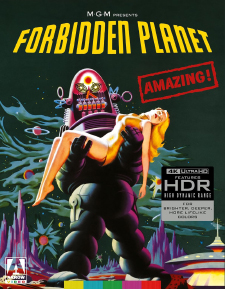
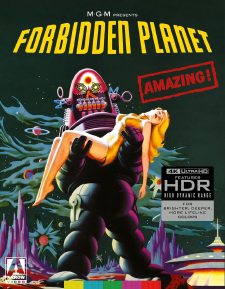
Forbidden Planet (4K UHD Review)
Director
Fred McLeod WilcoxRelease Date(s)
1956 (September 29, 2026)Studio(s)
Metro-Goldwyn-Mayer/Warner Bros. (Arrow Video)- Film/Program Grade: A
- Video Grade: A
- Audio Grade: A-
- Extras Grade: B+


Review
The 1950s were a decidedly unique period in American cultural history. With World War II finally in the rear view mirror, a generation of soldiers returned home to a time of unparalleled economic prosperity and opportunity. Radio was quickly giving way to television in homes across the country, but this also enabled the rapid spread of duck-and-cover, Cold War paranoia in addition to simple entertainment. Yet the Atomic Age was also a time of unrivaled technological and scientific optimism, when almost literally anything seemed possible. And for a generation of readers who’d grown up during the peak of literary science fiction, it was the imminent dawn of space travel that most captured the imagination.
This was due in no small measure to writer Willy Ley’s 1949 speculative science coffee table book, The Conquest of Space, beautifully illustrated with color and monochrome paintings of gleaming rockets and alien landscapes by artist Chesley Bonestell. An immediate best-seller, the book inspired multiple hardcover sequels, not to mention a wildly-popular Man Will Conquer Space Soon! series of articles in the pages of Collier’s Magazine (written by Ley and real-life rocket experts like Werner Von Braun and Fred L. Whipple). Walt Disney’s Man in Space documentaries for the Disneyland TV series soon followed, as did such films as Rocketship X-M (1950), Destination Moon (1950), and producer George Pal’s Conquest of Space (1955).
But while both Destination Moon and Conquest of Space attempted to treat the subject of space travel with something like a realistic approach, science fiction was still a B-genre for the Hollywood studios in the 1950s, which raced to capitalize on the trend by delivering such Red Scare-fueled entries as The Day the Earth Stood Still (1951), When Worlds Collide (1951), The Thing from Another World (1951), and The War of the Worlds (1953). Still, artist and writer Irving Block—who’d done matte paintings for Rocketship X-M—was nevertheless convinced of the genre’s potential for more serious storytelling. And working with fellow scribe Allen Alder, he conceived a loose sci-fi adaptation of Shakespeare’s The Tempest set on a distant planet (with a clever Freudian twist), which the pair pitched to MGM producer Nicholas Nayfack in 1954.
Initially titled Fatal Planet, the project spent nearly two years in development at the studio, with Cyril Hume eventually hired to produce a screenplay and MGM contract director Fred McLeod Wilcox chosen to helm the effort, now called Forbidden Planet. Eventually, taking note that science fiction was particularly popular with younger filmgoers—a much coveted audience demographic—Dore Schary, the prolific playwright and producer who’d replaced Louis B. Mayer as the president of MGM in 1951, realized that Forbidden Planet was an opportunity to not only treat the genre seriously, but also to back its production with A-picture money—something no other studio had fully committed to (and no mere television series could compete with).
Set in the year 2257, the story tracks the crew of United Planets Cruiser C57D, which has been dispatched on a years-long mission to rescue the Bellerophon, a deep-space expedition ship to the planet Altair IV, with which Earth has lost contact. Upon arrival, Commander Adams (Leslie Nielsen, Airplane, The Naked Gun) and his crew discover that only the mysterious Dr. Morbius (Walter Pidgeon, How Green Was My Valley, Funny Girl) and his daughter Altaira (Anne Francis, Blackboard Jungle, Honey West) have survived. Yet despite their potentially dire circumstances, Morbius has constructed a virtual paradise on the planet with the assistance of his robot servant Robby and some kind of incredibly powerful technology. But soon after Adams informs Morbius of his orders to collect the doctor and his daughter and return them to Earth, an invisible force begins attacking his crew. And when Morbius refuses to leave, Adams and his men quickly discover the doctor’s shocking secret.
Despite Forbidden Planet’s high concept aspirations, it’s worth noting that neither Hume nor Wilcox was selected for the job because they were visionaries. Indeed, Hume’s previous work included Tarzan the Ape Man (1932), Flying Down to Rio (1933), and The Great Gatsby (1949), while Wilcox’s best-known films at that point were Lassie Come Home (1943) and Courage of Lassie (1946). Instead, the pair was chosen because they were competent and the studio trusted them with its money. And it’s here that Wilcox’s journeyman experience in organizing productions delivered its best results. Because what really elevates Forbidden Planet is the sheer talent of the artists, craftspeople, and technicians who contributed to its making, a team that included A. Arnold Gillespie (miniatures), Warren Newcombe, Howard Fisher, Henri Hillinick, and Matthew Yuricich (matte paintings), Irving G. Ries (special effects), Hugh Hunt (set design), and Joshua Meador (a veteran animator on loan from Disney), supervised by art directors Arthur Lonergan (whose later work includes M*A*S*H and Robinson Crusoe on Mars) and Cedric Gibbons (who designed the Academy Award statuette and who’d worked on The Wizard of Oz).
From a design and visual effects standpoint, Forbidden Planet’s production is spectacular. Capitalizing on the flying saucer craze, the film marks the first time that filmgoers saw human beings arriving on such a craft. Gibbons himself painted an extraordinary 350-foot cyclorama to depict the alien landscape on MGM’s Stage 15 at such a scale that a full-sized spacecraft could be build in front of it. It’s hard to imagine that the legendary production designer Ken Adam wasn’t influenced by the style of Morbius’ home and laboratory—both look like the very model for many a later Bond villain lair. Forbidden Planet certainly influenced the science fiction films and TV series that followed it, including Star Wars and The Twilight Zone, but most particularly Gene Roddenberry’s classic Star Trek. But perhaps no aspect of the film was more impactful than Robby the Robot, the brainchild of designer Robert Kinoshita (who would also later build the B9 Robot for Irwin Allen’s Lost in Space TV series). It took more than two months to install and test the 2,600 feet of wiring and six electric motors that allowed the mechanical marvel to function, at a reported cost of $125K (of the film’s roughly $1.96 million budget), making him one of the most expensive movie props in cinema history to that point.
Spectacular CinemaScope marvels aside, Forbidden Planet shines for other reasons too. As one of the first such projects to really treat its subject matter as legitimate drama, the cast is good across the board. While Pigeon shines as the brilliant but egomaniacal Morbius, it’s easy to forget that Nielsen was right in his element here, having made quite a name for himself in serious roles long before he turned to comedy. Anne Francis delivers a solid performance as Morbius’ naive but brilliant daughter. And if you look closely, savvy genre fans might recognize a pair of additional faces, including Warren Stevens (The Barefoot Contessa, Star Trek) as the ship’s doctor and Richard Anderson as its chief engineer—you may know him better as Oscar Goldman from The Six Million Dollar Man. (And every time I see Stevens, I can’t help thinking that he looks like Soviet actor Vyacheslav Tikhonov from Sergei Bondarchuk’s War and Peace.) Forbidden Planet certainly delivers on its science fiction potential, touching upon the great mysteries of humanity, our love/hate relationship with technology, and our overall place in the Universe. As such, it’s arguably the most significant film of its genre until the arrival of Stanley Kubrick’s 2001: A Space Odyssey twelve years later. And while Kubrick deliberately chose to take 2001 in a different direction from Forbidden Planet design-wise, that in itself reveals the film’s impact on the zeitgeist of the time.
Forbidden Planet was shot by cinematographer George J. Folsey (Meet Me in St. Louis, Seven Brides for Seven Brothers) on 35mm Eastmancolor film in the CinemaScope format with anamorphic lenses, resulting in a projection aspect ratio of 2:55:1 for theatrical exhibition. For its release on Ultra HD, Warner MPI scanned the original camera negative in 16-bit 4K resolution. Digital restoration and HDR grading were completed for Arrow by Silver Salt in a full 4K workflow, with the resulting presentation compatible with both HDR10 and Dolby Vision capable displays. Arrow has encoded the image for release on a 66GB disc, with video data rates averaging 90 Mbps. Colors are incredibly bold, vivid, and accurate, as evidenced immediately by the opening titles. Contrast is exceptional too, with the film’s early spacescapes exhibiting truly deep blacks. Highlights have a pleasing and natural gleam, thanks to the added dynamic range, and choices in both lighting and palette combine to render a moody and evocative atmosphere. Optically-printed visual effects and transitions have a bit of added grain and detail loss as expected, but overall image detail is excellent. Photochemical grain is generally light to light medium.
It’s worth noting though that a few shots exhibit a visual artifact known as “the mumps,” caused by the fact that early CinemaScope lenses were optically flawed, causing the anamorphic effect to drop off close to the glass. This means that in occasional close-ups, actors’ faces can appear a little too stretched horizontally. Modern digital restorations sometimes correct this issue, but in this particular case Arrow and MPI have obviously chosen not to (note a series of shots starting at about 24:28, and later at 34:04). In any case, the result of all their work is a lovely image that represents the very best this film has looked on disc to date. It’s certainly a nice improvement upon the previous Blu-ray release.
From an audio standpoint, the film’s vintage Perspecta and mono soundtracks have been digitally remastered and restored by Endpoint Audio using the original sound elements provided by Warner. The 4K disc includes that English audio in 2.0 mono, 3.0 Perspecta, and 5.1 surround, all in lossless DTS-HD Master Audio format. Dialogue and sound effects are clean and readily discernible, unencumbered by age-related artifacts. All three mixes remain true to the film’s vintage sonic intent, with the 3.0 and 5.1 mixes each expanding the soundstage a little—the 5.1 in particular adds just a bit more ambience using the real channels. (My personal preference is the Perspecta track, which sounds notably fuller and more robust.)
And the film’s soundtrack—credited as “electronic tonalities” because electronic music pioneers Bebe and Louis Barron weren’t members of the musicians' union—truly shines here. Forbidden Planet features the first-ever entirely electronic film score, produced using custom electronic circuits and tape loops. As their process was so new and innovative, the Barrons were constantly having to rebuild their equipment because the very act of creating their eerie sound effects was literally destroying their circuits.
Arrow’s 4K Limited Edition is a 2-disc set that includes the remastered film in 4K only (a remastered Blu-ray version is available separately), along with a Blu-ray of special features. The contents of those discs break down as follows:
Disc One: The Film (4K Ultra HD)
- Audio Commentary by Kim Newman and Barry Forshaw – NEW
- Theatrical Trailer (HD – 3:41)
Disc Two: Special Features (Blu-ray)
- Unearthly Aura (HD – 23:29) – NEW
- Watch the Skies!: Science Fiction, the 1950s and Us (Upsampled SD – 55:31)
- Amazing!: Exploring the Far Reachers of Forbidden Planet (Upsampled SD – 26:37)
- Robby, the Robot: Engineering a Sci-Fi Icon (Upsampled SD – 13:45)
- Deleted Scenes (Upsampled SD – 13:15)
- Lost Footage (Upsampled SD – 9:23)
- The Invisible Boy (1957) (HD – 89:31)
- The Robot Client (1958) (Upsampled SD – 25:36)
- Excerpts from MGM Parade
- Episode 27 (Upsampled SD – 2:16)
- Episode 28 (Upsampled SD – 3:58)
- Theatrical Trailers
- Forbidden Planet (HD – 3:41)
- The Invisible Boy (Upsampled SD – 2:32)
- Image Galleries (HD) – NEW
- Original Screenplay
- Posters and Lobby Cards
- Black & White Promo Stills
- Color Promo Stills
New for Arrow’s edition are a fine audio commentary by critics Kim Newman and Barry Forshaw, who clearly appreciate this film a great deal. Their steady banter is infectious and entertaining as they deliver a wealth of trivia, context, and production detail. Also new is Unearthly Aura, in which English dramatist and composer Neil Brand discusses the film’s electronic score. And a very nice touch here is the addition of a series of HD galleries, featuring production artwork and imagery, as well as the film’s complete original screenplay!
Beyond that, Arrow carries over nearly every disc-based feature from Warner’s previous 50th Anniversary Edition DVD release. There’s an interesting selection of deleted and extended scenes taken from the workprint version of the film, a sampling of ‘lost’ footage including various camera tests and unused effects shots, a pair of excerpts from episodes of MGM Parade in which Walter Pigeon promotes the film, a complete episode of The Thin Man TV series featuring Robby the Robot, the bonus 1957 film The Invisible Boy (which also featured Robby), and the same trio of excellent documentaries. The first is a fun TCM piece called Watch the Skies!, that features George Lucas, Steven Spielberg, Ridley Scott, and James Cameron talking about the history of science fiction films. It’s narrated by Mark Hamill. The second piece, Amazing!, examines the making of Forbidden Planet and includes interviews with cast members Leslie Nielsen, Anne Francis, and Earl Holliman, as well a host of effects wizards, historians, and directors, including Joe Dante, our dear late friend Bob Burns, John Landis, Dennis Muren, Alan Dean Foster, John Dykstra, John Carpenter, and William Malone. The third documentary focuses specifically on the design and construction of Robbie the Robot, again offering interviews and a look at rare photos and artwork. Finally, you get the film’s theatrical trailer as well as a trailer for The Invisible Boy.
The packaging also includes a double-sided fold-out poster, a reversible sleeve featuring two original artwork options, and a 43-page booklet containing new essays by critics Frank Collins and Johnny Mains, remastering notes, and select archival material.
Forbidden Planet proved quite popular with audiences upon its initial release and was a box office success. Well received by critics at the time, the film has since become a beloved favorite of the day, and is today deservingly regarded as a landmark of cinematic science fiction. Entertaining, thought-provoking, and a veritable feast for the eyes, Forbidden Planet is welcome addition to the 4K Ultra HD format... and another highly recommended release from Arrow Video!
- Bill Hunt
(You can follow Bill on social media on X, BlueSky, and Facebook, and also here on Patreon)