
Essential Film Noir: Collection 6 (Blu-ray Review)
Director
James Edward Grant/Jerry Hopper/Phil Karlson/Edward LudwigRelease Date(s)
1954/1955/1956 (April 29, 2026)Studio(s)
Universal-International/Warner Bros. Pictures/Paramount Pictures/Republic Pictures (Imprint Films/Via Vision Entertainment)- Film/Program Grade: See Below
- Video Grade: See Below
- Audio Grade: See Below
- Extras Grade: B-
- Overall Grade: B+

Review
[Editor’s Note: This is a Region-Free Australian Blu-ray import.]
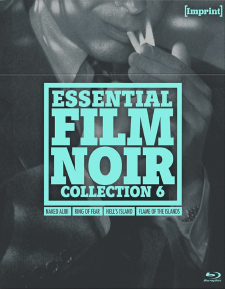
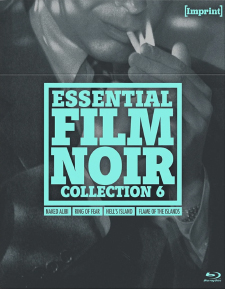
I’m not sure just how essential the four titles included in Essential Film Noir: Collection 6 are, and question whether some could even be considered noir at all, but Imprint’s latest boxed set undeniably packages four curious offerings well worth seeing at least once. The video transfers are all great, the discs Region-Free, and the set includes many worthy, sometimes creative extra features. As usual, it’s all packaged in a very sturdy box, each title getting its own Blu-ray case.
Though it gets a little sluggish toward the end, Ring of Fear (1954) is one heck of a loopy movie, an outrageous entertainment approaching high camp. It was produced by John Wayne’s production company, Wayne-Fellows, and though originally conceived for 3-D was ultimately shot in early CinemaScope. Its overwrought dialogue and bizarre casting make this a bona fide oddity.
The Clyde Beatty Circus comes to town, and in a B-movie montage faintly echoing Cecil B. De Mille’s Oscar-winner The Greatest Show on Earth (1952), boxcars uncomfortably crammed with Asian elephants (misidentified as African), camels, and other animals are unloaded, an old-fashioned circus parade marches through some unidentified city’s downtown district, and the narrator extols the joys of the Big Top.
Meanwhile, over at the State Mental Institution (Maximum Security Division), convicted and emphatically Irish felon Dublin O’Malley (Sean McClory) appears before the parole board declaring, “I’m telling you I’m not crazy! I’m as sane as any man here!” In movie terms this is surefire evidence that Dublin is completely nuts. Further, Dublin loses it after being shown a photograph of old flame and circus aerialist Valerie (Marian Carr), and before you can say “schizophrenia” Dublin escapes, eventually making his way to Beatty’s Circus. Wanting to maintain a low profile, Dublin gets a job as the circus ringleader.
In addition to obsessing over Valerie, now married to fellow aerial artist Armand (John Bromfield), Dublin is seeking revenge against Clyde Beatty (Clyde Beatty) for allegedly humiliating him in the lion’s cage. Blackmailing alcoholic clown Twitchy (Emmett Lynn) to help him, Dublin plots to cause a few “accidents” in the ring. After several close calls, do Beatty and circus executive Frank Wallace (Pat O’Brien) call the cops? Of course not—they hire bestselling pulp novelist Mickey Spillane (Mickey Spillane) to solve the case!
Ring of Fear was directed and co-written (with actor Paul Fix) by James Edward Grant, a longtime pal and collaborator of Wayne’s whose best films tended to be collaborations or adaptations. His worst scripts were usually original screenplays and often downright awful. Ring of Fear is neither subtle nor logical. When a sabotaged safety rope nearly kills the famous lion-tamer, a newspaper headline, in 20-point type, blares, “Clyde Beatty In Brush with Death!” at which point Dublin, disappointed, sneers, “Next time, Beatty!”
As a director, Grant is much worse. His only other credit, Angel and the Badman (1947), is pretty good, but one suspects that film’s very hands-on star, Wayne, guided that Republic production through its paces. Left to his own devices, Grant’s work on Ring of Fear is at times amazingly amateurish. The film is such a mess some scenes with comic relief Pedro Gonzales-Gonzales appear to have been added late in production, almost as an afterthought, to bridge the herky-jerky material which has notably awkward transitions from one scene to the next.
Grant was also extremely sloppy during the editing phase. He uses the same parade footage over and over so that as Beatty’s Circus supposedly moves from town-to-town, it parades past the same small-town businesses again and again. (We keep seeing the same movie theater showing The Moon Is Blue.) Though it works as a curio, Ring of Fear isn’t nearly as entertaining as the endlessly enjoyable Circus of Horrors (1960), by far the best of the Psycho-Circus subgenre. And, as circus movies in general go, producer Wayne had better luck with Circus World (1964), an underrated, epic production for Samuel Bronston.
It would be interesting to learn more about what must have been a troubled production. William A. Wellman stepped in and directed some footage, while Kenneth Tobey, who had starred in The Thing just three years before, appears in what’s practically a bit part.
All this ineptitude is actually pretty entertaining, however, and the film does deliver in terms of slam-bang action and B-movie spectacle. Its circus footage of real acts (including the ill-fated Flying Wallendas) functions as a great historical record of one of the leading 20th century American circuses. Though by today’s standards its treatment of some of the animals is very politically incorrect, there’s no denying that Beatty’s act is singularly impressive and dangerous-looking. The film’s credits amusingly bill all of the acts that appear in the film.
It’s unfortunate that the film spends so much time with Dublin and his demons, because it’s fun to watch non-actors Beatty and Spillane. For a dramatic feature of the ’50s, all the unsubtle in-jokes are amusing. Spillane is introduced in a scene with vendor Vince Barnett, addicted to Mike Hammer novels, engrossed in a paperback of My Gun Is Quick. In the movie, Spillane is partnered with Jack Stang, another non-actor who was the real-life basis for the Mike Hammer character (and who actually resembles Ralph Meeker, who played Hammer in Kiss Me Deadly).
Imprint’s Ring of Fear is licensed from Paramount, which in turn acquired rights from Batjac, the successor to Wayne-Fellows. The Wayne-Fellows titles retained by Batjac tend to have sub-par video transfers. Partly this is due, in this case, to the technical limitations of early CinemaScope and WarnerColor, but maybe also Batjac didn’t properly maintain its film elements. Ring of Fear seems derived from an internegative rather than the original camera negative; the image is a little soft, and the color is a bit unnatural, though it appears Paramount may have done some digital work to clean it up. Both Imprint’s Blu-ray case and menu screens declare the audio as LPCM 2.0 mono, but it’s clearly stereo surround, with much directionality in term of dialogue and sound effects, and the musical score is often directed to the surround speakers. As with all the titles in this set, optional English subtitles are offered, and the disc is Region-Free.
Extras consist of a new audio commentary with Max Allan Collins (who took over the Mike Hammer book series after Spillane’s death) and Heath Holland, and As Themselves, a new video essay by Paul Anthony Nelson.
RING OF FEAR (FILM/VIDEO/AUDIO/EXTRAS): B-/B/A/B
Though always fun to watch actors Sterling Hayden, Gloria Grahame, and Gene Barry, Universal-International’s B-level film noir crime thriller Naked Alibi (1954) is let down by a preposterous script with absurd characters and situations. Much of the story revolves around a character leading a double life, but writer Lawrence Roman, working from Gladys Atwater and J. Robert Bren’s story Cry Cooper, seem to confuse that type of character with those suffering from extreme multiple personality disorder. The plot also hinges on a highly improbable coincidence, and at times almost plays like a parody of classic noir, particularly Grahame’s little monologue near the end.
Police Chief Joe Conroy (Hayden) is certain that humble local baker Al Willis (Barry) is responsible for the murder of Det. Lt. Fred Parks (Max Showalter) following a tense police interrogation, and later for blowing up a police car killing officers also involved in Willis’s arrest. Conroy is fired after a press photographer captures an image of the policeman appearing to brutalize Willis, but still won’t let up. Eventually Willis skips town, telling his supportive wife, Helen, that he needs to clear his head.
Conroy, acting alone, follows Willis to Border Town, in Mexico according to Wikipedia and other sources. There, Willis resumes his criminal activities and abusive relationship with saloon singer Marianna (Grahame). Shortly after arriving, Conroy is rolled by a trio of thugs (one is played by actor Michael Fox) who stab him, steal his wallet and leave him for dead. In a too-amazing coincidence, his lifeless body is discovered by Petey (The Night of the Hunter’s Billy Chapin), who just so happens to live in the apartment directly below Marianna, along with his Uncle Charley (Paul Newlan, of M Squad). (Uncle Charlie and Petey are described in some sources as Mexican, but they sure don’t look or act it, nor does practically anyone else.) Ironically, it’s Marianna who cares for Conroy, the very man looking to nail her boyfriend.
The biggest problem with Naked Alibi is that early scenes depict Willis as a pillar of his local community, sweet and kind to his wife, and a hard worker tirelessly kneading dough at the bakery. Gene Berry plays him as halting and apparently uneducated, but very possibly innocent, and that maybe Conroy is obsessively, misguidedly trying to pin a rap on him.
But once in Border City, Willis, for lack of a better term, goes ape-shit. Insanely jealous, he threatens anyone who so much looks at his girlfriend, and considering her occupation as a singer, he’s frequently beating people within an inch of their life. Willis here is cocky and conniving, brooding with hate, the very opposite of his mild-mannered counterpart. None of this remotely corresponds to the real phenomenon of people leading double lives, an interesting subject pretty much bypassed here entirely.
Gene Barry’s scenery-chewing as Border Town Willis doesn’t contrast well with Sterling Hayden’s hard-boiled stoicism. Hayden’s acting was in a different class, more like Robert Mitchum’s seeming “non-acting” acting. Mitchum was better at it and more versatile, but both possessed a kind of utter authenticity one can’t fake, and Hayden is eminently watchable in just about anything. In spite of the bad script, he’s mesmerizing throughout, and the excellent high-def transfer allows viewers to study his eyes and face intimately.
The coincidence that Conroy, stabbed and left for dead, would virtually wind up in Marianna’s bed is a big stretch, but equally so is all that follows. Though in footage of the attack Conroy appears to have been stabbed deep by a long knife, Marianna insists he doesn’t need to see a doctor. Indeed, the film suggests he needs no stitching up, and no bandages, either, just plenty of bed rest. It works, too. Within a few days, Conroy is back to fisticuffs, never once wincing from his recent wounding.
Reportedly the picture was shot in Tijuana, but the vast majority was obviously filmed on Universal’s backlot, the movie’s police station/courthouse later famously reused in the Back to the Future trilogy. The unreality of Border Town and its dearth of Spanish and Mexican people borders on the surreal.
It’s a little sad seeing Gloria Grahame, so recently in major noirs like In a Lonely Place (1950) and The Big Heat (1953), so wasted in this, playing such an outrageous genre cliché spouting terrible dialogue that it’s almost like watching Catherine O’Hara in an SCTV spoof. The supporting cast is good, with Max Showalter, Don Haggerty, and a few others in plum roles. Chuck Connors, as Conroy’s lieutenant, is so tall, young and sinewy that he looks as much like Conan O’Brien as the Chuck Connors of later work like The Rifleman.
Imprint’s Blu-ray of Naked Alibi appears to source the same excellent 2K video transfer used in Kino’s 2019 Blu-ray release. The black-and-white film is presented in crisp 1.85:1 widescreen, with LPCM 2.0 mono audio, supported by optional English subtitles. Unlike Kino’s disc, Imprint’s is Region-Free.
Extras consist of a new audio commentary track by Samm Deighan; Shadows at the Border, a new video essay hosted by Eloise Ross; a recreation of a Naked Alibi radio ad targeting college students; a trailer, and the short film The Cinematographer (1951), a one-reel short that, like Naked Alibi, is directed by Jerry Hopper, the film produced by the Academy of Motion Picture Arts & Sciences.
NAKED ALIBI (FILM/VIDEO/AUDIO/EXTRAS): B-/A-/A/A-
Hell’s Island (1955) is an odd one. Filmed in the expensive VistaVision process and originally with prints by Technicolor, such films were usually big, flashy productions: White Christmas, The Ten Commandments, etc. This picture, however, came from Paramount’s B-picture unit, Pine-Thomas Productions, churning out product for less than $1 million a picture. Hell’s Island is mostly set in the Caribbean, but instead of showing off the VistaVision process with location footage, most of it was shot on soundstage exteriors and backlot streets. The only name actor in the cast is John Payne, a minor star at 20th Century-Fox for his musicals, Westerns, and crime films, though best remembered today as the young attorney sharing his apartment with Kris Kringle in Miracle on 34th Street (1947). He left Fox that same year, going freelance, but by the end of the ’50s had moved to television and, later, returned to the stage.
Hell’s Island is a mish-mash of time-worn film noir clichés. Following the strange opening, with the climax to the film playing under the main titles, the story is narrated by Mike Cormack (Payne) in flashback, while being treated for a gunshot wound. A former Los Angeles-based assistant district attorney, Cormack went on a bender after being dumped by his fiancée, eventually going to work as a special security agent at a Las Vegas casino. There he’s approached by electric wheelchair-bound Barzland (Francis L. Sullivan, in his last film role), a Sydney Greenstreet-type, with a Wilmer-like gunsel assistant, Lawrence (Walter Reed, surprisingly effective), Barzland hiring Cormack to retrieve a priceless ruby that may be in the possession of Janet Martin (Mary Murphy), Cormack’s former fiancée now in remote Santo Rosario, in the Caribbean.
Janet, the picture’s Brigid O’Shaughnessy, soon wraps lovesick Cormack around her finger, convincing him to help her break her supposedly innocent husband, Eduardo (Paul Picerni) out of prison.
Hell’s Island is a good two reels shorter than The Maltese Falcon but seems twice as long, so dull and interesting is the film, which never comes within one-tenth of Falcon’s impact, in any department. The great film composer Miklós Rózsa’s musical score is atypically unmemorable. The characters are drab; Mary Murphy, for instance, is no Mary Astor. The fine English actor Francis L. Sullivan, so excellent in David Lean’s Dickens films Great Expectations (as Jaggers) and Oliver Twist (as Mr. Bumble) can do nothing to enliven Maxwell Shane’s flaccid screenplay.
One of this critic’s all-time favorites is Farewell, My Lovely (1975), the Raymond Chandler adaptation starring Robert Mitchum as private eye Philip Marlowe. Marlowe’s narration, so perfectly spoken by Mitchum, is like poetry. Conversely, John Payne’s Marlowe-esque narration of Hell’s Island isn’t even third-rate, mostly consisting of Cormack describing action already onscreen and obvious to the movie audience, like a bad audio commentary track.
Like Sullivan, John Payne was a good actor, but not good enough to even partly overcome the weakness of the screenplay. The role really calls for a more hardened, more cynical character anyway, a Scott Brady type, and Payne doesn’t fit the bill. Toward the end of its run, the TV series Peter Gunn did a series of south-of-the-border episodes similar to Hell’s Island, and those weren’t just more entertaining, they were half-hour shows, unlike this interminable effort.
At least it’s pretty: Imprint’s Blu-ray, licensed from Paramount, seems derived from a 4K scan of the original, oversized horizontal camera negative. The resultant video transfer is supremely sharp with excellent color and zero signs of damage. The LPCM 2.0 mono audio is also very good, offered with optional English subtitles and the disc itself is Region-Free.
Extras consist of a new audio commentary track by Gary Gerani and The United States vs. Hell’s Island, “a recreation of 1965 (sic?) Senate Testimony of Paramount Vice President Y. Frank Freeman” over the film’s then-racy poster. (I think the date is wrong, and should be 1955.)
HELL’S ISLAND (FILM/VIDEO/AUDIO/EXTRAS): C/A/A/B
A bit better than one might expect, Flame of the Islands (1956) is a lavish production by lowly Republic Pictures’ standards, the studio on its last legs and belatedly trying to compete with the majors. (The company ceased production in 1958.) It’s not really film noir at all, and more like bush-league Douglas Sirk.
Yvonne De Carlo stars as Roz Dee, a New York secretary rumored to be the mistress of millionaire Carlton Hammond. When he drops dead, his semi-invalid widow, Evelyn (Frieda Inescort, in a warmup to her role in The Alligator People) summons Roz, surprising her with a check for $100,000, hoping her late husband’s “friend” will disappear. And so she does, to Nassau, joined by friend Wade Evans (Zachery Scott), they approached by Cyril Mace (Kurt Kasznar) to invest in his private gambling club. She agrees, partly for the opportunity to sing in its nightclub, both she and Wade unaware that Cyril is using them as a front for the real investors, Cuban gangsters.
Instead of the usual romantic triangle, Flame of the Islands absurdly offers a crowded romantic pentagon. Wade is secretly in love with her, Cyril lusts after her, and soon “reformed drunk” Rev. Kelly Rand (James Arness), now operating a fishing boat-for-hire, falls for her, too. For her part, Roz has invested in the gambling joint correctly guessing that the One That Got Away, millionaire playboy Doug Duryea (Howard Duff), will soon appear. She was involved with Doug when she was just a poor teenager but, being from the wrong side of the tracks, Doug’s mother, Mrs. Duryea (Barbara O’Neill), put the kibosh on that. (O’Neill was only three years older than Duff; she looks more like his dowdy wife than his mother.) Now Doug, his mother still joined at the hip, does indeed appear—but will he even recognize Roz, a woman he’s not seen in 15 years?
Flame of the Islands doesn’t look anything like the usual Republic product, filmed as it was on location in the Bahamas, in Republic’s in-house Trucolor process, and for 1.66:1 widescreen. There’re still too many rear-screen process shots for its own good, but the film has a unique look; much of the film uses real Nassau interiors rather than studio sets, moving away from the artifice of the studio’s house style, and the movie is like a time capsule of life among mid-1950s Nassau’s high society.
Republic had no stars under contract by 1955. Yvonne De Carlo had been a genuine if mid-level movie star, mostly at Universal-International, as a kind of second-string Ava Gardner. Howard Duff had been a big star in radio before being hired by Universal, where for a time he and De Carlo were lovers prior to his marriage to actress-director Ida Lupino, Duff later appearing in a number of Lupino’s films. Zachery Scott was a familiar face if not quite a star, mainly associated with villainous parts for Warner Bros. in the ’40s. James Arness, by contrast, was up-and-coming, still under contract to John Wayne’s company. Reportedly, it was during the production of Flame of the Islands that Arness was called to screen-test for a new TV series called Gunsmoke.
As a movie actress, I confess to never really warming up to De Carlo who, for all her apprehensions, came off best later, on the sitcom The Munsters, which showed off her talents as a comedienne. Yet, in a movie like Flame of the Islands, one can’t help but admire her obvious dedication; she’s in there, swinging, in every scene, including performing a couple of songs and quasi-dance numbers where she approximates the burgeoning Calypso phenomenon, songs written by Sonny Burke and Jack Elliott.
Imprint’s Region-Free Flame of the Islands looks great on Blu-ray, especially nice considering how minor and obscure this title is. It has its share of grainy and/or blurry dissolves and other optical effects, but straight cuts are impressively sharp and the color, not quite up to Technicolor’s brilliance, seems very accurate. The LPCM 2.0 mono is also good, and like the other titles here supported by optional English subtitles.
Extras here are limited to a 30-minute-plus video essay on De Carlo by Philippa Berry, The Most Beautiful Woman in the World.
FLAME OF THE ISLANDS (FILM/VIDEO/AUDIO/EXTRAS): B-/A-/A/B-

- Stuart Galbraith IV