
Brit Noir Collection III (Blu-ray Review)
Director
Seth Holt/Don Chaffey/Sidney HayersRelease Date(s)
1958/1961 (July 28, 2026)Studio(s)
Ealing Studios/A.C.T. Films/Lynx/Independent Studios (Kino Lorber Studio Classics)- Film/Program Grade: See Below
- Video Grade: See Below
- Audio Grade: See Below
- Extras Grade: B-
- Overall Grade: A-

Review
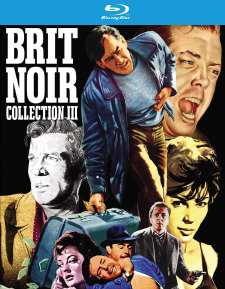
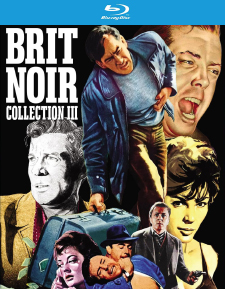
Brit Noir Collection III offers another round of three previously hard-to-see titles, these particularly good and unusual.
Nowhere to Go (1958), was one of the last films from Ealing, which by this time had sold off its studio and was now working out of MGM-British Studios in Borehamwood. Conversely, it marked the directorial debut of Palestinian-British former editor Seth Holt, the last beneficiary of Ealing’s policy of promotion-from-within. Wanting to impress, Holt went all-out, at times even going a little overboard with his stylish direction. Although critics praised his work, he went back to editing for Saturday Night and Sunday Morning (1960), finding directing jobs only on television, including a quartet of Danger Man episodes. Later, for Hammer, he directed two excellent thrillers, Taste of Fear (1961) and The Nanny (1965), but bad luck and alcoholism largely wrecked his career. He died of a heart attack on the set of Blood from the Mummy Tomb (1971), five weeks into a six-week shoot. He was only 47 years old.
Canadian confidence man Paul Gregory (George Nader) make a daring prison break with the help of associate Victor Sloane (Bernard Lee, cast against type), Sloane hiding Gregory in flat whose owner, has gone to Tangier for several weeks.
In flashbacks, the audience learns what got him to this point: some time before, he gained the confidence of an elderly Canadian widow (silent star Bessie Love) visiting England to sell her late husband’s valuable coin collection. Winning her trust, he completes the sale without her knowledge, stashes the money is a safe deposit box, then allows himself to be caught, figuring on a five-year sentence reduced for good behavior, well worth it for the amount of cash he’s stolen. But the judge makes an example out of him, sentencing him to ten years.
Like a collapsing house of cards, once out of prison everything goes wrong. Sloane demands all the stolen money, threatening Gregory’s life and stealing his safe deposit key. Then Bridget Howard (Maggie Smith, in her credited film debut) the disillusioned girlfriend of the flat owner, implicitly gay, turns up, suspicious of the new house guest. Gregory tries outsmarting Sloane, and later seeks help from mobster Sullivan (Harry H. Corbett), but by this time Gregory and the stolen money are much too hot to touch. What’ll he do?
A user review on the IMDb put it as astutely as I could: “If this film had been made in 1950s France by directors named Clouzot or Melville, this Ealing production would be a regular on the revival circuit and in film school classrooms.” Indeed. The film looks less like a typical late-1950s British crime film than a French one, with its bold visual style and surprising confidence. The prison break that opens the film, for instance, is ten minutes with no dialogue, just pure visual storytelling. And throughout the film are long scenes with little or no dialogue or musical underscoring, pulling audience interest in deeper. Director Holt overdoes it a little bit here and there: one shot of a cat perched on a roof ledge with the camera angled down toward the street, where the police are closing in, draws attention to itself, but Holt’s determination to keep the film visually interesting all the time pays off.
MGM cut Nowhere to Go by 15 minutes from its original 104 minutes to fit it into one-half of a double-bill with Torpedo Run, but the Blu-ray is of the complete original cut. Nader is very good; this may be his best film performance, and Bernard Lee, far afield from his usual type, is intriguingly menacing as Gregory’s impatient partner. Twenty-four-year-old Maggie Smith, in her first important film role, likewise makes a strong impression.
All three titles are licensed from StudioCanal. Nowhere to Go is presented on Disc 1, the other two on Disc 2, all Region “A” encoded. Nowhere to Go, presented in 1.75:1 widescreen (MGM’s preferred ratio for its non-’scope releases of the period), is the most ruddy-looking of the three, seemingly sourced from secondary elements, which are softer and more washed-out than the other two films, though still serviceable. All three movies are offered in DTS-HD Master Audio 2.0 mono with optional English subtitles, the sound here adequate, no better.
The lone extra is a new audio commentary track by David Del Valle.
NOWHERE TO GO (FILM/VIDEO/AUDIO/EXTRAS): A-/B+/A-/B-
The Man Upstairs (1958) is a taut suspense story, confined entirely to the interior of a multistoried London boarding house and the street below. The premise is similar to Fourteen Hours (1951), starring Richard Basehart as a man threatening to jump from a 15th story window, adding a dash of 12 Angry Men. (It also resembles the Jean Gabin film Le jour se lève, directed by Marcel Carne in 1939.) In The Man Upstairs, Richard Attenborough stars as Peter Watson, a mentally-disturbed man in a top-floor flat, unable to sleep and freezing cold because he’s unable to light his coin-operated gas-fire. In the middle of the night, he reaches out to several annoyed neighbors, including artist Nicholas (Charles Houston), sleeping with his model (Maureen Connell) across the hall, and downstairs neighbor Pollen (Kenneth Griffith), whom calls the police after being knocked down by Watson. A police sergeant (Graham Stewart) and constable (Edward Judd) arrive, and in a scuffle the sergeant falls several flights and is badly injured, prompting unsympathetic Inspector Thompson (Bernard Lee) to want to move in and remove Watson by force.
However, downstairs neighbor Mrs. Barnes (Dorothy Alison), whose children were tutored by Watson, urges caution, as does mental health care worker Mr. Sanderson (Donald Houston). Meanwhile, the various neighbors are ordered to wait downstairs in one flat where they debate the situation, including alcoholic landlady (Patricia Jessel), Mr. Barnes (Alfred Burke), elderly Miss Acres (Amy Dalby), and others. They debate their moral obligations to Watson play out much like (though not nearly as intriguingly) the jurists in 12 Angry Men.
Written by Alun Falconer, Robert Dunbar, and director Don Chaffey, The Man Upstairs is a bit obvious and clunkily overwritten, but the picture generates decent tension, telling its story more or less in real time, and confining it entirely to boarding house and the street out front, where nosy onlookers, reporters, and both firemen and policemen soon clog the street, gives it an appropriately localized, even claustrophobic aura. Further, Richard Attenborough’s almost clinical performance of a man having a nervous breakdown and seeing no way out of a terrible situation, provides the credibility needed to offset the sometimes-trite conversation downstairs.
Also making a strong impression, once again, is Bernard Lee, who played myriad such parts in British films, but always the much more methodical, paternal policeman who was, at worst, curmudgeonly. Here, however, Lee’s Inspector Thompson has seemingly lost all reason, upset by the critical injury to a sergeant under his command. In one scene he pushes a soldier to provide him with tear gas canisters unlawful for domestic use. He has no patience for mental health care counselor Sanderson and especially none for empathetic Mrs. Barnes, for much of the film Watson’s only advocates. The other characters are recognizable but broad types, especially Kenneth Griffith’s fussy, sanctimonious tenant, Griffith’s performance a bit overly theatrical.
Yet, it’s a good film overall, its outcome unpredictable until the very end.
Again licensed from StudioCanal, The Man Upstairs has a better video transfer than Nowhere to Go, the 1.66:1 widescreen, black-and-white film set entirely at night, so the excellent detail and strong blacks go far. The DTS-HD 2.0 mono audio is also a bit better, and likewise supported by optional English subtitles.
This time the lone extra is a new audio commentary track featuring film historian Howard Berger.
THE MAN UPSTAIRS (FILM/VIDEO/AUDIO/EXTRAS): A-/A-/A/B-
Regarded as one of the best British crime films, Payroll (1961) is a heist yarn with all the usual genre tropes and then some, familiar even to 1961 audiences, but is so shockingly brutal that it still packs a wallop even today.
In Newcastle, crooks Johnny Mellors (Michael Craig), their ruthless leader, along with Monty Dunston (Kenneth Griffith), Blackie (Tom Bell), and Bert Langridge (Barry Keegan) plot a daring armored car payroll robbery, using inside man Dennis Pearson (William Lucas), an accountant, to provide them with plans of the armored car’s security systems. (He makes photocopies on a Thermo-Fax machine, one of the earliest such devices.) Pearson needs his cut of the take to placate his shrewish, Viennese immigrant wife, Katie (Françoise Prévost), yearning for a more luxurious lifestyle than her middle-class husband can provide. And no wonder—they live in the shadow of Newcastle’s nuclear power plant.
Their plan essentially involves ramming the armored car repeatedly to gain entry, and in doing so they crush to death its driver, Harry Parker (William Peacock). They make off with 50,000 pounds (about 1.44 million today), but the guard in the back of the vehicle, himself critically wounded, fatally shoots Bert. The majority of the film’s 102-minute running time follows what comes after.
Katie quickly grasps her increasingly agitated husband’s involvement in the crime, she spending her time trying to figure out where he’s hidden his share while hedging her bets by becoming sexually involved with Johnny. Pearson himself is stalked by Parker’s vengeful widow, Jackie (Billie Whitelaw), driving him into a state of total mental collapse. Meanwhile, Monty, upset by Bert’s death and Johnny’s and Blackie’s ruthlessness, goes on a bender, threatening the entire enterprise.
Adapted from Derek Bickerton’s 1959 novel, Payroll has a very familiar plot populated by stock genre characters. What makes it stand out so spectacularly is its merciless, pitiless and unsympathetic characters. Heist movies typically have at least one sympathetic character, whom the viewer hopes will succeed or least get away in the end; James Whitmore in The Asphalt Jungle, Sterling Hayden in both that film and The Killing, etc. In Payroll, however, none of the characters are very sympathetic; Katie, for instance, is the greediest and most heartless female character of them all, an extreme rarely equaled in noir, and quite similar to Marie Windsor’s character in The Killing.
Kenneth Griffith is less theatrical than he was in The Man Upstairs, spineless worriers being his forte. The characters played by Michael Craig and Tom Bell, the former cruel and the latter angry and impatient, have no regard for human life; a good moment has Johnny preparing to bludgeon the wounded Bert with a spanner (wrench) lest he be captured alive.
Bell is best remembered as Helen Mirren’s menacing rival, Det. Sgt. Otley, on Prime Suspect, a role he played until his death at 76. In Payroll, Johnny tells Blackie, “You’ve got more years in front of your than I have,” yet while Bell died 20 years ago, Michael Craig is still with us at age 97. Further, there’s Billie Whitelaw’s vengeful widow. With her steely eyes and pinched, hawk-like features, she quickly came to specialize playing intensely obsessive parts like that in Payroll, culminating with her iconic Mrs. Maylock in The Omen. Unusual for such films, there’s no Bernard Lee or John Gregson-type policeman role; in Payroll, the law is largely irrelevant.
The Newcastle (and Gateshead, Tynemouth, Rugby, and Southwold) locations add significantly, adding to the working-class atmosphere of the story, and a welcome break from the familiar London locations normally seen in such films.
Again in 1.66:1 widescreen and black-and-white, Payroll has the best 1080p video transfer of the three, a nearly perfect encoding with inky blacks and impressive sharpness. The DTS-HD Master Audio 2.0 mono is also very good, and as with the other titles, is Region “A” encoded and supported by optional English subtitles.
The lone extra this time is an audio commentary track featuring Steve Mitchell and Gary Gerani.
PAYROLL (FILM/VIDEO/AUDIO/EXTRAS): A/A/A/B-
Brit Noir Collection III has the best all-around set of titles—all three films are very good-to-great—though Home at Seven remains my favorite of the nine titles released to date. Highly recommended.
- Stuart Galbraith IV