
Brit Noir Collection I (Blu-ray Review)
Director
Basil Dearden/Guy Hamilton/John LemontRelease Date(s)
1950/1952/1961 (May 26, 2026)Studio(s)
Ealing Studios/London Films/Zodiac Productions (Kino Lorber Studio Classics)- Film/Program Grade: See Below
- Video Grade: See Below
- Audio Grade: See Below
- Extras Grade: B-
- Overall Grade: B+

Review
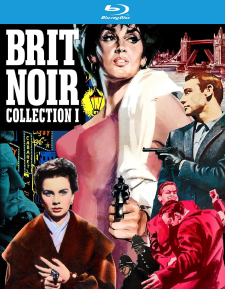
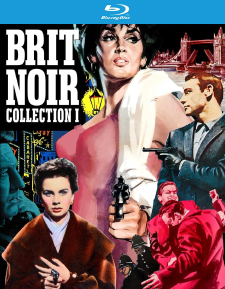
Home video has a “big tent” approach as to what qualifies as film noir these days, with many titles labelled noir primarily something else, or only marginally noir, or not noir at all. But if that marketing tool helps get relative obscurities like those found in Brit Noir Collection I released then I, certainly, am not complaining. Further, fans of actor Herbert Lom will be pleased: he’s featured in all three films.
Cage of Gold (1950), for instance, is mostly a romantic melodrama with crime film elements, but it’s well-directed by Basil Dearden, boasts an excellent cast, and has unusual, not-entirely-predictable components. The film stars Jean Simmons, she barely 21 but already a top British star, but what makes this picture really crackle is the superb performance by David Farrar, both actors late of Powell and Pressburger’s magnificent Black Narcissus (1947).
Painter Judith Moray (Simmons) is engaged to doctor Alan Kearn (James Donald), but reunites with old flame Bill Glennan (Farrar), a roguish wing commander during the war. After sweeping Judith off her feet with endless nights of nightclubbing and the like, she breaks off her engagement with Alan to marry Bill, but he’s revealed as a con artist only interested in Judith’s father’s money. When she explains he’s no longer wealthy, Bill hightails it to Paris, abandoning a pregnant Judith in London. In desperation she turns to Alan, hoping he will provide an abortion—unimaginable in a 1950 Hollywood film. Alan, with the patience of a saint, takes her back.
Meanwhile, in Paris, Bill retreats to another old flame, Marie Jouvet (Madeleine Lebeau), a singer at a cabaret where Bill assisted club owner Rahman (Herbert Lom) in a smuggling racket. He convinces Bill to let him use his name on a forged passport to smuggle a man into New York, but the plane crashes en route and, later, Judith and Alan believe Bill died in the crash. Two years later, however, Bill returns to London to blackmail the young couple and threatens to reclaim his biological son.
Director Michael Powell speculated that Farrar might have been one of Britain’s top actors had he cared more about his career. One sees why watching Cage of Gold, in which Farrar expertly plays a con artist targeting vulnerable women. Usually such characters in films are suave but obviously oily, the movie audience immediately able to peg him as crook and often left wondering why the women he targets can so easily be fooled. Farrar doesn’t play him that way; in his early scenes he appears charming if a little forceful, but perfectly legitimate. Instead, aided by Jack Whittingham’s (Thunderball) screenplay, Bill is a heartless, almost psychopathic master manipulator, but like bona fide psychopaths, has a strong if superficial charm, carefully gauging each woman’s vulnerabilities, carefully stringing them along. The delicacy of Farrar’s characterization is at once extraordinarily subtle and viscerally loathsome. Jean Simmons and James Donald are both good, but Farrar carries the picture.
Unusual for a British film made in 1950, Cage of Gold includes not only a fair amount of footage shot on location in Paris—cinematographer Douglas Slocombe manages a beautifully composed shot of Farrar near the Arc de Triomphe—but also quite a bit of dialogue in French, translated into English via subtitles. (The original theatrical version was likely subtitled as well, but possibly not.) Marie’s cabaret singing is supported by, on the piano, Léo Ferré, the great French poet, composer, and performer, and both Farrar and Lom speak French in scenes where they should be speaking French instead of English. There’s enough of a French component one might assume it was a British-French co-production but that’s not the case.
Madeleine Lebeau gets an “and introducing” credit, even though she had previously appeared in at least five Hollywood movies before this, most famously Casablanca (1942). Playing Yvonne, the discarded mistress of Humphrey Bogart’s Rick, her character briefly flirts with Nazi soldiers until stirred by Victor Laszlo’s defiant ordering of the house band to play La Marseillaise, Yvonne joining in, tears running down her cheeks as she sings. She wasn’t acting; she and her then-husband, Jewish-French actor Marcel Dalio (who played the croupier in Casablanca), fled Paris via transit visa to Portugal, reaching the U.S. via Chile, her real-life story not unlike Ingrid Bergman’s in the movie. Cage of Gold appears to have been her only British film; she was back in France after the war, appearing in French films and some European co-productions, including La Parisienne with Brigitte Bardot, and Fellini’s 8 ½. She was the last surviving credited actor of Casablanca when she died at 92 in 2016. It’s interesting watching Lebeau here. In Casablanca she was barely 19 years old while here she’s a fleshed out, more experienced 27, delivering a strong performance.
All three movies in Kino’s Brit Noir Collection I are 4K restorations by StudioCanal. Cage of Gold, presented in its original black-and-white, 1.37:1 standard frame looks good after a rather grainy Rank logo. It’s not superb but commendable; not quite as sharp as it might be, but reasonably so with good detail and blacks. As with the other titles, the DTS-HD Master Audio (2.0 mono) is strong, optional English subtitles are provided, and the disc is Region “A” encoded.
The lone extra on each title is a commentary, in this case one by writers Bryan Reesman and Max Evry.
CAGE OF GOLD (FILM/VIDEO/AUDIO): A-/A-/A
The Ringer (1952) is the fifth film adaptation of Edgar Wallace’s 1925 novel, an old chestnut also adapted into a 1929 play, akin to America’s perennial old dark house mystery The Bat. This version is mostly quite bad; it’s like a 1950s version of an early-talkie drawing room mystery—it’s certainly not film noir. A good cast can’t save it, though director Guy Hamilton’s staging of a largely superfluous chase scene, cleverly set on rooftops overlooking Piccadilly Circus, and a lively climax compensate for its shortcomings somewhat.
Disreputable solicitor Maurice Meister (Herbert Lom, without his hairpiece) has been receiving threats by an elusive criminal known as “The Ringer,” once believed dead but now apparently in London, seeking vengeance for the death of his sister, The Ringer believing Meister responsible. Deptford police Inspector Wembury (Charles Victor) and Scotland Yard Inspector Bliss (Norman Wooland, sporting a menacing goatee) are put in charge of the case, joined by Aberdonian police surgeon and amateur sleuth Dr. Lomond (Donald Wolfit), as well as the Ringer’s wife, Cora Ann Milton (Greta Gynt), and Cockney petty thief Sam Hackett (William Hartnell), whom the police unaccountably encourage Meister to hire on as a security consultant.
Meister, for his part, is less concerned about the Ringer than he is lusting after his secretary, Lisa (Mai Zetterling, admittedly mesmerizing), though she is in love with John Lemley (Denholm Elliott), a client of Meister’s fresh out of prison, complicating Meister’s plans to take Lisa with him to America.
The Ringer was hopelessly old-fashioned even by 1952 standards, and Guy Hamilton, making his directorial debut, is clearly out of his depth; he can’t breathe any life to the staginess of its corny plot. It really does resemble an early talkie, something like The Canary Murder Case or the earliest Charlie Chans, more so than a ’50s British crime film, and quite unlike anything noir. When West Germany’s Rialto Films hit pay dirt loosely adapting old Edgar Wallace stories later in the decade, Der Hexer (1964), their remake of The Ringer, directed by Alfred Voher, proved to be one of their best—visually stylish and amusing. This Ringer isn’t half as funny trying twice as hard to generate laughs. Also seriously damaging things are the nearly insufferable English stereotypes, especially Hartnell’s inveterate Cockney thief, costumed here like a music hall comedian, and his equally overdone Cockney wife, played by Dora Bryan. Even the deliberately, extravagantly over-the-top Timson family of villains in John Mortimer’s Rumpole of the Bailey stories have more credibility.
Probably Hamilton’s lack of experience directing actors accounts for the profoundly variable performances. Hartnell and Bryan are wildly over-the-top; Wolfit (whose theatricality was immortalized in The Dresser) is indulgent though more restrained than usual; Lom is smooth and professional, as he was even in the worst movies; Denholm Elliott, as he often did at this point in his career, plays another young man on the verge of a nervous breakdown, running the gamut of emotions. Lom, Victor, and Zetterling come off well; most of the others don’t.
Yet, as bad as most of The Ringer is, that rooftop action scene in the middle and the lively if ludicrous climax go a long way to redeem the picture; clearly Hamilton was more confident with that material than the drawing room mystery stuff. It’s not quite enough to make one forgive the film’s many weaknesses, but it helps.
The black-and-white, 1.37:1 standard frame video transfer of The Ringer is a marked improvement over Cage of Gold, the image spot-on throughout, very sharp and without any signs of damage or wear. The DTS-HD Master Audio (2.0 mono again) is also very good.
This time the lone extra is a new audio commentary track by writers Julie Kirgo and Peter Hankoff.
THE RINGER (FILM/VIDEO/AUDIO): C+/A/A
The Frightened City (1961) is a routine but colorful crime film headlined by Herbert Lom and John Gregson, but the plot really revolves around third-billed Sean Connery, one year before his breakout role as James Bond in Dr. No.
The movie is built around an utterly absurd premise, that accountant Waldo Zhernikov (Lom) could persuade through proxy Harry Foulcher (Alfred Marks) the leaders of London’s six big criminal gangs to band together and form an underworld “trade union” to maximize the profits from their protection rackets. Presupposing that none of these gangsters have accountants of their own, the six gang leaders enthusiastically go along with Waldo’s scheme, Foulcher hiring ex-second-story man Paddy Damion (Connery) as their comparatively nonviolent enforcer, Paddy having temporarily given up crime after his longtime partner, Wally (Kenneth Griffith) was crippled in a fall.
Waldo’s scheme proves wildly successful, but the insatiable accountant, dissatisfied with the limited income from family-owned pubs and restaurants, turns his attentions to bigger game, beginning with a major construction company whose latest building project faces stiff penalties if not completed on-schedule. He becomes so enwrapped in this that he all but forgets about his mistress, aspiring singer Anya (Yvonne Romain), who anyway is lusting after Paddy, he virtually dumping longtime girlfriend Sadie (Olive McFarland) in the process. Meanwhile, Det. Inspector Sayers (John Gregson) believes he can put a stop to all this through Paddy, disillusioned after Foulcher uses him to murder a rival gangster.
The kind of picture The Frightened City is can best be exemplified by an early scene in which Foulcher introduces Paddy to Waldo. Waldo shows off his collection of medieval armor, which includes a wall-mounted shield with a giant blade protruding from the center of it, like a German lantern shield, dangerously pointing toward the center of the room. The moment the movie audience sees it, they know that before the movie is over, either Foulcher or Waldo will end up being impaled by that thing.
Supposedly 007 producers Cubby Broccoli and Harry Saltzman were persuaded to hire Connery partly on the basis of his performance in this film. Connery’s definitely rough around the edges, but particularly when seducing Yvonne Romain’s Anya character, exhibits early signs of the Man Who Would Become Bond. John Gregson would soon star on the TV series Gideon’s Way, playing another Scotland Yard man similar to his role here. Though top-billed, he’s absent from the film for long stretches, but in 1961 both he and Lom were bigger names then Connery.
The Frightened City gets its own disc; the earlier two films share Disc 1. Again licensed from StudioCanal, the film is presented in its original black-and-white and, oddly, 1.85:1 widescreen. This could be an error: in the U.K. at this time, non-’scope releases were almost invariably 1.66:1, excepting British titles with heavy American financing, money from studios like Columbia or Universal. The 1.85:1 doesn’t appear horribly wrong though the framing is a little tight at times. The image mostly looks good, but around the 49-minute mark there’s a very noticeable frame wobble lasting several minutes. Given this is reportedly a 4K restoration, one is surprised it wasn’t fixed at that time.
The lone extra is an audio commentary track by film historians C. Courtney Joyner and Bruce Scivally.
THE FRIGHTENED CITY (FILM/VIDEO/AUDIO): B/A-/A
Three British titles of variable quality but each entertaining in their own way, Brit Noir Collection I is recommended.
- Stuart Galbraith IV