
Bohachi Bushido: Code of the Forgotten Eight (4K UHD Review)
Director
Teruo IshiiRelease Date(s)
1973 (April 14, 2026)Studio(s)
Toei Company/Boum Productions (Mondo Macabro)- Film/Program Grade: N/A
- Video Grade: A-
- Audio Grade: B+
- Extras Grade: A-

Review
Teruo Ishii should be no stranger to fans of pink or Category III films, as he made two of the most well-known ero guro films, Shogun’s Joy of Torture aka Tokugawa onna keibatsu-shi, and Orgies of Edo aka Zankoku Ijo Gyakutai Monogatari Genroku Jokeizu. Falling right in line with those works is Bohachi Bushido: Code of the Forgotten Eight aka Poruno jidaigeki: Bōhachi bushidō, made several years later. Based upon the manga by Kazuo Koike and Goseki Kojima (Lone Wolf and Cub), it takes the jidaigeki genre and mixes it with the chambara and pink genres to create a highly violent, highly sexual, and highly exploitative piece of storytelling.
Japanese cinema in the 1960s and 1970s grew increasingly violent over time, with samurai characters hacking limbs off or slicing chests open with frequent geysers of blood spurting everywhere. Women’s nudity was also being exploited ten-fold, and nowhere is either of these aspects more prevalent than in something like Bohachi Bushido. In fact, there’s hardly a scene in this film in which any of the female cast members aren’t completely nude or subjected to sex, rape, or assault of some kind. For the uninitiated, it’s surely a shock to the system, but for seasoned veterans, it’s probably par for the course.
What gets you through a film like this is its plot, and it definitely has one and is fairly easy to follow along with, akin to something like the previously referenced Lone Wolf and Cub in which a wandering samurai becomes a part of a bigger story, or something like Akira Kurosawa’s Yojimbo. It’s all fairly incestuous, even infecting American cinema with its tropes. A wandering samurai (Tetsurō Tamba) is hired to help a faction of people, but in this instance, he’s literally been hired by the bad guys, including the head of the Bōhachi (Tatsuo Endō), who want to do away with him once his task is complete. Meanwhile, there are incessant violations of women who are wearing almost nothing for the entirety of the running time. Also in the cast are Gorō Ibuki, Yuriko Hishimi, and Takuzo Kawatani.
What it boils down to is this: Bohachi Bushido is not for the timid or the close-minded. It’s far from being the most offensive pink-like production that Asia has to offer, but if you’re a stranger to the onslaught of female subjugation present in these types of films, then you better prepare yourself if you decide to dip a toe or two into the waters. Thankfully, Bohachi Bushido is beautifully made with a great score and solid visuals, which lends itself to UHD quite easily.
Cinematographer Jūhei Suzuki shot Bohachi Bushido: Code of the Forgotten Eight on 35mm film with anamorphic (Toeiscope) lenses. The results were finished photochemically and framed theatrically at the aspect ratio of 2.35:1. Mondo Macabro brings the film to Ultra HD with a 4K scan of the original camera negative, which has been graded for High Dynamic Range in HDR10 only, and encoded to a dual-layered BD-66 disc. It’s an impressive presentation with bit rates sitting mostly in the 65 to 75Mbps range. Grain is present but minimal, and the image is crisp outside of opticals. Highly-stylized sequences including the bridge-bound opening sword fight set against the setting sun showcases the deep blacks and rich hues that HDR can offer. Mostly natural flesh tones and perfect contrast are evident throughout, as is a stable and clean image. There are also no obvious encoding issues or other anomalies. It’s a terrific-looking picture.
Audio is included in Japanese 2.0 mono DTS-HD Master Audio with optional English subtitles. Aside from a minor natural hiss and some sibilance, this is a fairly straightforward monaural experience that offers good support for dialogue and score.
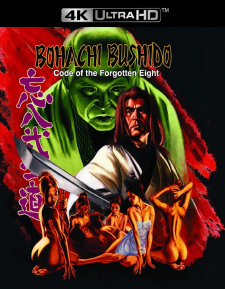
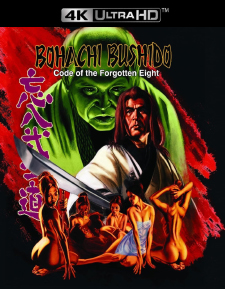
The Mondo Macabro 4K Ultra HD release of Bohachi Bushido: Code of the Forgotten Eight sits in a black Amaray with artwork by Justin Coffee that’s also used for the Blu-ray release, with clothes covering the frontal nudity. The now out-of-print Limited Edition 2025 UHD release was housed in a red Amaray case with uncut artwork, an exclusive slipcover, and a 22-page insert booklet containing an essay by Mark Schilling. That release was limited to 2,000 units only. The following extras are included on both releases:
- Remembering Teruo Ishii With Shinya Tsukamoto (HD – 17:44)
- Audio Commentary by Tom Mes
- Archive Interview With Actress Yuriko Hishimi (Upscaled SD – 21:05)
- Archive Interview: What Is Pinky Violence? (Upscaled SD – 15:33)
- Archive Audio Commentary by J-Taro Sugisaku, Takao Nakano, and Yoshiki Hayashi
- Introducing the Commentators (Upscaled SD – :42)
- Bohachi Bushido Original Trailer (HD – 3:11)
Remembering Teruo Ishii speaks to actor Shinya Tsukamoto (Tetsuo: The Iron Man) about his upbringing, his career, and his memories of working with director Terio Ishii on his final film Blind Beast vs. Dwarf aka Môjû tai Issunbôshi. In the audio commentary by author, film scholar, and Japanese cinema expert Tom Mes, he delves into the history of Toei Company making these kinds of films while also delving into the careers of the cast and crew, including Teruo Ishii. In the 2008 interview with actress Yuriko Hishimi, she discusses becoming an actress at Toho and the work she did there. What Is Pinky Violence? examines the genre with filmmaker Jtarô Sugisaku. The second audio commentary, presented in Japanese with English subtitles, features filmmaker Jtarô Sugisaku, screenwriter Takao Nakano, and producer and film scholar Yoshiki Hayashi. It’s a much more reactionary track, but they discuss the film at length while watching it together. Introducing the Commentators speaks briefly to each of them. Last is the film’s trailer.
Not included from Eureka’s 2026 UHD release in the U.K. is a still gallery; the film Bohachi Bushido: The Villain, featuring an audio commentary by Arne Venema and Stefan Hammond, and its own still gallery; the essay From Codes to Chaos by Joe Hickinbottom; and a booklet containing an essay by Jennifer Coates. Also absent from the 2008 Discotek Media DVD release is a set of From the Manga to the Movie comic panels, the text essays Memories of Bohachi Bushido by Mark Schilling, and About the Film by Chris D.
For pink film fans, as well as fans of Japanese cinema, Mondo Macabro’s UHD of Bohachi Bushido: Code of the Forgotten Eight is definitely a release worthy of your collection.
- Tim Salmons
(You can follow Tim on social media at these links: Twitter, Facebook, BlueSky, and Letterboxd. And be sure to subscribe to his YouTube channel here.)