
Blazing Magnum (Blu-ray Review)
Director
Alberto De MartinoRelease Date(s)
1976 (September 22, 2026)Studio(s)
Security Investment Trust Company/Les Productions Mutuelles Ltée (Kino Lorber Studio Classics)- Film/Program Grade: B
- Video Grade: B+
- Audio Grade: A-
- Extras Grade: A-

Review
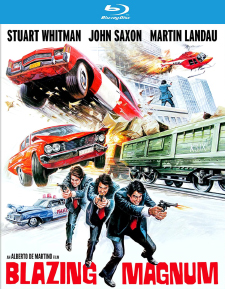
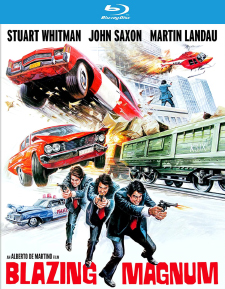
Not what one might be expecting, the front cover poster art for Blazing Magnum (Una magnum special per Tony Saitta, 1976) suggests an action-packed poliziotteschi (the Italian crime film genre dominating the 1970s), but in fact it’s more like an Italian giallo (murder mystery-thriller) done in the style of a Dirty Harry movie. Further, it features no Italian stars, its cast dominated by American actors, and was filmed entirely in Ottawa, Ontario and Montreal.
Though this Italian-Canadian-Panamanian co-production was sold as a poliziotteschi-type thriller in Italy, for the U.S. release by American International Pictures (AIP), the entire advertising campaign was completely altered. AIP’s posters—in a rare moment of honesty—suggested a moody thriller and they changed the title. On the posters the movie became Strange Shadows in an Empty Room, but the onscreen title drops the “Strange” and reads Shadows in an Empty Room. For that version, director Alberto De Martino is credited as “Martin Herbert.”
Kino Lorber’s Blu-ray includes both the original Italian version, reportedly derived from a new 4K remastering of the 35mm camera negative, as well as AIP’s version, likely from an IN (internegative) or theatrical print. For this review, I primarily watched the latter given the English-speaking cast, initially unaware that optional English audio had also been grafted onto the Italian version, in addition to the original Italian audio with English subtitles. In terms of content, the two versions are virtually identical.
Ottawa Police Capt. Tony Saitta (Stuart Whitman) learns that his sister Louise (Carole Laure) died suddenly at a college party, seemingly poisoned by someone there. Working with police Sgt. Ned Matthews (John Saxon), Saitta learns that Louise recently dumped her boyfriend, Fred (Jean LeClerc), in favor of respected (and married) physician Dr. George Tracer (Martin Landau), who coincidentally was at the party and fruitlessly attempted to revive her.
Saitta and Matthews immediately suspect Tracer, but other strange crimes muddy up their hypothesis: a drag queen is murdered, his body mutilated in a rock-crusher at an excavation site, though a photograph of a stolen black pearl necklace among the remains connects the victim to Louise. Saitta also questions Louise’s blind piano teacher roommate, Julie (Tisa Farrow), and sexually promiscuous party guest Margie (guest star Gayle Hunnicutt).
On its own terms, as an exploitation film, Blazing Magnum/Shadows in an Empty Room is offbeat and unexpectedly entertaining. With a more credible, finely-tuned screenplay, its story might have worked as a mainstream Hollywood production. As it is, the movie is not remotely believable, what with Saitta leading the investigation into his own daughter’s murder, Saitta destroying everything in sight without regard for collateral civilian damage or injury, and its two big car chases, particularly the second one, is completely outrageous, defying the laws of physics, etc.
Those car chases were staged by Rémy Julienne, the former motocross champion who became Europe’s leading stunt coordinator and driver for such sequences, including six James Bond movies. His work here is unusually impressive for such a modest production (probably $1.5 million or less).
Likewise, director Alberto De Martino’s overall direction of the film’s action scenes show imagination. The climax features a big chase by Saitta pursuing the knife-wielding killer through a hospital, the killer threatening the staff and patient in an operating room during surgery, and later threatening a newborn in a maternity ward (!). There’s also an unusual, amusing—if politically-incorrect—sequence with Saitta brawling with three drag queens, one of whom brandishes a hot curling iron.
The downsides are that De Martino’s direction of the film’s more giallo-like qualities is flat and uninteresting, and the musical score by Armando Trovajoji (the second husband of Pier Angeli) is positively headache-inducing, much of it incorporating something like an electronic whine. The film always plays better when there’s no music at all.
It’s fun to watch so many actors associated with continental and/or cheap movies corralled together in one movie: Whitman, Saxon, Landau, Farrow. They’re all pretty much slumming. As Saitta, Whitman can’t muster up the slightest bit of emotion over the murder of his sister; he pretty much treats it as just another case and never obsesses over finding her killer nor, except in the action scenes, does he resemble “Dirty” Harry Callahan. Saxon is underutilized, Landau gives his usual polished, measured performance, and Farrow is pretty but can’t act. Gayle Hunnicutt has more to do than most of them put together.
Kino’s Blu-ray presents both versions of the film on a single Region “A” disc, both in 1.85:1 widescreen with DTS-HD Master Audio 2.0 mono audio, supported by optional English subtitles. The 4K remastering of Blazing Magnum looks okay, but lacks the clarity of most 1.85:1 widescreen Italian productions from the period on Blu-ray. Unlike the U.S. version, it exhibits much digital tweaking to make it presentable and somehow looks less like organic 35mm film than the U.S. version, even though it’s in better shape. The U.S. version, which includes the AIP logo, shows a lot more damage and looks like it was derived either from an internegative or theatrical print, but does play less tweaked than the “restored” Italian cut. Both are acceptable, but neither is great and each has its own set of plusses and minuses. As noted above, Italian and English tracks, along with English subtitles, are available on the Italian version, or one can watch the U.S. release version. The cuts are virtually identical with running times mere seconds within one another.
Previously released on Blu-ray in Japan in 2018 and in the U.K. in 2023, some of the extras are derived from the U.K. version, released by StudioCanal. They consist of an audio commentary track by Steve Mitchell and Troy Howarth; Special Sentiment, featuring director Alberto De Martino (who died in 2015); City Hunter, a discussion of the film by Kim Newman; and a trailer.
Way more entertaining (and marginally better) than I was expecting, Blazing Magnum/Shadows in an Empty Room is not to be taken seriously, but enjoyable on its own terms and recommended.
- Stuart Galbraith IV