
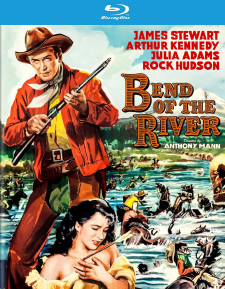
Bend of the River (Blu-ray Review)
Director
Anthony MannRelease Date(s)
1952 (May 12, 2026)Studio(s)
Universal-International (Kino Lorber Studio Classics)- Film/Program Grade: A-
- Video Grade: A-
- Audio Grade: A-
- Extras Grade: B


Review
Kino first released Bend of the River (1952) to Blu-ray in 2019 with an okay but not great video transfer. This reissue upgrades the picture quality substantially via a 4K scan of the three Technicolor camera negatives, and while the results aren’t quite as splendiferous of Warner Archive’s work on similar Technicolor titles from the early ’50s, it’s still a big improvement.
The second of eight collaborations between actor James Stewart and director Anthony Mann, Bend of the River is perhaps the most conventional of their five Westerns together, but it’s an outstanding film nonetheless.
Their first, Winchester ’73 (1950) helped redefine Stewart’s onscreen persona and offscreen bank account. After serving as a combat flyer in the Army Air Forces, like other ’30s stars he initially struggled after returning to a rapidly changing postwar Hollywood. Frank Capra’s It’s a Wonderful Life (1946) hinted at the darker, more psychologically complex roles Stewart would soon excel at, but he fumbled in mostly forgettable films during 1946-50. Winchester ’73, about a cowboy’s obsessive search for a stolen, prized rifle, presented a disturbing hero in Stewart, and was one of three 1950 films that redefined the American Western. (The others were Delmer Daves’s Broken Arrow, also starring Stewart; and Henry King’s The Gunfighter. Mann’s Devil’s Doorway, also 1950, should really be included as well.)
Winchester ’73 and, later, Bend of the River, also forever altered Hollywood’s star system. A then-struggling Universal-International rejected Stewart’s $200,000 asking price (a deal that also included Harvey) so Stewart’s agent, MCA’s Lew Wasserman, brokered a deal whereby Stewart would instead receive a percentage of the profits, as well as retain cast and director approval. He ended up making a record-setting $600,000 on Winchester ’73, and around $750,000 for Bend of the River.
Soon after the Civil War, former Kansas-Missouri border raider Glyn McLyntock (Stewart) has joined a wagon train of settlers bound for Oregon, becoming an invaluable scout, they unaware of his disreputable past. Checking the trail ahead, he encounters a lynching, Glyn rescuing accused horse thief Cole (Arthur Kennedy) from being hanged. Cole, himself a former (but, in contrast to Glyn, unrepentant) border raider, joins the wagon train just as it’s attacked by a small band of Shoshone Indians, during which beautiful Laura Baile (Julie Adams) is arrowed in the shoulder. Glyn and Cole kill the Indians, but Laura’s father and de facto leader of the settlers, Jeremy Baile (Jay C. Flippen), doesn’t trust Cole despite his indispensable help, believing bad man can never change, a rotten apple that must be discarded lest the entire barrel rot.
The wagon train arrives in Portland, where from Tom Hendricks (Howard Petrie) they order food and supplies that will see the settlers through the long, harsh winter, the supplies to be sent upriver the first week of September. While in Portland both Laura and her younger sister, Marjie (Lori Nelson), find themselves attracted to suave gambler Trey Wilson (Rock Hudson). Laura, still recovering from her arrow wound, is forced to stay in Portland while she recovers, and Cole also elects to stay in the sleepy frontier town.
Months pass, and by October the settlement is running out of food with no word on the overdue shipment of supplies, nor of Laura’s condition. Concerned, Glyn and Jeremy ride back to Portland, only to find the city overrun following a gold strike. Their supplies sit idly on the dock, and Glyn pays several unsavory men (including characters played by Harry Morgan, Royal Dano, and Jack Lambert) to load them onto Captain Mello’s (Chubby Johnson) steamship. At the local gambling hall, he’s surprised to find a recovered Laura working as a cashier, and now in a relationship with Cole. Glyn confronts Hendricks, who refuses to release the supplies, as they can command ten times the money he originally sold them for. A shootout ensues, with Glyn, Cole, Trey, and Laura fleeing with the loaded ship, and both Hendricks and a nearby gold mining camp determined to steal back supplies literally worth their weight in gold.
With a significant portion of the picture shot on location around Mt. Hood, Sandy River, and Timberline, Oregon, Bend of the River is a handsome production, filmed on the kind of grand, Technicolor scale that made the dying B-Western form look cheaper than ever. Borden Chase’s screenplay may be a trifle more conventional than the other Mann-Stewart Westerns, but it’s one chockful of suspense and action. I’ve probably seen it eight or nine times through the years and it’s still awfully exciting, from the early, still-shocking moment beautiful Julie Adams takes a Shoshone arrow.
The main source of dramatic conflict, Glyn’s bromance with Cole, is handled with great subtlety. As marvelously played by Arthur Kennedy, Cole is roguishly breezy and likeable, but always with Glyn’s awareness that he might turn on him at any moment. The remorseful and reformed Glyn doesn’t try to turn his former comrade into a passive homesteader, but hopes through some kind of osmosis, exposed to sincere, goodhearted “nice people” like Jeremy, Cole might follow Glyn’s path of reformation. Cole, however, is cynical about his chances: once, he insists, Jeremy learns about their past, even Glyn will find himself ostracized by the judgmental, intolerant settlers. The neurosis one usually associates with the Mann-Stewart Westerns thus is effectively split razor’s edge between Glyn and Cole, and both actors are up to the thin line that separates them.
Chase’s script does a fine job fleshing out memorable supporting parts, all well cast. Chubby Johnson was a utility player in movies (and, later, TV) cast in Edgar Buchannan-type parts, sometimes uncredited even after his choice role in a major release like Bend of the River. Here his steamboat captain shares a particularly memorable scene with Jay C. Flippen, after successfully fleeing the first leg of their escape from Hendricks and his posse. Jeremy is grateful for the enormous risk Captain Mello has taken, but the old-timer shrugs it off, saying he used to do stuff like that all the time along the Mississippi, and that he’s happy to help folks as nice as Jeremy. It’s a throwaway bit, a short breather from all the action before and after it, but the delicate writing makes it unforgettable.
Likewise, Mann’s direction is intelligent and maximizes the suspense throughout, particularly the startling shootout at Hendrick’s gambling saloon, and the good mix of location and soundstage cutting in a climatic fight in the Snake River. Indeed, the art direction, co-credited to future director Nathan Juran, is exceptionally good, especially the carefully lit soundstage exterior sets of the wagon train at night.
Both the 2017 German import and earlier Kino release sourced an imperfect comp negative combining the three matrices, which resulted in strong blues but less vibrant flesh tones and reds, which looked a bit washed out and even a little brownish. The alignment of the three components were generally fine but occasionally slightly off. The 4K remastering from the original black-and-white negatives fixes all color alignment issues, though the color does appear slightly subdued to my eyes. Still, it’s a major improvement over the earlier release. The DTS-HD Master Audio (mono) is fine on this Region "A" disc, and comes with optional English subtitles.
Supplements are limited to a terrible-looking trailer along with the audio commentary from that earlier release by Toby Roan. A new commentary track, this time by Julie Kirgo and C. Courtney Joyner, round out the extras.
Not the best of the Anthony Mann-James Stewart collaborations, but awfully strong and still most entertaining, Bend of the River is highly recommended.
- Stuart Galbraith IV